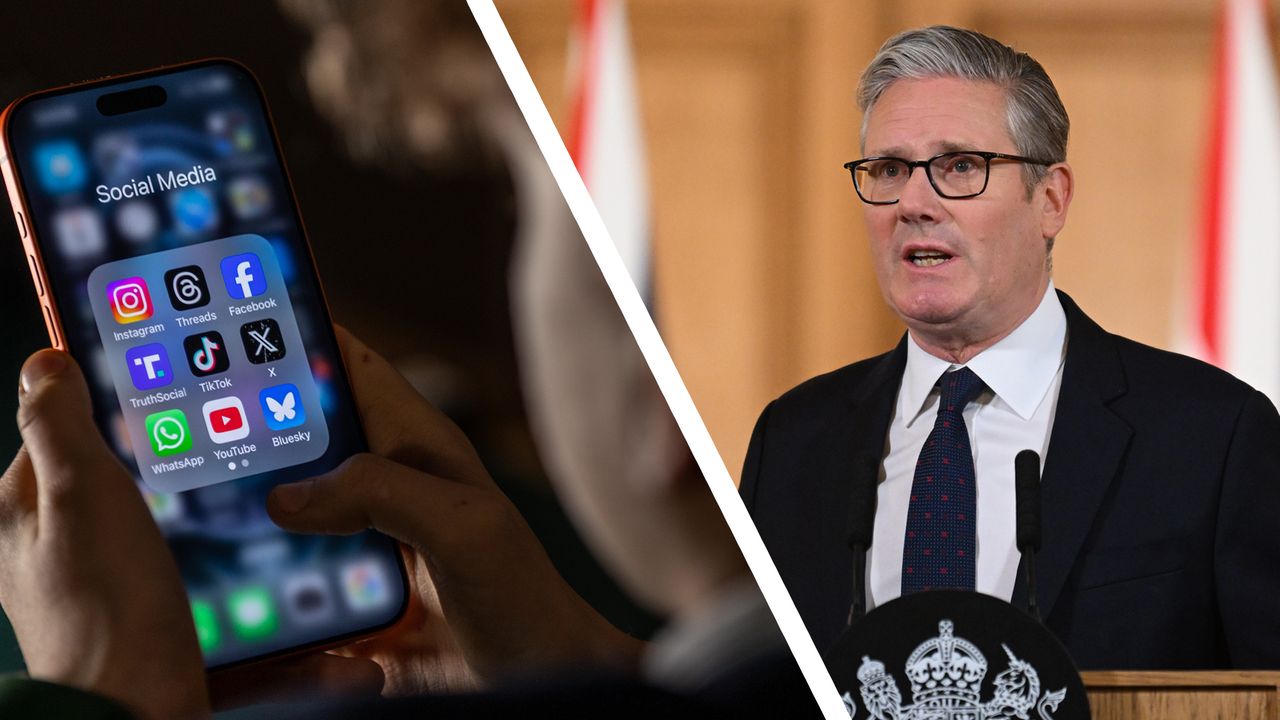
The UK has become the latest country to ban social media for under-16s, with Prime Minister Keir Starmer announcing today that “children will be given back their childhoods thanks to government action”.
Following Australia’s decision to lock teens out of popular social media apps in December 2025, the UK has promised “world-leading additional restrictions” on features like live streaming and strangers communicating with children.
The landmark legislation, which the UK government says is “backed by 9 in 10 parents”, is expected to be brought before Parliament before Christmas, and could then come into force in Spring 2027.
So how exactly will the social media ban work, and what does it mean for children in the UK? You can follow all of the latest updates here live…
Refresh
Ban is “backed by 9 in 10 parents”
The UK government is pretty confident its social media ban for under-16s has public support and will be passed by Parliament “before Christmas”.
It says the announcement follows “one of the biggest national conversations held by this government” with over “116,000 responses submitted by parents, children and experts across the country”.
In those responses, “9 in 10 parents said they would support a social media ban for children under 16s”, it said. Surprisingly, the government added that most “young people” also backed action” with “two-thirds agreeing that children younger than 16 should not be allowed to use at least some social media platforms”.
That said, it didn’t clarify exactly what it meant by “young people” and some inevitable controversy will arise more from its implementation than the broader idea.
UK says it will “learn the lessons” of Australia ban
Reports have claimed that Australia’s social media isn’t proving very effective, with research from the Molly Rose Foundation claiming that over half of under-16 users were still on TikTok, YouTube, and Instagram.
The UK government says it will “learn the lessons from Australia’s experience” by introducing “more highly effective age assurance (HEAA) measures to support compliance, making it far harder for children to bypass safeguards”. Exactly what that entails, and how it will be balanced with privacy concerns, isn’t yet clear.
This is an ‘Australia plus’ ban
As expected, the UK’s proposed social media ban for under-16s is following a so-called ‘Australia plus’ model. That means it’s following the thrust of Australia’s legislation by restricting access to social media apps for children, but also adding extra restrictions for platforms that aren’t banned.
The UK says this will include “world-leading blocks on harmful functions such as livestreaming and stranger communication with children for under-16s” and will affected “a wider range of online services, including on gaming sites”.
And that’s not it — the government says it will “also be looking in more detail at overnight curfews and breaks in infinite scrolling for under-18-year-olds”. Exactly how this might be implemented isn’t clear, which is why Prime Minister Keir Starmer has said the UK will “set out more detail in July”.
Which platforms are affected?
The UK government’s statement lists some of the major platforms that will be affected by its proposed ban. These are
- Snapchat
- TikTok
- YouTube
- X
The UK government says that “we do not intend for messaging services like WhatsApp and Signal to be included in the social media ban”.
However, there are also planned restrictions for “so-called AI ‘romantic companion’ chatbots – designed to simulate sexual relationships or roleplay with users”, which will “have to enforce a minimum age of 18”.
The statement adds that “similar intimate functionalities will be restricted for under-18s on AI chatbots more widely”.
Hello, and welcome to our liveblog on the UK’s landmark social media ban for under-16s.
We’ll be rounding up all of the latest news, reactions and more here today, but first a quick primer on what’s happened.
The UK announced the social media ban for under-16s this morning. The statement says that social media is “designed to be addictive” and that the restrictions will give mean “less time for scrolling and more time for play”.
The government says it will “use the same model for a social media ban as Australia” and that means the platforms will include Snapchat, TikTok, YouTube, Instagram, Facebook and X. It won’t include private messaging apps likes of WhatsApp and Signal.
If it’s passed by Parliament later this year, the ban is expected to come into force from Spring 2027.