the elephant never forgets
Werner Herzog directed this evocative NatGeo documentary of an ornithologist’s quest to find a new species.
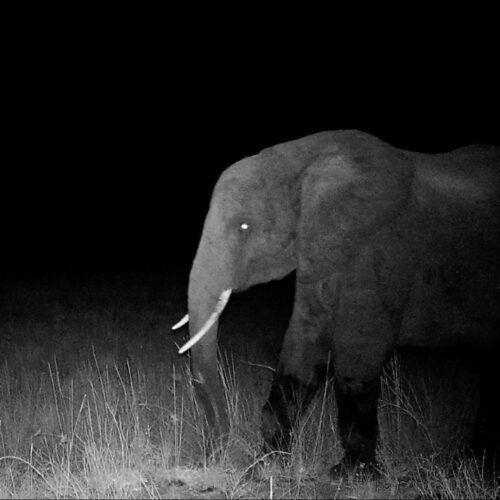
The first photo of a “ghost elephant” captured by a motion-controlled camera. Credit: Courtesy of The Wilderness Project Archive
Deep in the Angolan Highlands lurks a rumored new species of elephant. Conservationist and ornithologist Steve Boyes has been searching for this elusive herd for years and the story of his journey is the focus of Ghost Elephants, a haunting, evocative documentary directed by Werner Herzog. The film debuted at the Venice International Film Festival last summer and is now coming to National Geographic and Disney+.
It might seem unusual for an ornithologist to embark on a quest to find remote pachyderms, but for Boyes the connection is perfectly natural. He grew up in South Africa and wanted nothing more than to be an explorer, just like the people he read about every month in National Geographic magazine. “I grew up waiting for the magazine to arrive; I wanted the maps,” Boyes told Ars. “Those would become my garden, or the field beyond, or the river—wild places imagined and real.”
Boyes’ parents frequently took him and his brother out into the wild, including visits to Botswana and Tanzania. “We used to embed ourselves in baboon troops and walk with impalas,” said Boyes, and while his brother feared elephants, Boyes was walking with them from a young age. Ghost Elephants contains some gorgeous underwater footage of elephant feet plodding through the water, and elephants swimming on their sides, behavior that matches Boyes’ own experiences with the animals. Under the right circumstances, if they don’t feel threatened, elephants “will come and swim around you and with you and interact with you,” he said. “So elephants have always fascinated me.”
As an adult, Boyes conducted his PhD research on the Meyer’s parrot in the Okavango Delta, which has the single largest population of elephants in the world. They shared a symbiotic relationship of sorts with the parrots. “Every tree that the parrots were feeding on, the elephantss were feeding on,” he said. “The elephants were creating the nest cavities for the parrots by disturbing the trees.”
Boyes first met Herzog at a Beverly Hills restaurant through a mutual friend and the two ended up chatting at length, “about the meaning of life, where thoughts come from, personal experiences of loneliness, and the ghost elephants,” said Boyes. Herzog has said that after meeting Boyes, “An unexpected project that felt like the hunt for Moby Dick, the White Whale, came at me with urgency. Like many of my films, this is an exploration of dreams, of imagination—weighed against reality.”
Dreams weighed against reality
Dr. Steve Boyes stands in the rotunda of the Smithsonian Museum confronting the largest elephant ever killed Skellig Rock, Inc
When Herzog visited Boyes in Namibia, he fell in love with the region’s culture, mythology, and people, and his camera captures far more than just a scientific quest for elephants. We are treated to a ritual elephant dance—during which a tribal elder falls into a trance, so the spirit of the elephant can enter his body—and a history of the tribe’s ingenious use of poisoned arrows to hunt. Boyes is granted an audience with the local king, seeking his blessing for the expedition. At one point, the director becomes fascinated by a poisonous spider he films in the middle of the night, carrying dozens of equally poisonous babies on her back.
“Once he was locked in, there was no discussion with him around the story or anything outside of being interviewed or being actively in the experience,” said Boyes of Herzog’s creative process. It was direct and efficient, with Herzog usually capturing the footage he needed right away, seeing no need for additional coverage. The questions the director asked were unique as well. “The first question was, ‘What would a world without elephants be like? What do you dream of?’” recalled Boyes. “He took us into a mode of thought that was very different from just preparing for an expedition. I love him. He’s wonderful.”
Ghost Elephants opens in the rotunda of the Smithsonian National Museum of Natural History, which has housed the largest elephant mount in the world since 1959—affectionately dubbed Henry or “the Giant of Angola.” A Hungarian big game hunter named Josef J. Fénykövi shot and killed Henry in November 1955 with a dozen high-caliber bullets. Henry is the largest elephant ever recorded, over 13 feet tall and weighing about 11 tons, and there was the remains of an old iron slug from a flintlock rifle embedded in Henry’s left front leg. So Henry could have been 100 years old or more at the time he was killed.
Visiting Henry is the perfect starting point for the film, since Boyes suspected he might be related to the new species of ghost elephant in the Angolan highlands. Boyes had searched for these elephants using modern camera traps and other advanced technologies, to no avail. This time, he recruited three KhoiSan master trackers—Xui, Xui Dawid, and Kobus—who left their southern village to accompany Boyes’ team into the Angolan Highlands.
It was not an easy trip, given the remoteness of the “Source of Life,” i.e., the Angolan Highlands Water Tower where the elephants live—so named because it provides 95 percent of the water to the Okavango Delta. They made the first part of the journey by car, abandoning the vehicles once they reached the first impassable river and carrying supplies and motorcycles through the water to the opposite bank. They traversed the final 30 miles on foot.
Finally, after several months, having collected dung samples (for DNA analysis) and captured a bit of blurry cell phone footage showing the barest glimpse of a ghost elephant lurking in thick foliage, Boyes reached what he described as a point of “complete surrender.” It was the last day of the expedition, and he and and several members of his team went out once more just before dawn. Other team members had been tracking two big bulls and Boyes et al. were able to follow the tracks, this time with master tracker Xui out in front.
About three hours in, Xui suddenly stopped and whispered, “Steve, Steve, Steve.” And an elephant walked into full view. Boyes was able to capture the footage on his cell phone—the only available camera at the time. Alas, the arrow meant to take a skin sample just bounced off the elephant’s thick hide and scared the animal away. Boyes and his cohorts pursued it for the next five hours until they ran out of water and made their way back to camp, exhausted.
On the hunt
During the elephant trance dance, the village elder faints. Skellig Rock, Inc
The genetics analysis completed thus far has confirmed that these remote elephants are indeed a new, genetically isolated species, and that Henry’s father was a ghost elephant. Boyes, as a conservationist, is deeply concerned about their continued survival. The documentary includes disturbing 1950s footage of hunters slaughtering elephants from helicopters, felling the magnificent creatures with nary a thought about the delicate ecosystem they were disrupting. “What you’re seeing in that horrific footage is the wholesale destruction of wildlife populations to make room for agriculture and development,” said Boyes. “That happened all across Africa. We lost a huge amount of wildlife over that period.”
The very remoteness and inaccessibility of their home turf has protected the ghost elephants thus far. Even if a helicopter could reach the area, it wouldn’t have sufficient fuel to get back out. But traditional Western approaches to conservation, like establishing the land as a protected wildlife reserve free of any human presence, might not be the best strategy, per Boyes, who thinks we should be taking our cues from the local inhabitants. “They can talk for days about conservation,” he said. “They have their own hunting season, sacred sites, they confiscate weapons. They manage this very closely.”
So the idea of separating people from the elephants “is counterintuitive to them,” Boyes continued. “They’re like, ‘This place will completely fall apart without us.’ We’re talking about 20,000 people in a landscape the size of England, very connected to language, tradition, and culture.” The best strategy, he feels, is for those people “to remain there as the guardians and custodians of those landscapes, and to continue to protect the elephants.”
Meanwhile, the quest to document the herd continues. Last November, Boyes was able to get samples from five different bull elephants based on the tracks they left behind. They found the tracks of 16 more members of the herd across the river, including five babies, and then the tracks of another 18 elephants.
“The gift of working with the master trackers is that you don’t to need to see them to know that they’re there,” said Boyes. “I’ve gone back three times since filming to track the elephants and I’m going back again in May. I’m going back in July. I can’t get enough of these forests. But I don’t need to see [that first elephant] again. If I do, I do.”
Ghost Elephants premieres on National Geographic on March 7, 2026, and will be available for streaming on Disney+ the following day. There is also a companion coffee table book, Okavango and the Source of Life: Exploring Africa’s Lost Headwaters.

Jennifer is a senior writer at Ars Technica with a particular focus on where science meets culture, covering everything from physics and related interdisciplinary topics to her favorite films and TV series. Jennifer lives in Baltimore with her spouse, physicist Sean M. Carroll, and their two cats, Ariel and Caliban.