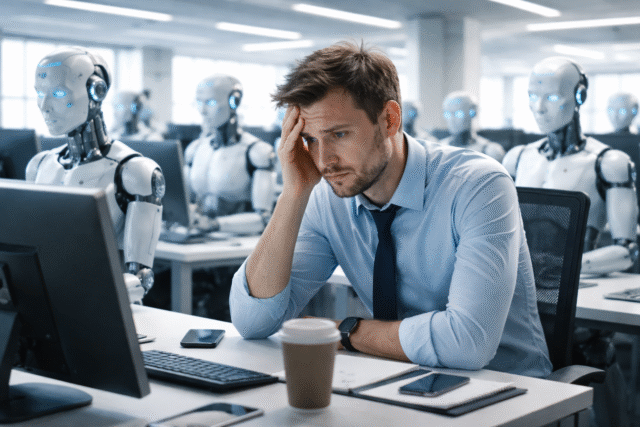
A new survey suggests that employees are worried that AI could have a major impact on the culture of work, not just how tasks are completed. The research from Resume Now finds that 63 percent of American workers expect AI to make the workplace feel “less human”, while concerns about skills erosion and job loss remain widespread.
The findings come from the company’s AI and Workplace Humanity Report, which surveyed 1,003 employed adults across the United States about how artificial intelligence could affect workplace culture, skills, and job security.
SEE ALSO: Half of Americans think AI is a threat, the other half don’t. Who’s right?
Many workers say the biggest change could be how work feels rather than how fast it gets done. A combined 63 percent of respondents said AI will make the workplace feel less human during the next year. Within that group, 43 percent expect work to feel less human as tasks become more automated and less valued, while 20 percent believe workplaces could become much less human and increasingly driven by machines.
A smaller group believes AI could improve the human side of work. Sixteen percent of respondents said AI could make workplaces feel more human by freeing employees to focus on meaningful tasks. Another 21 percent said they expect little or no change to the overall workplace experience.
AI skills vs. human skills
Concerns about declining human skills also appeared prominently in the survey results. More than half of respondents, 57 percent, said overreliance on AI reducing human skills will be the biggest workforce issue in 2026. That concern ranked higher than job displacement, which 49 percent of workers cited as a major issue linked to AI adoption.
Other issues raised by respondents include the dehumanization of work, cited by 42 percent of workers, along with surveillance or data misuse at 36 percent and a lack of transparency or accountability in AI systems at 35 percent.
Some respondents also pointed to bias in hiring or promotions tied to automated systems, although that concern appeared less frequently in the results.
Workers also identified several personal risks tied to the increasing use of AI in workplaces. Job loss naturally still ranks as the leading concern, cited by 29 percent of respondents. Data misuse and privacy violations followed at 23 percent, while 20 percent pointed to the potential loss of creativity or critical thinking in their work.
Other respondents raised concerns about workplace monitoring. Eighteen percent said constant surveillance or tracking through technology is one of their main worries connected to AI adoption.
“AI can improve efficiency, but technology adoption is never just about output,” said Keith Spencer, career expert at Resume Now. “When most workers say AI will make the workplace feel less human, it signals anxiety about critical thinking, surveillance, and connection. Employees aren’t rejecting AI. They’re asking how it will be used and whether it strengthens or weakens the human side of work.”
Despite these concerns, many workers do not expect AI expertise to become mandatory across most jobs in the near future. Nearly half of respondents, 48 percent, said AI skills will be important in some roles but not most by the end of 2026.
Only 18 percent said they expect AI skills to be required across nearly all white collar jobs. Another 17 percent said those skills will remain optional or limited to certain roles, while an additional 17 percent believe AI requirements are likely to be overhyped and unnecessary in many positions.
You can access the full report here.
What do you think about how AI could change the culture of work? Let us know in the comments.