tea for two and two for tea
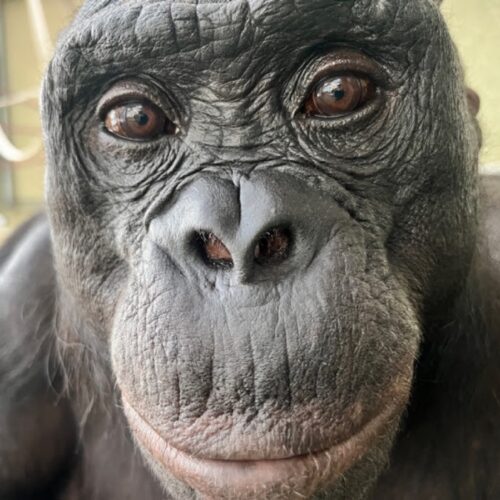
“Kanzi is able to generate an idea of this pretend object and at the same time know it’s not real.”
Credit: courtesy of Ape Initiative
Little kids hosting make-believe tea parties is a fixture of childhood playtime and long presumed to be exclusively a human ability. Researchers at Johns Hopkins University presented evidence in a new paper published in the journal Science that a bonobo named Kanzi was also able to participate in pretending to hold a tea party. For the authors, this suggests that apes are capable of using their imagination just like human toddlers.
“It really is game-changing that their mental lives go beyond the here and now,” said co-author Christopher Krupenye. “Imagination has long been seen as a critical element of what it is to be human, but the idea that it may not be exclusive to our species is really transformative. Jane Goodall discovered that chimps make tools, and that led to a change in the definition of what it means to be human, and this, too, really invites us to reconsider what makes us special and what mental life is out there among other creatures.”
Per Krupenye et al., by the age of two, human children are able to navigate imaginary scenarios like a tea party, pretending there is real tea present even if the teapot and cups are actually empty. Cognitively speaking, it’s an example of secondary representation, because it involves decoupling an imagined or simulated state (pretending there is actual tea in the cup) with the reality (the cup is empty).
Scientists have long pondered whether other animals, notably primates, also possess such mental capacities. There is some anecdotal evidence for this. For instance, a young chimpanzee was observed dragging imaginary blocks across the floor, just as the chimp did with real wooden blocks. Some female chimps in the wild will carry and play with sticks, treating them as infants—a rudimentary form of playing with a doll. And a 2006 study found that chimps and bonobos that had been exposed to human culture would sometimes perform pretend actions, like holding a bowl to a doll’s mouth to feed it, in response to verbal prompts.
Such studies have nonetheless been met with skepticism when it comes to interpreting the behavior as evidence of animals’ ability to engage in make-believe. For instance, it’s possible the animals are responding to behavioral cues, like the direction of a gaze, to solve such tasks.
“Kanzi, let’s play a game!”
Enter Kanzi, a 43-year-old bonobo who lives at the Ape Initiative and is capable of responding to verbal prompts, either by pointing or using a lexigram of more than 300 symbols. There had also been anecdotal observations of Kanzi engaging in pretense. Krupenye et al. conducted three distinct experiments with Kanzi, each involving an 18-trial session.
In the first experiment, a scientist would offer a verbal prompt: “Kanzi, let’s play a game! Let’s find the juice!” They would then place two empty transparent cups on a table and pretend to fill them from an empty transparent pitcher, with another verbal prompt (“Kanzi, look!”). The scientist would pretend to pour the “juice” in one of the cups back into the pitcher, placing the pitcher under the table. Then they asked, “Kanzi, where’s the juice?” and recorded which cup the bonobo pointed to first.
“If Kanzi could only track reality (that both cups were empty), he should have chosen at chance between the two options, whereas if his choices were guided by stimulus enhancement, he should have selected the incorrect cup that had been ‘emptied’ above chance,” the authors wrote. “In contrast, if Kanzi could represent the pretend juice, he should have chosen above chance the cup containing the ‘imaginary’ juice, the empty cup that had not been ‘poured’ back into the pitcher. That is exactly what Kanzi did.” Kanzi selected the correct cup 34 out of 50 times (68 percent).
To rule out the possibility that Kanzi simply believed there was real juice in the empty cups, the team conducted a second experiment following a similar protocol, but with one of the cups containing real juice. Then they asked Kanzi to choose which he wanted. Kanzi chose the cup with real juice nearly 78 percent of the time (14 out of 18 trials), evidence that he could tell the difference between real and pretend juice.
Finally, the team conducted one last experiment in which an experimenter pretended to sample a grape from an empty transparent plastic container before placing the “grape” in one of two transparent jars. After they pretended to empty one of the jars, they asked Kanzi, “Where is the grape?” Kanzi chose correctly nearly 69 percent of the time (31 out of 45 trials).
While Kanzi didn’t score perfectly on the pretend tasks, “It’s extremely striking and very exciting that the data seem to suggest that apes, in their minds, can conceive of things that are not there,” co-author Amalia Bastos, now at the University of St. Andrews in Scotland, said. “Kanzi is able to generate an idea of this pretend object and at the same time know it’s not real.” Whether Kanzi’s success can be generalized to other apes without the benefit of his “enculturation” will be the focus of future research.
Science, 2026. DOI: 10.1126/science.adz0743 (About DOIs).

Jennifer is a senior writer at Ars Technica with a particular focus on where science meets culture, covering everything from physics and related interdisciplinary topics to her favorite films and TV series. Jennifer lives in Baltimore with her spouse, physicist Sean M. Carroll, and their two cats, Ariel and Caliban.