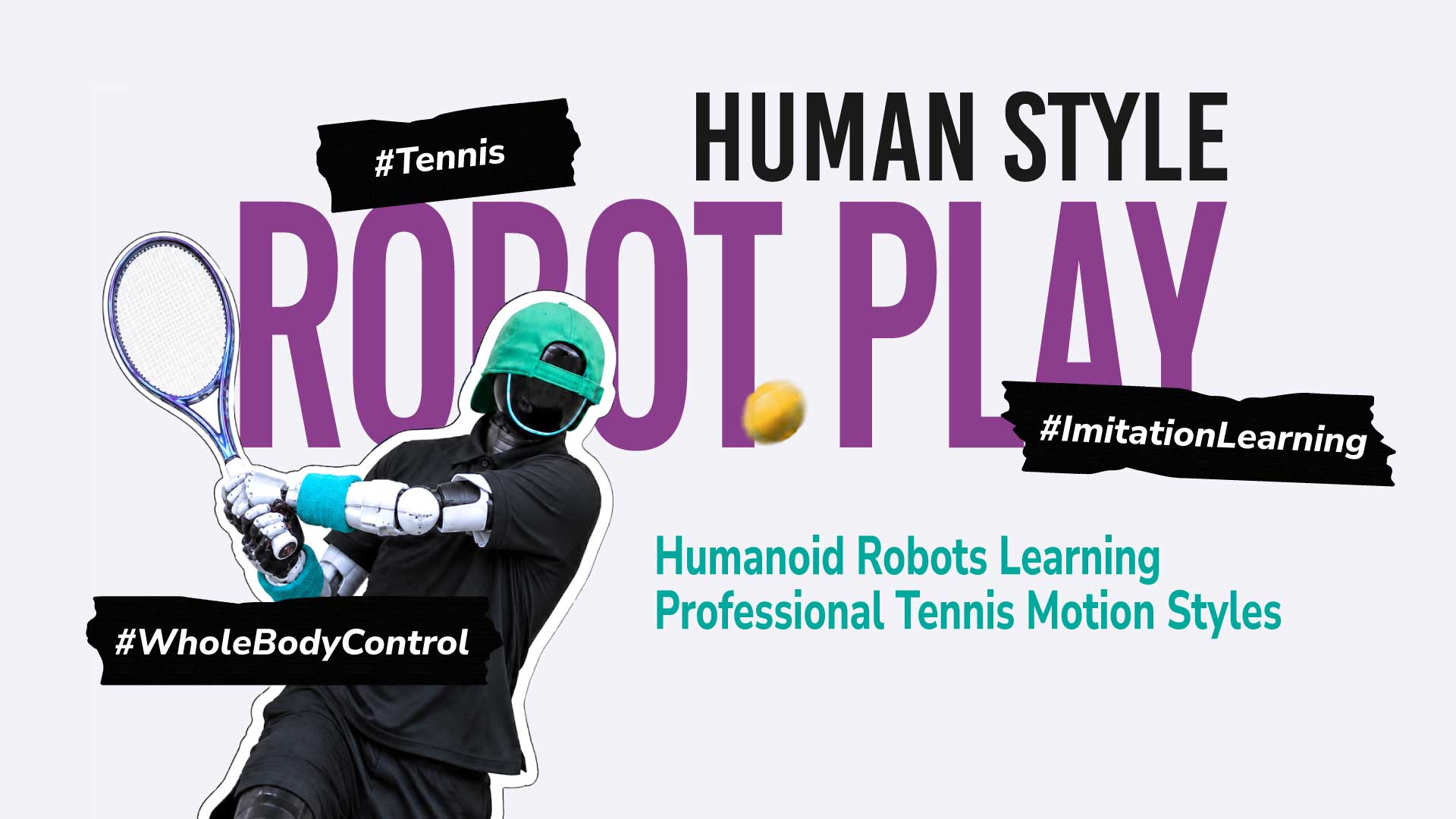
AdaPT — the first proof of concept in the company’s program on professional athletic skills for humanoids — was pre-trained on part of the HiPHI-series data, heading into RO-MAN 2026
Key facts
- AdaPT teaches real humanoid robots — the Unitree G1 and the full-size Dobot Atom — professional tennis rally and serve styles, deployed in the real world, including in-the-wild serving without motion capture.
- The motion foundation was pre-trained on part of the HiPHI-series data — including a relevant subset of the publicly released HiPHI dataset and the larger, licensable HiPHI-MOV corpus — and continued expansion with additional HiPHI-series data shows that scaling motion data substantially improves the foundation’s stability and performance.
- Developed by Noitom Robotics with Shanghai AI Laboratory, Dobot Robotics, and Shanghai Jiao Tong University; paper, code, and video are available now at the AdaPT project page.
TOKYO, Aug. 21, 2026 (GLOBE NEWSWIRE) — Two days after making HiPHI public at the World Robot Conference, Noitom Robotics (NR) and its research collaborators unveiled AdaPT, a system that teaches humanoid robots to play tennis in the styles of professional players — rallying and serving on real hardware, ahead of RO-MAN 2026 in Fukuoka next week.
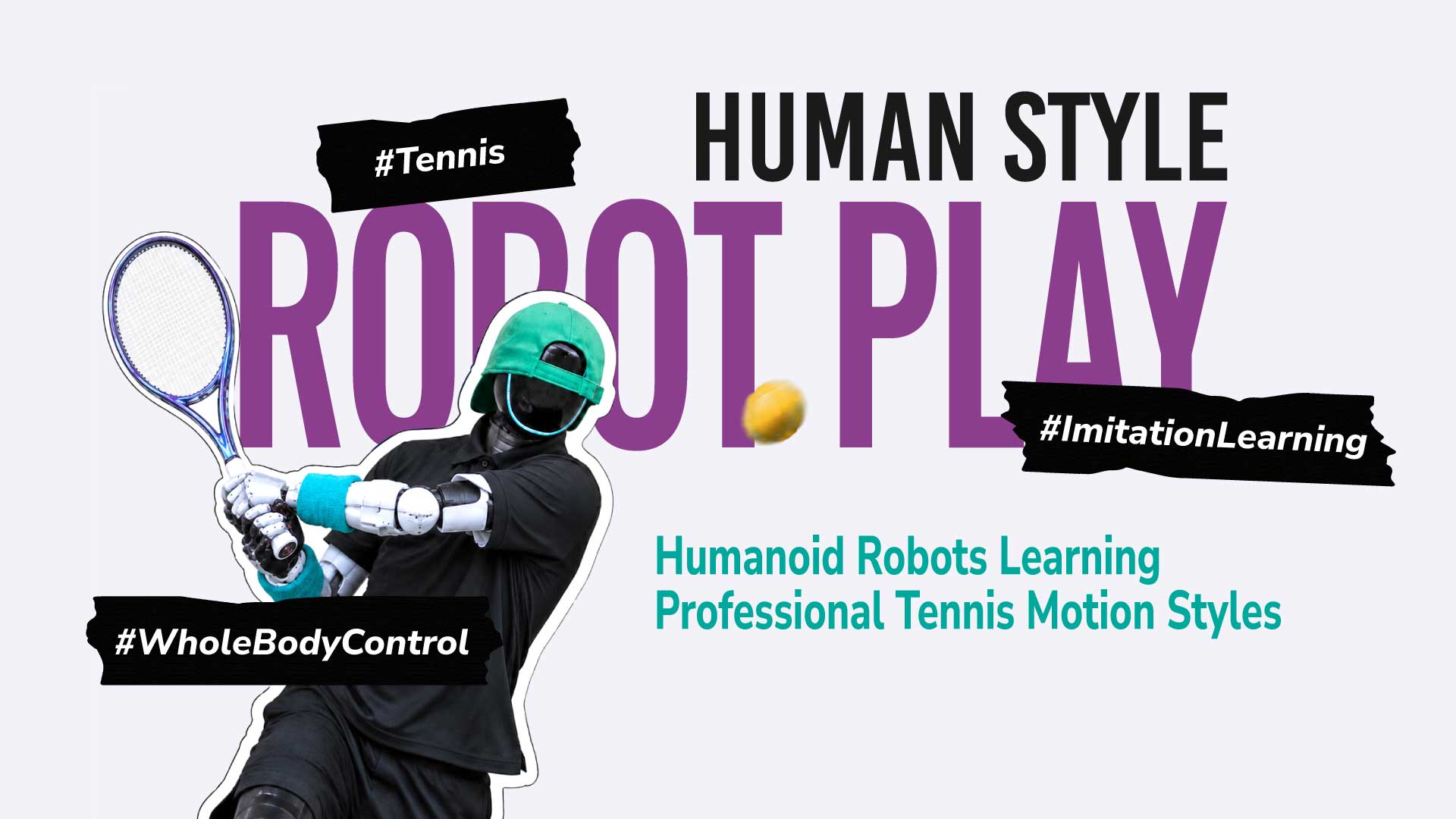
A Media Snippet accompanying this announcement is available by clicking on this link.
AdaPT (Adaptive Motion Planning and Tracking) learns professional tennis rally and serving styles and executes them on physical humanoids, using adaptive planning and tracking mechanisms to bridge the sim-to-real gap. As reported in the accompanying academic paper, the system reproduces the distinctive playing styles of three professional players — Rafael Nadal, Roger Federer, and Novak Djokovic — learned from publicly available broadcast footage, and a further professional style learned from motion capture. It is validated on the Unitree G1 and the full-size Dobot Atom, and demonstrates in-the-wild serving using only a camera and a consumer tracker — no motion-capture environment required.
The demonstration and the dataset come from the same infrastructure, the same team, and the same week — and together they show the thesis in action. The motion foundation behind AdaPT was pre-trained on part of the HiPHI-series data: a series that spans the publicly released HiPHI dataset and the substantially larger HiPHI-MOV corpus, available for commercial licensing. Broadcast video shows what champions do, but it lacks the precise physical states a robot can learn from; the footage had to be physically corrected against high-precision motion before it became trainable, with professional-player capture supplying what video could not. Large-scale breadth, made learnable by high-precision structure.
“On Tuesday we made the foundation public. Today you can watch what gets built on ground like this,” said Dr. Tristan Ruoli Dai, Founder and CEO of Noitom Robotics. “AdaPT is the learnability thesis on a tennis court: everyone has seen these strokes ten thousand times on television, but a robot can only learn them when precise, physically grounded motion makes that video learnable. That is the World Compiler working.”
AdaPT is joint work between Noitom Robotics, Shanghai AI Laboratory, Dobot Robotics, and Shanghai Jiao Tong University, and is step one of a proof of concept on professional athletic skills for humanoid robots.
“We pre-trained the motion foundation on part of the HiPHI-series data and post-trained it on high-precision capture of professional athletes — large-scale breadth first, professional precision on top,” said Dr. Lei Han, Chief of Research and Development at Noitom Robotics. “This is step one. We are looking for robot-embodiment companies to partner with us in taking the research further — and if professional players would like their style to live on in a robot, we would love to speak with them.”
The academic paper, source code, and demonstration video are available now, alongside the AdaPT project page. HiPHI remains publicly available on Hugging Face, and commercial data licensing — including the HiPHI-MOV corpus — is available through ModalityNet. Noitom Robotics will be at RO-MAN 2026 in Fukuoka, 24–28 August.
Links
- Project page: https://humanoidtennis.github.io/AdaPT/
- Paper (arXiv): https://arxiv.org/abs/2608.20087
- Code (GitHub): https://github.com/noitom-robotics/AdaPT
- Demonstration video: https://www.youtube.com/watch?v=mEF-YTn-ksU
- HiPHI dataset (Hugging Face): https://huggingface.co/datasets/noitomrobotics/HiPHI
- Commercial licensing (ModalityNet): https://modalitynet.com
About Noitom Robotics
Noitom Robotics is a data company specializing in omnimodal data for Physical AI. Through ModalityNet (modalitynet.com) — our implementation of the World Compiler — we transform real-world human motion, interaction, and behavior into learnable representations across three corpora: HiPHI-MOV (motion), HiPHI-OM (omni-modal interaction), and ITW (in-the-wild), giving embodied AI the structured, training-ready foundation that raw data alone cannot provide.
Media contacts — International: Roch Nakajima, Chief Marketing Officer, roch@noitomrobotics.com. China: Tan Yuxin, evan@noitomrobotics.com.