AT&T and Verizon claim right to a jury trial was violated by FCC fines.
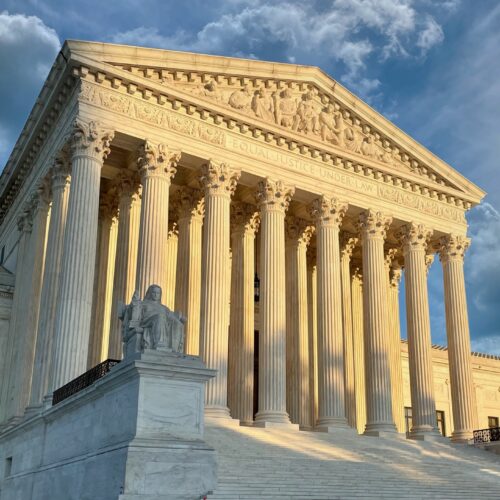
The Supreme Court. Credit: Getty Images | Douglas Rissing
The Supreme Court will hear a case that could invalidate the Federal Communications Commission’s authority to issue fines against companies regulated by the FCC.
AT&T, Verizon, and T-Mobile challenged the FCC’s ability to punish them after the commission fined the carriers for selling customer location data without their users’ consent. AT&T convinced the US Court of Appeals for the 5th Circuit to overturn its fine, while Verizon lost in the 2nd Circuit and T-Mobile lost in the District of Columbia Circuit.
Verizon petitioned the Supreme Court to reverse its loss, while the FCC and Justice Department petitioned the court to overturn AT&T’s victory in the 5th Circuit. The Supreme Court granted both petitions to hear the challenges and consolidated the cases in a list of orders released Friday. Oral arguments will be held.
In 2024, the FCC fined the big three carriers a total of $196 million for location data sales revealed in 2018, saying the companies were punished “for illegally sharing access to customers’ location information without consent and without taking reasonable measures to protect that information against unauthorized disclosure.” Carriers challenged in three appeals courts, arguing that the fines violated their Seventh Amendment right to a jury trial.
Carriers claim FCC violates right to jury trial
The carriers’ cases against the FCC rely on the Supreme Court’s June 2024 ruling in Securities and Exchange Commission v. Jarkesy, which held that a similar but not identical SEC system for issuing fines violated the right to a jury trial.
The conservative-leaning 5th Circuit appeals court decided that the FCC violated AT&T’s rights while “act[ing] as prosecutor, jury, and judge.” But the 2nd Circuit and District of Columbia Circuit courts found that each carrier could have obtained a jury trial if it simply decided not to pay the fine.
“Verizon could have gotten such a trial” if it had “declined to pay the forfeiture and preserved its opportunity for a de novo jury trial if the government sought to collect,” the 2nd Circuit judges wrote. Instead, Verizon chose to pay the fine “and seek immediate review in our Court.” That option didn’t exist in the SEC v. Jarkesy case because of differences between US telecom law and securities law, the court said.
Verizon’s petition to the Supreme Court seeks a ruling on “whether the Communications Act violates the Seventh Amendment and Article III [of the Constitution] by authorizing the FCC to order the payment of monetary penalties for failing to reasonably safeguard customer data, without guaranteeing the defendant carrier a right to a jury trial.”
Verizon argued that the option of refusing to pay the fine doesn’t satisfy its right to a jury trial:
If a carrier wants to guarantee judicial review, it must pay the penalty and then seek review in a court of appeals, which reviews the agency’s order on the administrative record under the deferential standards of the Administrative Procedure Act. If the carrier wants a jury trial, by contrast, it must defy the FCC’s order and refuse to pay, after which the Department of Justice may, but is not required to, file a lawsuit in district court to collect the unpaid forfeiture. While waiting for that DOJ lawsuit that might never come, the carrier suffers serious practical and reputational harms from the final FCC order.
Trump admin backs FCC right to issue fines
FCC Chairman Brendan Carr voted against the fines last year, arguing that the Biden-era FCC overstepped its authority. But Carr’s argument was about FCC authority to regulate data privacy practices, not the right to a jury trial, and the FCC has continued to defend its legal process since Carr took over as chairman.
The Trump administration petition in the AT&T case said the 5th Circuit ruling “conflicts with this Court’s precedents and with decisions of two other courts of appeals.” The brief said a Supreme Court precedent from 1899 states that “the Constitution ‘does not prescribe at what stage of an action a trial by jury’ must occur, and that a statute may authorize such a trial ‘for the first time upon appeal’ from an initial decision.”
A 1915 Supreme Court ruling upheld a similar scheme “under which an executive agency could issue initial decisions finding regulated parties liable for money damages, subject to review by a jury in an Article III court,” the government told the Supreme Court. The 5th Circuit ruling “identified no basis for distinguishing this case from those precedents,” and “has serious practical consequences, since it deprives the Commission of one of its most important regulatory remedies and severely impairs the agency’s ability to enforce federal communications law,” the government brief said.
While the Supreme Court is only taking up the AT&T and Verizon cases, the T-Mobile case would be affected by whatever ruling the Supreme Court issues. T-Mobile is seeking a rehearing in the District of Columbia Circuit, an effort that could be boosted or rendered moot by whatever the Supreme Court decides.

Jon is a Senior IT Reporter for Ars Technica. He covers the telecom industry, Federal Communications Commission rulemakings, broadband consumer affairs, court cases, and government regulation of the tech industry.