Swiss-based QoreChain Association releases production-grade testnet v2.19.0 featuring NIST-standard post-quantum signatures (Dilithium-5), reinforcement-learning-driven block sequencing (PRISM), unified Ethereum, Cosmos, and Solana contract execution, and a cross-network validator architecture spanning 25 connected Layer-1 networks. On the strength of the testnet milestone, mainnet launch is advanced from Q4 2026 to Q2 2026.
Rolle, Switzerland, April 22, 2026 (GLOBE NEWSWIRE) — QoreChain Association, a Swiss nonprofit registered in Rolle and operating under Swiss law, today announced the public release of blockchain testnet version 2.19.0 and confirmed a second-quarter 2026 mainnet launch for its Layer-1 network. QoreChain is the first Layer-1 to ship all four pillars together in production: NIST-standard post-quantum cryptography, AI-native PRISM consensus, a unified triple virtual machine runtime that executes Ethereum, Cosmos, and Solana contracts on shared state, and a cross-network validator architecture spanning 25 connected chains. The project was built over eight years of self-funded development, without a token-raise, ahead of the arrival of cryptographically relevant quantum computing.
Why this matters: the Harvest Now, Decrypt Later threat.
Nearly every blockchain in production today signs transactions using elliptic-curve cryptography that a sufficiently powerful quantum computer will be able to break. Security researchers call the resulting attack pattern “Harvest Now, Decrypt Later”: adversaries record encrypted blockchain traffic and address data today, then forge signatures against it once quantum machines arrive. The United States National Institute of Standards and Technology, or NIST, finalized replacement standards in 2024 under the designations FIPS 203 and FIPS 204. QoreChain is the first Layer-1 to ship those standards in production across the entire chain, not as a roadmap item.
What the technology actually is.
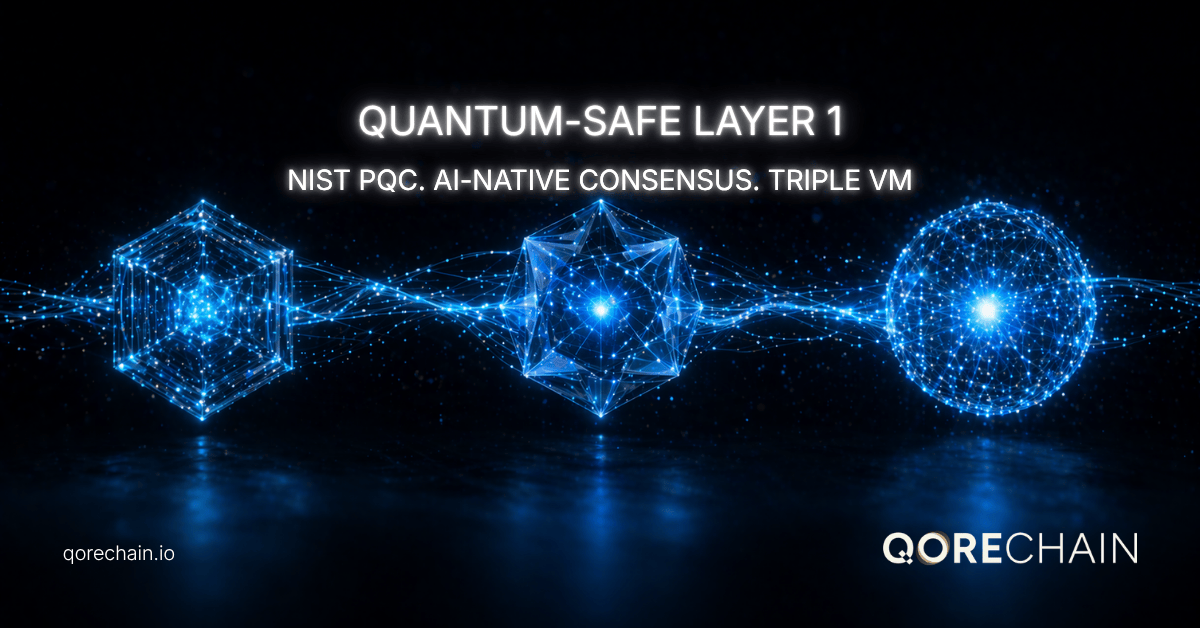
Quantum-safe signatures. Every transaction on QoreChain is signed using Dilithium-5, the NIST Category-5 signature algorithm published as Federal Information Processing Standard 204. Key exchange uses Kyber-1024, published as FIPS 203. Hashing uses SHAKE-256. None of these depend on the elliptic-curve math that a quantum computer can break.
AI-native consensus. QoreChain runs a reinforcement-learning consensus optimizer called PRISM, which stands for Policy-driven Reinforcement-learning for Intelligent State Machines. PRISM continuously learns from chain state to optimize block ordering, mempool prioritization, and gas metering. On-chain artificial intelligence services are priced in the native QOR token through three tiers: Fast, Balanced, and Advanced.
Triple virtual machine. QoreChain runs three smart-contract environments in a single unified state: the Ethereum Virtual Machine (EVM), CosmWasm for Rust-based contracts, and the Solana Virtual Machine (SVM). A decentralized-finance application deployed on QoreChain can call contracts written for Ethereum, Cosmos, and Solana inside a single transaction, with the quantum-safe signature scheme applied at the chain layer rather than the application layer.
Cross-network validator economics.
QoreChain validators earn revenue across three streams. They produce blocks and collect standard block rewards. They operate bridge watcher nodes across 25 connected Layer-1 networks, earning attestation fees on every cross-chain message. They validate artificial-intelligence service requests priced in QOR. At network maturity, cross-network operations are projected to contribute roughly 60 percent of total validator revenue. Fee distribution across the network is fixed at 37 percent to validators, 30 percent burned (creating deflationary pressure on supply), 20 percent to the treasury, 10 percent to stakers, and 3 percent to operators of light nodes.
Proof points available to the public now.
- Testnet v2.19.0 is live, running 47 genesis modules and all three virtual machines.
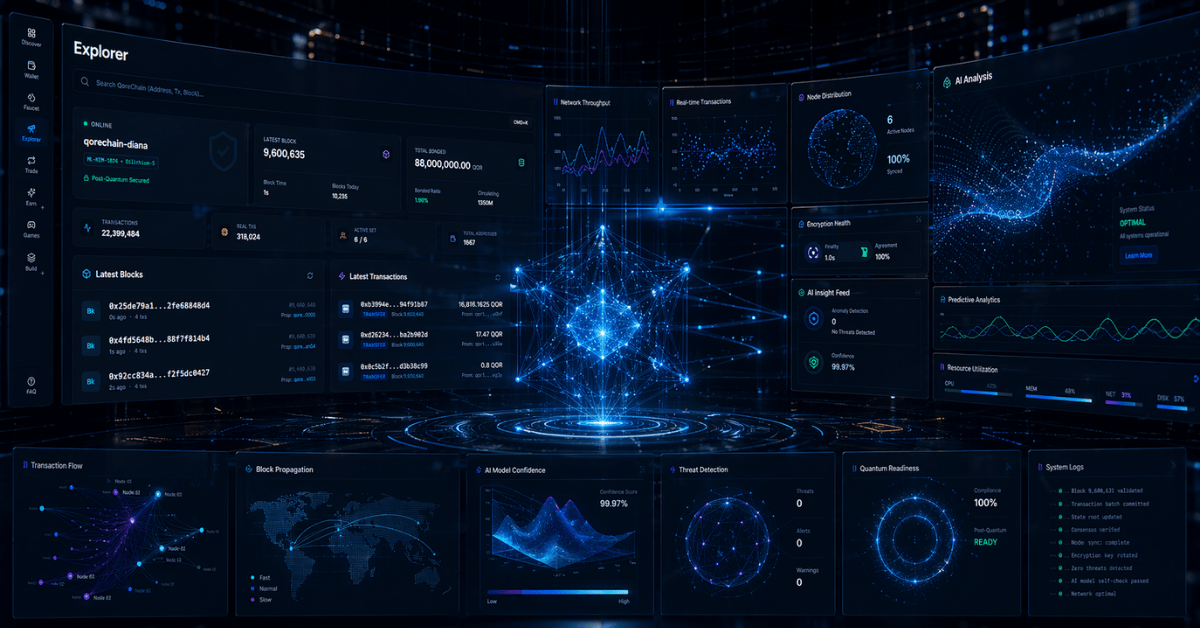
- The public explorer and validator dashboard are available at https://dashboard.qorechain.io.
- Source code is open for review.
- Infrastructure is operated on credits from Amazon Web Services, Google Cloud, Cloudflare, GitHub, OVHcloud, and other enterprise providers.
Founder comment.
“The threat to current blockchain signatures from quantum computers is arithmetic, not speculation,” said Liviu Epure, founder of QoreChain Association. “When capable machines arrive, every transaction signed with today’s cryptography becomes retroactively forgeable. QoreChain is shipping the Federal standard for post-quantum signatures in production now, alongside artificial-intelligence-driven consensus and unified multi-chain execution, so builders can deploy on infrastructure that is ready for the next decade rather than the last one.”
Token summary.
The native token is QOR. Total supply is capped at 4.5 billion. Launch price at token generation is $0.02, for an initial circulating supply of approximately 721 million QOR, an initial market capitalization of approximately $14.4 million, and a fully diluted valuation of $90 million. Staking rewards are issued from a bounded, declining emission schedule within the cap, and 30 percent of all transaction fees are burned, creating continuous deflationary pressure on circulating supply.
Links.
- Website: https://www.qorechain.io
- Whitepaper: https://www.qorechain.io/whitepaper
- Testnet explorer: https://dashboard.qorechain.io
- GitHub: https://github.com/QoreChain
- X: https://x.com/QoreChain
- Telegram: https://t.me/QoreChainCommunity
About QoreChain.
QoreChain Association is a Swiss nonprofit registered in Rolle, Switzerland (CHE-484.963.998), building a quantum-safe, artificial-intelligence-native Layer-1 interchain infrastructure blockchain. Mainnet is targeted for the second quarter of 2026.
Disclaimer: The information provided in this press release is not a solicitation for investment, nor is it intended as investment advice, financial advice, or trading advice. Investing involves risk, including the potential loss of capital. It is strongly recommended you practice due diligence, including consultation with a professional financial advisor, before investing in or trading cryptocurrency and securities. Neither the media platform nor the publisher shall be held responsible for any fraudulent activities, misrepresentations, or financial losses arising from the content of this press release.
CONTACT: Florin Marin
Qore Chain Association
team(at)qorechain.io