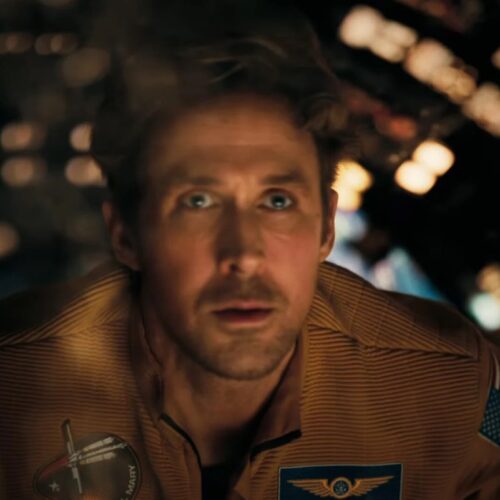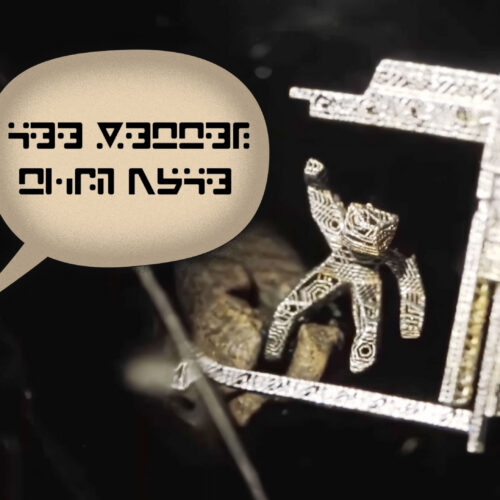
Ars speaks with a linguist about the ease with which Grace and Rocky communicate.
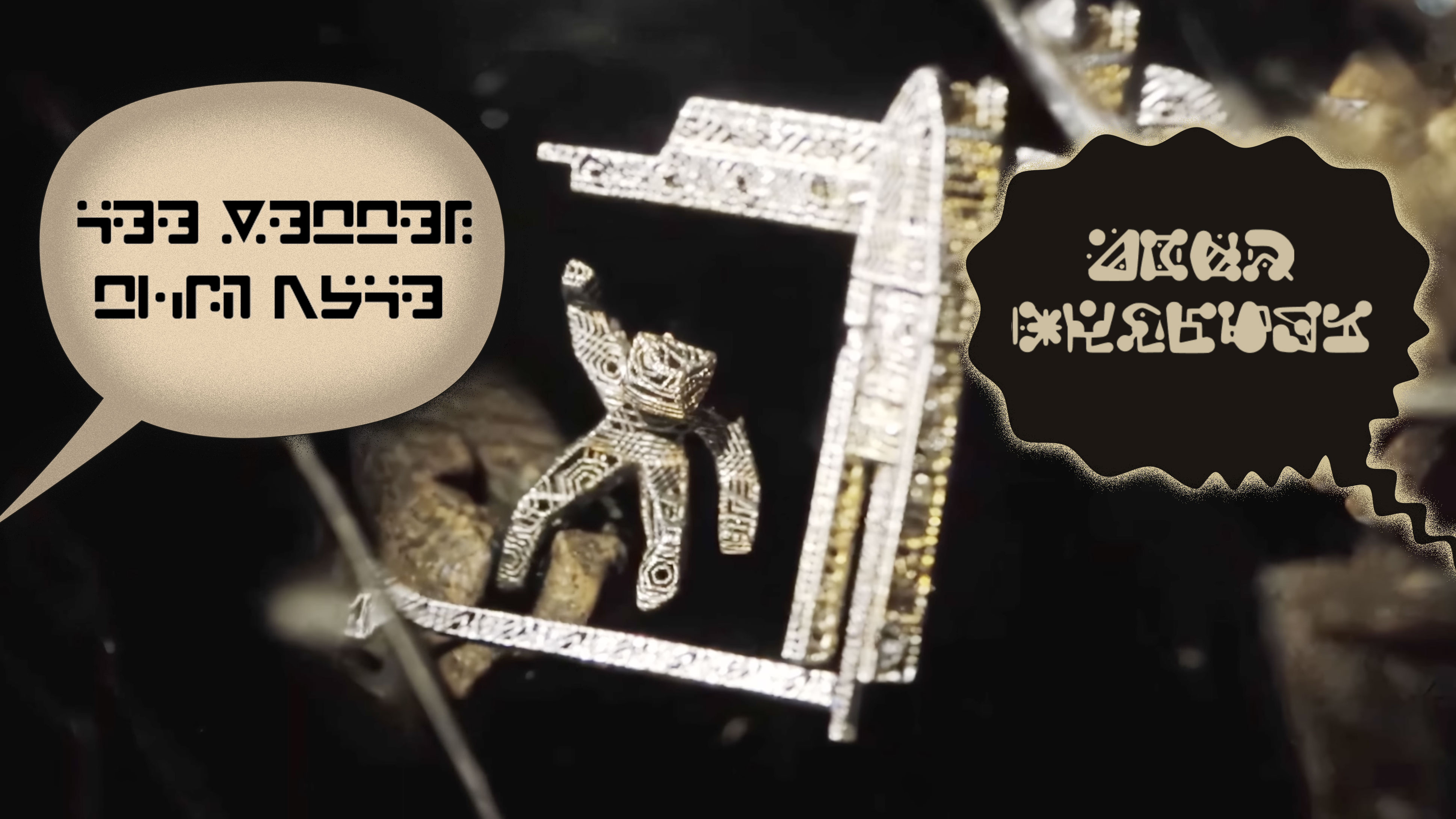
Credit: Aurich Lawson | Amazon MGM Studios
Credit: Aurich Lawson | Amazon MGM Studios
The film adaptation of Andy Weir’s novel Project Hail Mary hits general release today, March 20, and it’s great—go see it! Though a little light on the science, the movie goes hard on the relationship between schoolteacher Ryland Grace (Ryan Gosling) and an extraterrestrial named Rocky, and it’s a ride well worth taking.
But as good as it is, the movie shares a small flaw with the book: Despite having very few things in common, Grace and Rocky learn to communicate with each other extremely quickly. In fact, Grace and Rocky begin conversing in abstracts (concepts like “I like this” and “friendship”) in even less time than it takes in the book. Obviously, there are practical narrative reasons for this choice—you can’t have a good buddy movie if your buddies can’t talk to each other. It’s therefore critical to the flow of the story to get that talking happening as soon as possible, but it can still be a little jarring for the technically minded viewer who was hoping for the acquisition of language to be treated with a little more complexity.
And because this is Ars Technica, we’re doing the same thing we did when the book came out: talking with Dr. Betty Birner, a former professor of linguistics at NIU (now retired), to pick her brain about cognition, pragmatics, cooperation, and what it would actually ake for two divergently evolved sapient beings not just to gesture and pantomime but to truly communicate. And this time, we’ll hear from Andy Weir, too. So buckle up, dear readers—things are gonna get nerdy.
A word about spoilers
This article assumes you’ve read Weir’s novel and that you’ve seen the movie. However, for folks who haven’t yet seen the film, I don’t think there’s much to be spoiled in terms of the language acquisition portions that we’re going to discuss—the film covers rather the same ground as the book but in a much more abbreviated way.
Still, if you want to avoid literally all spoilers, skip this article for now—at least until you’ve been to the theater!
The yawning chasm of “meaning”
Dr. Birner’s specific field of study is the science of pragmatics. “Pragmatics has to do with what I intend by what I say and what I mean in a particular context,” she explained to Ars on a Zoom call earlier this week. She elaborated by bringing up her (nonexistent) cat—the phrase “my cat” can have a multitude of meanings attached, all of which are inferred by context.
If you know Dr. Birner has a cat, her saying “my cat” could refer to that cat; if you know that she doesn’t have a cat but used to, “my cat” could refer to that cat instead, even though the semantics of the phrase “my cat” haven’t changed. That’s pragmatics, baby!
Pragmatics are particularly relevant to the Grace/Rocky language-acquisition problem because the discipline involves the creation of inferences by the listener about the speaker’s mental state and about what specific meanings the speaker implies.
But “meaning” is a fraught word here, too, because ultimately we cannot know for certain the exact meaning being implied by another person because we cannot ever truly peek inside someone else’s mind. “We are always making guesses about what our shared context is and what our shared cultural beliefs are, and, indeed, what our shared knowledge as members of the species are,” Dr. Birner continued. “And I think of this because of thumbs-up/thumbs-down.”

Two Eridian thumbs up. Or down!
Credit: Amazon MGM Studios
Two Eridian thumbs up. Or down! Credit: Amazon MGM Studios
“The cognitive linguists George Lakoff and Mark Johnson put out a book, boy, back in the ’80s,” she said. “They talked about all of language as metaphorically built up from embodiment, our embodied experience, and our senses. So we sense up and down, and then we have this whole metaphorical notion of happy is up, so we have a thumbs up, ‘I’m feeling up today. I’m just feeling high. My spirits are lifting.’”
“Or, I can be down in the dumps,” she said. “I can be feeling low, my mood is dropping, thumbs down,’ and there’s this whole metaphorical conception. And I loved the way Project Hail Mary played with that in that Rocky didn’t share that. Rocky did not have a metaphor of ‘happy is up,’ the way Lakoff and Johnson would say we all just do.”
I asked Dr. Birner if our “up is good, down is bad” association has a biological basis in our cognition or if it’s something that has simply been shaped into a broadly shared metaphor over thousands of years of language use, and she took a moment to answer.
“That’s a really good question, and I don’t remember whether they deal with that,” she said. “But I could imagine it being biological because we start as little helpless things that can’t even stand up. And soon we stand up, we get taller, we get smarter, we get better and better the taller we get. I can actually very well imagine a biological basis for it.”
The first leap—not math, but truth
Let’s focus in on some of the specific linguistic mountains Grace and Rocky would have had to climb. The one that struck me as perhaps the most basic would be starting from pantomime and figuring out the most important thing: the twin concepts of yes and no, and the companion dualities of true/false and equal/not-equal. To me, this feels like the most mandatory of basics.
And here, perhaps, we can fall back on some good ol’ Sagan—or at least the movie version of Sagan. Dr. Birner and I (along with my colleague Jennifer Ouellette, who also hung around on the Zoom call) went back and forth for some time, but in the end, no one could really figure out a more straightforward way to demonstrate these concepts than the “primer” scene in 1997’s Contact, where the unknown alien signal is shown to contain a small grouping of symbols that appeared to represent addition, along with “equals” and “not equals” sign equivalents.
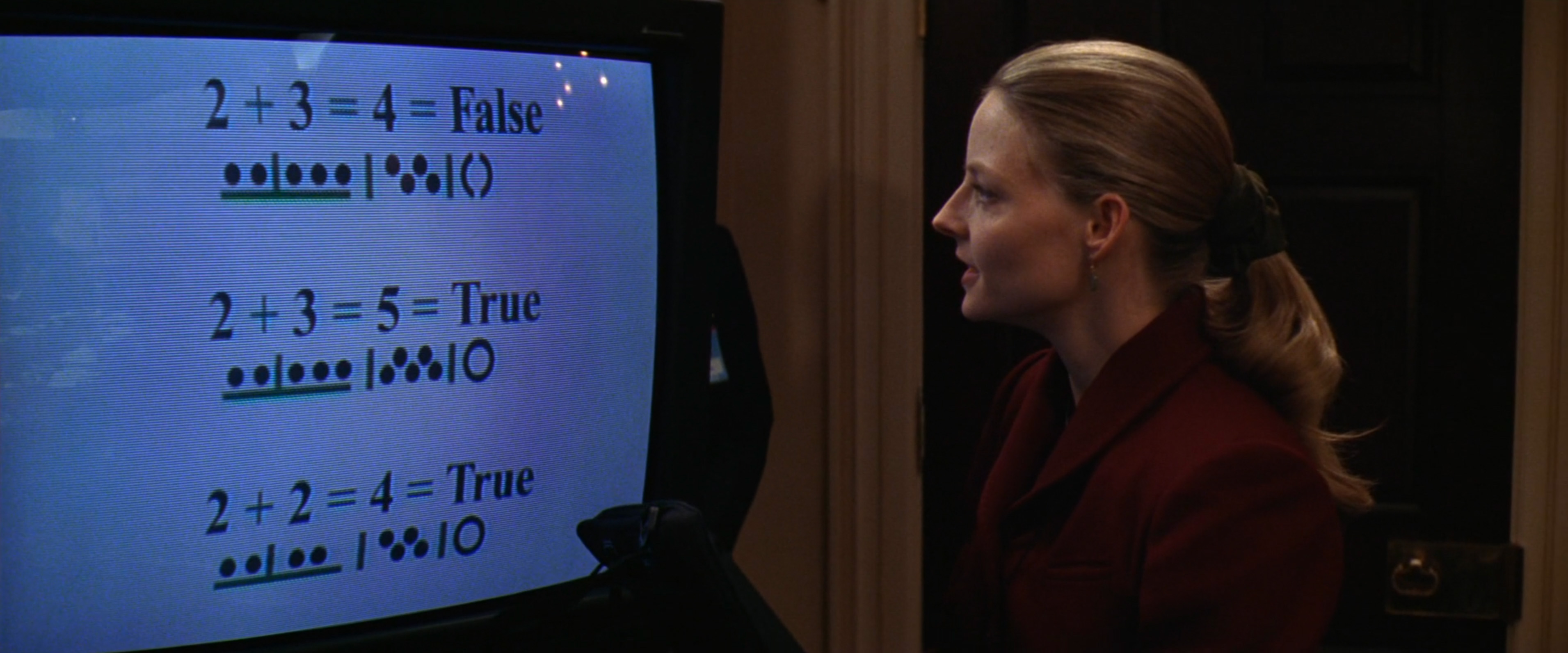
Sagan’s Contact leads with a quick remedial math lesson.
Credit: Warner Bros.
Sagan’s Contact leads with a quick remedial math lesson. Credit: Warner Bros.
“That’s a good way to go about it, with equivalent and not-equivalent,” said Dr. Birner. “So at least you get negation, and now you can work on perceptual oppositions—up and down, black and white, loud and soft. I think that would probably be the jumping-off place for yes and no.”
Though there are linguistic biases in English and other human languages that might peek through even here—the inherent tie between “positive” (as in agreement) and “positive” (as in “this thing is good and I like it”). Careful aliens would likely want to spend a fair amount of time interrogating this bias—if it’s even visible at this point. And it likely wouldn’t be, as we haven’t built any of those syntactic bridges yet.
Pidgin? Not so fast
Getting those bridges built—going past “yes” and “no” and into some of the other basics that must be established to communicate—is not straightforward. Grace and Rocky benefit from being in a tightly constrained environment with a set of mutual problems to solve; two humans in a similar situation would likely develop a “pidgin”—an ad-hoc working language cobbled together out of components of both speakers’ languages.
But as Dr. Birner points out, true pidgin here is impossible because neither Grace nor Rocky are capable of actually producing the sounds required to speak the other’s language in the first place. “They don’t actually develop a pidgin,” she said. “They each have to learn the other’s language receptively, not productively.”

Rocky (left) and Grace (right), learning each others’ languages.
Credit: Amazon MGM Studios
Rocky (left) and Grace (right), learning each others’ languages. Credit: Amazon MGM Studios
“Which is great,” she went on, “because when kids acquire language, it’s sort of a truism that reception precedes production. Every kid is going to understand more than they’re producing. Necessarily! You can’t produce what you don’t understand yet. So it makes the problem a little easier for Grace and Rocky—they don’t have to produce each other’s language, just understand it.”
Who is even there?
Grace and Rocky are lucky in that both humans and Eridians are ultimately extremely similar in their cognition and linguistics, even if their vocalizations aren’t alike. This means a lot of the mandatory requirements for conversation as we understand them are already present.
“If I encounter Rocky, I need to know, does he have a mind?” she posited. “Does he have what we call a theory of mind? Does he have a mind like mine? And does he understand that I have a mind like his, but separate? Does he understand that I can believe different things from what he believes? Can I have false beliefs? That’s all a prerequisite for communicating at all. If your mind and my mind had all the exact same stuff in it, there’d be no need to communicate.
“H.P. Grice said that communication doesn’t happen without the assumption that both parties are being cooperative,” she said. The word “cooperative” here doesn’t necessarily mean that both parties are copacetic—Dr. Birner pointed out that even when people are fighting, they tend to still be cooperatively communicating. There are rules to the interaction that must be followed if one party intends to impart meaning to the other.
Beyond adherence to the cooperative principle, another bedrock of communication is the notion of symbols, the understanding that a word can represent not just an abstract concept but can actually stand in for a thing. “I can use the word mug,” explained Dr. Birner, holding up a mug, “and mean this. And you understand what I mean, and I don’t have to show you the mug every single time.”
Also on the “mandatory” list is an understanding of the concept of displacement, which Dr. Birner attributes to the researcher Charles F. Hockett. “Displacement has long been said to be solely human, though not everyone agrees with that. It’s the ability to refer to something that is distant in time or space. I can tell you that I had a bagel this morning, even though I’m not having it right now and it’s not present right here. I had it elsewhere and I had it earlier,” she said
She continued: “There’s this wonderful article, 1979 by Michael Reddy, called ‘The Conduit Metaphor,’ where he says that we think in metaphors. And the metaphor he’s talking about is that language is a conduit, and we really just pass ideas from my brain to yours. And he says it’s a false metaphor. It’s clearly not true that that’s what happens, but we talk about it as though it does. ‘I didn’t catch your meaning,’ or ‘Give that to me again.’ We talk as though this is a thing we literally convey, and of course we don’t convey meanings. Reddy argues that the vast majority of human communication is actually miscommunication, but so trivially that we never notice.”
By way of example, she referenced her nonexistent cat again. “If I mentioned my cat, Sammy, well, you’ll have some mental image of a cat,” she said. “It almost certainly isn’t remotely like Sammy, but it doesn’t matter. I don’t need to explain everything about Sammy. If I did, the conversation would grind to a halt and you’d never interview me again. Also, I’d be violating the cooperative principle because I would be saying too much for the current context.”
Math, the universal language?
It is a common trope in science fiction—and one brought up more than once in the comments on our last article on this subject—that “math is the only universal language.” It’s a fun, pithy saying that perhaps makes mathematicians feel good about their dusty chalkboards, but at least from my knothole, it’s a false generalization because the language in which one does one’s mathematics must be settled before any mathing can happen.
“I’m not sure that even is true on Earth,” said Dr. Birner about the notion of math as universal grammar. “The concept of zero hasn’t always been around, and how much math can you do without zero? There are languages that count, “One, two, three, many,” and that’s it. And those are human languages. So to say, ‘Math is a universal language,’ I’m already not totally on board there.”

Gosling as Ryland Grace, employing math to save the world.
Credit: Jonathan Olley / Amazon MGM Studios
Gosling as Ryland Grace, employing math to save the world. Credit: Jonathan Olley / Amazon MGM Studios
“I think math would help, but I don’t think it would get them terribly far because they need the notion of objects. They need the notion of the semiotic function, that things stand for other things.” She paused pensively, then went on. “And once they’ve got that, that there are discrete objects and we both think of the same things as discrete objects, then we can talk about counting those objects and now we’re off and running.”
Whole-object notion is another oft-overlooked component here—often referred to as the “gavagai problem.”
“You’re pointing to a rabbit, and you say, ‘gavagai!’” said Dr. Birner. “Well, does that mean ‘rabbit?’ Does that mean ‘fur?’ Does that mean ‘ears?’ Does that mean, ‘hey look?’”
“Quine’s notion is that we default to a whole object. Well, does what counts as a whole object for me count as a whole object for you? Does every conceivable culture have discrete borders on objects?”
The author speaks on human-Eridian similarities
Fortunately for Grace and Rocky, humans and Eridians do have all these things in common because in the universe of Project Hail Mary, the species share a common ancestor.
“Within the fictional context of this story,” explained Andy Weir to Ars in an interview, “the natural evolution of life began on planet Adrian in the Tau Ceti system. Then what we can call primordial Astrophage, like an ancestor of Astrophage, caused a panspermia event. It just kind of emanated out from the system and ended up seeding just a few plants.”
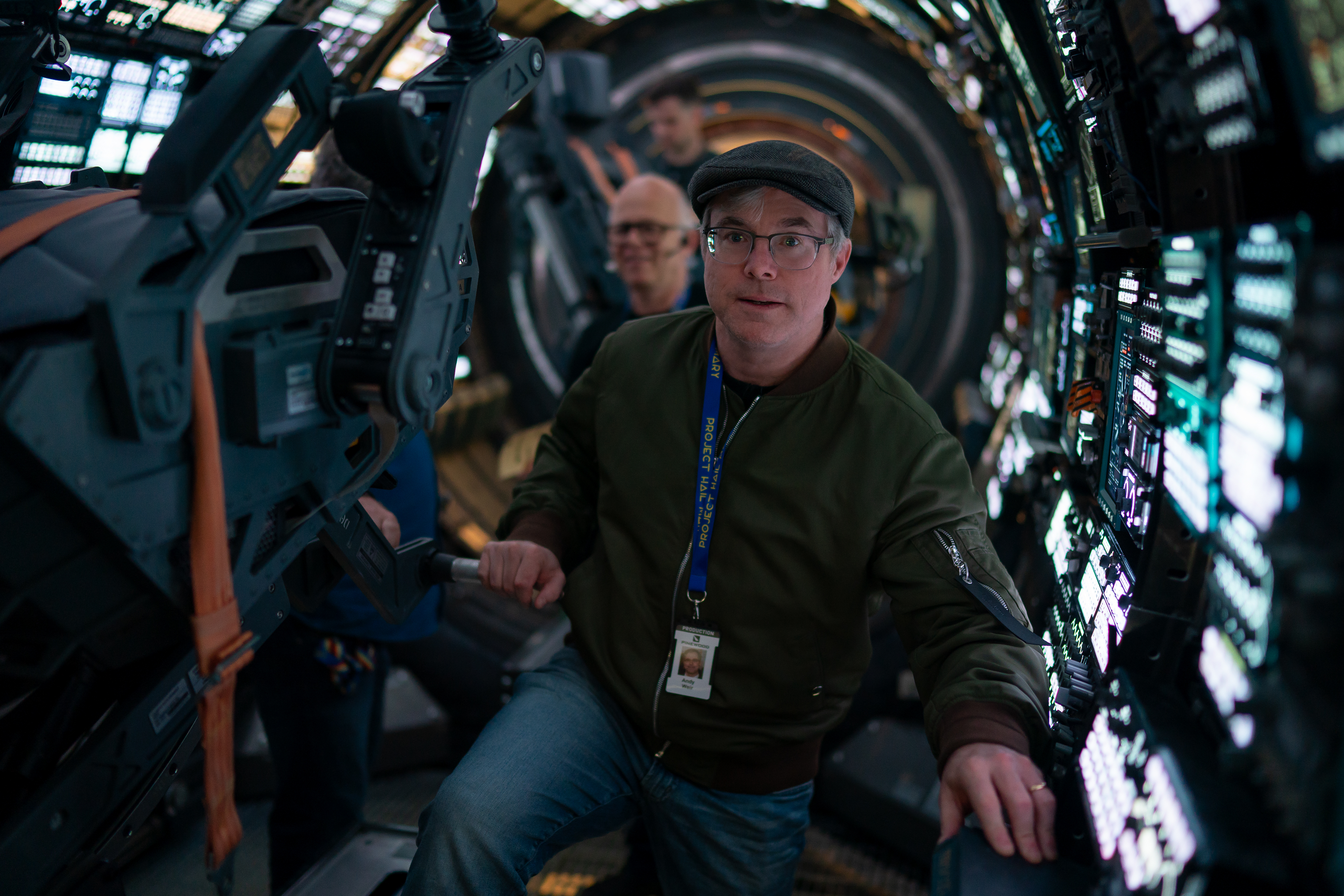
Author Andy Weir on the Hail Mary bridge set during filming (Weir was a producer on the movie).
Credit: Jonathan Olley / Amazon MGM Studios
Author Andy Weir on the Hail Mary bridge set during filming (Weir was a producer on the movie). Credit: Jonathan Olley / Amazon MGM Studios
“That panspermia event was about four and a half billion years ago. It seeded Earth with life. It seeded 40 Eridani—or rather, Erid with life, and maybe others as well. That means everything within a certain radius of Tau Ceti has a decent chance of having been infected with life, and all of that life is related. That’s why Eridian cells and Astrophage and human cells all have mitochondria, the powerhouse of the cell, and ribosomes, and DNA or RNA, and so on.”
Weir notes that he worked through a number of the same linguistic issues that Dr. Birner and I raised as part of the story generation process.
“Let’s say you have intelligent life on the planet,” he said. “What do you need? What does that species need to have to reach the point where they’re able to make spacecraft and fly around in space? Well, first off, you have to be a tribal thing. You can’t be loners. You can’t be like bears and tigers that don’t communicate with each other. You have to have the sense of a community or a tribe or a group or a gathering so that you can collaborate because you can specialize and do all these things. You need that.”
“Number two, you need language. One way or another, stuff from my brain has to get into your brain,” he said, echoing Dr. Birner’s note about Reddy’s conduit metaphor paper.
“Number three is you need empathy and compassion. A collection of beings altogether doesn’t work unless they actually are willing to take care of each other. And that’s not just found in humans—it’s found in primates. It’s found in wolf packs. It’s found in ants. It’s like any collectivized species has to have that trait.”
“You need to have compassion, empathy, which means putting yourself in somebody else’s situation. Compassion, empathy, language, a decent amount of intelligence, a tribal instinct, a group instinct, a society kind of building instinct,” he said. “You must, I believe, have all of those things in order to be able to make a spaceship. Any species that’s lacking any one of those won’t be able to do it. So any alien you meet in space is going to have all of those traits. The Friendly Great Filter is that any aliens you meet, I believe, have to have this concept of society, cooperation, empathy, compassion, collaboration, and so on.”

Sexy hero nerd Ryan Gosling, saving the world with his biceps and kind eyes.
Credit: Jonathan Olley / Amazon MGM Studios
Sexy hero nerd Ryan Gosling, saving the world with his biceps and kind eyes. Credit: Jonathan Olley / Amazon MGM Studios
I’m here for Weir’s explanation—it works within the context of the science fiction universe we’re being presented, and Rocky and Grace need to be able to talk to each other or we don’t have a book (or a film!). But does it ring true under scrutiny? After all, even here on Earth, there is a wealth of problem-solving, tool-using creatures much more closely related than humans and Eridians with vastly different cognitive toolkits. Cephalopods (with distributed nervous systems and pseudo-autonomous arms), corvids, and cetaceans all have their own evolutionary approaches to communication.
“There’s a point in the book where Grace says that Rocky is less closely related to him than the trees in his backyard,” said Dr. Birner. “Yes, we are family, but the tree in the backyard is more closely related. And I thought, well, let’s talk about that tree. Trees communicate. I don’t think trees have language. They don’t have a displacement, they don’t have syntax, they don’t have discrete units that can be put together in various ways or replace this unit with that and you’ve said something different.”
“That’s all language stuff, but they communicate,” she said. “One tree will put out a chemical through its roots that warns another tree or all the local trees about something going on. OK, it’s communicative. Is it intentional? I would say no—your mileage may vary—but once you say that I’m closer to that tree biologically than I am to Rocky, even though all three of us came from that same panspermia event, I don’t think you can lean on that for saying why it’s so easy to communicate with Rocky.”
Here, Ars’ Jennifer Ouellette made an important point. “Rocky is basically a rock,” she said. “He’s not a human form, and that’s going to affect how a language, if there is one, evolves in that species—and it’s really going to impact how they communicate.”
“Yes, embodiment is a big deal in communications,” replied Dr. Birner, returning to the subject she’d brought up earlier, that the nature of our flesh-prisons inherently shapes not just how we experience the world but how we communicate. Our physical forms are the product of evolutionary pressures—they are the results of the inevitable, inscrutable dialogue between environment and organism. And the evolutionary pressures faced by homo sapiens on Earth are vastly different than the evolutionary pressures faced by Eridians on Erid, and that same dialog on Erid led to vastly different outcomes.
“You may have heard of this,” she said, “Thomas Nagel and his wonderful paper ‘What Is It Like To Be A Bat?’” (I had not, but Ouellette had—in fact, she’d heard Nagel deliver a lecture on the paper.)
“I can try to imagine what it’s like to be a bat,” said Dr. Birner, “feeling the air beneath my wings and the sonar, but I’m imagining what it’s like to be me being a bat. I can’t imagine what it’s like for that bat. And to bring it back to even within human beings, I don’t know what it feels like to be Lee or Jennifer. I just don’t. And even if, Jennifer, we just met, you could tell me, ‘Oh, this is how old I am, and I have N kids for some value of N or N partner or whatever, a dog. I love to run in the morning. I have bagles for breakfast. You could go on and on and on, and I will never know what it is like to be Jennifer. And it’s such an interesting concept because it really messes with the notion of just what you were saying, Lee: How do you communicate with a mind you can never enter?”
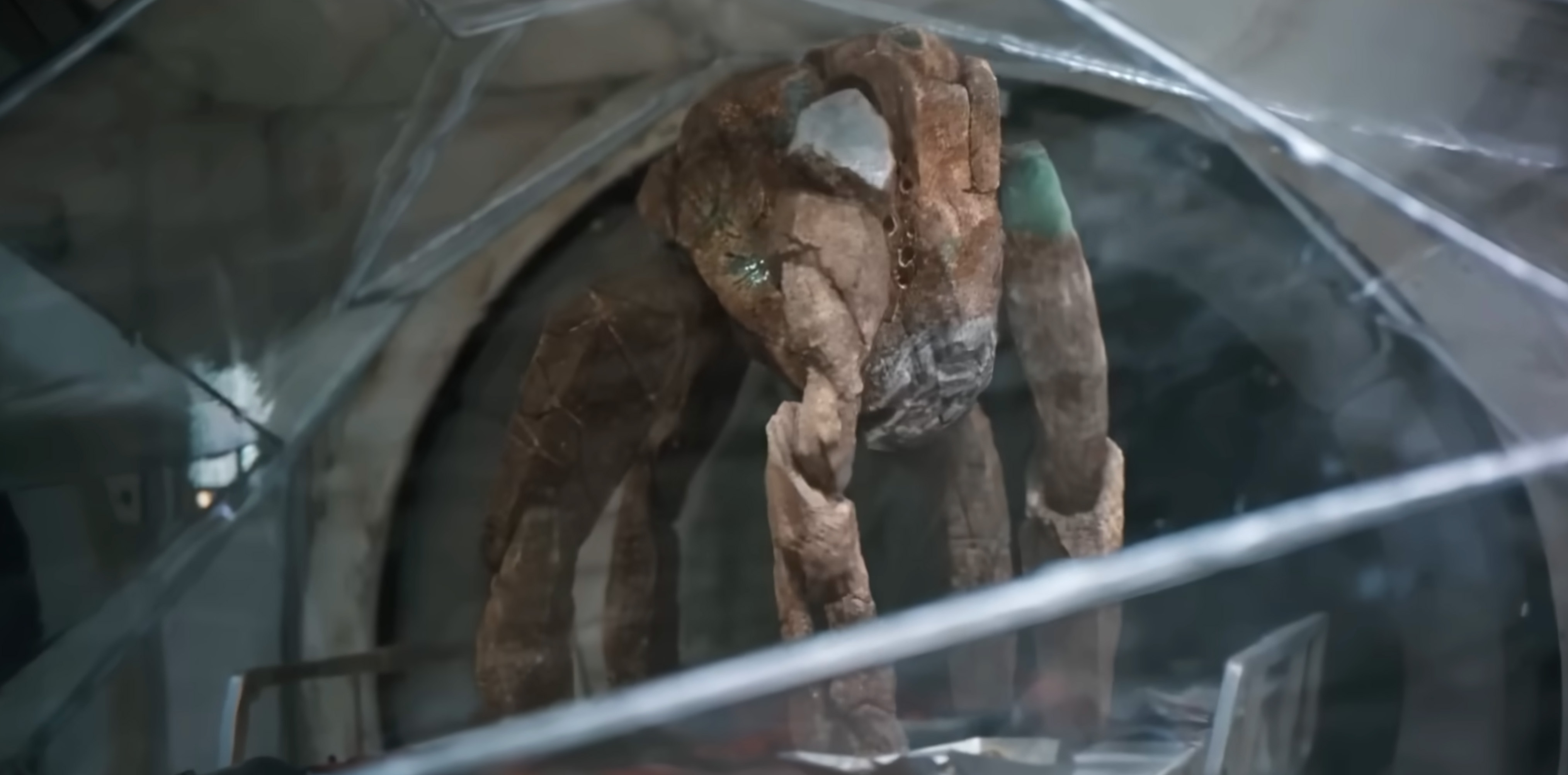
Rocky in all his beautiful glory.
Credit: Amazon MGM studios
Rocky in all his beautiful glory. Credit: Amazon MGM studios
“And that’s where I think that anthropic principle really cheats in most science fiction,” she finished up, referring to the principle that we’re all here to see a story, and certain things about the aliens need to be true for the story to work. “Because you would have to spend so much of your book describing what it is like to be Rocky—which, again, I’d read that book!—but it wouldn’t be a book about saving Erid and saving Earth because you’d need 500 pages just of what does it feel like to be an Eridian. And so what you end up with in both the book and the movie is it seems to feel a lot like being a human, except you’ve got a harder shell.”
Real first contact?
Given all of these factors, including and especially the idea that we can probably rely on a spacefaring technological species to have some of the same cognitive touchstones as humanity but also that “probably” is not “definitely,” I asked Dr. Birner how she might proceed if she suddenly found herself tapped to communicate with an alien and how she might know that meaning has been achieved.
She mentioned that for this scenario in Arrival—a film for which she was a linguistic advisor—the characters start with trying to establish names, but that naming might not be the right tack.
“There’s so much that has to come before that,” she said. “I like what Grace did, and I think I would probably do the same thing. Walk to the other end of the cage, see if it follows me. Assuming mobility—a big assumption, but let’s assume mobility and assume no obvious face. Let’s assume a Rocky-like creature. Will they follow me? That would establish some kind of cooperativity and theory of mind, that we now both think we both have minds.”
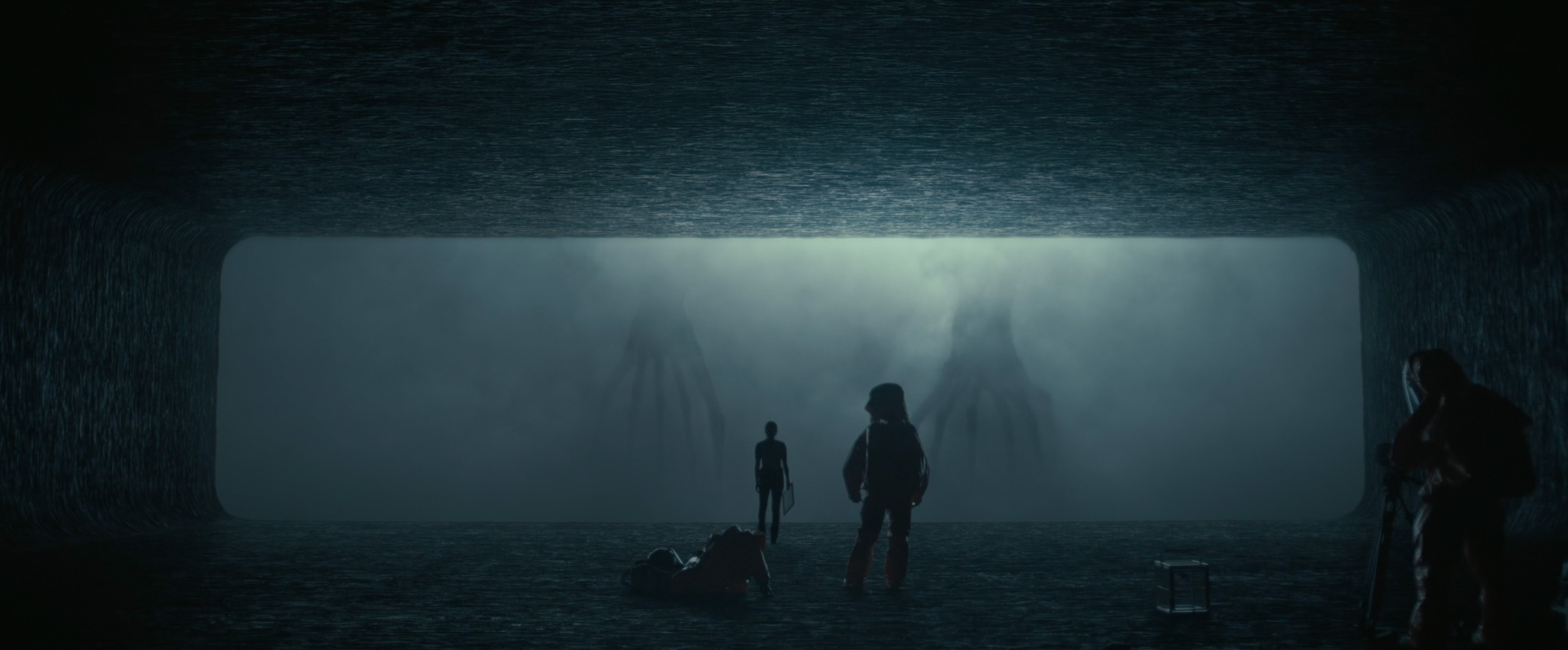
2016’s Arrival goes with a “names-first” approach to linguistic acquisition.
Credit: Paramount
2016’s Arrival goes with a “names-first” approach to linguistic acquisition. Credit: Paramount
“From there, presence of mind and friendly, mutual intent. At that point we go to the semiotic function—do you label things? Do you have things that stand for other things?”
“Grace does this with a clock,” I pointed out, “which works out to be probably the smartest thing he could have done because Rocky also has a clock handy and recognizes that that’s what it is.”
“Yeah, Rocky understands that it’s a clock because it’s got these little things that go around from image to incomprehensible image,” she said, referring to the spinning hands on the clock and Rocky’s apparent reasoning process. “I don’t know. Again, I’m saying you have to try to think ‘what is it like to be Rocky?’ Would you know that that’s a clock? Maybe you don’t measure time with numbers. Are there different measuring systems, some of which use math and some of which don’t?”
We pointed out that it’s narratively convenient that Eridians seem to use a written number system that employs place value and has a distinct base—and how even on Earth, that’s not a given. Many counting methodologies both ancient and modern are not place value systems—how much more complicated the conversation would have been had Grace brought out a clock using Roman numerals instead of Arabic!
Ultimately, as Ouellette then pointed out, any spacefaring entity must have some kind of working concept of space and time (either as the modern linked notion of “space-time” or in the old Newtonian separate mode)—though Weir made the fun choice of having Eridians lack any understanding of relativity.
Friendly aliens
The most dangerous thing about communicating with aliens this way isn’t mistaking a word or two—it’s the more fundamental problem of what happens to third- and fourth-order assumptions when the foundations those assumptions are built on aren’t quite right. Sure, Grace and Rocky can agree that they are “friends,” but how do you explain “friend”?
“To be someone’s friend can mean a million things,” said Dr. Birner. “I have my best friend since high school. I consider you a friend,” she said, pointing at me through the screen, “and we’ve talked three times. My daughter, who’s now 35, has turned into my friend. What does that mean?”
Indeed, the notion of “friend” is a rough one—it’s fundamental to human interaction, and as such, it carries with it a huge number of (sometimes contradictory) behavioral expectations. When you’re explaining “friends” to an alien, how do you paint it? That you and the alien have shared interests and should therefore work together? That you are genuinely interested in the alien’s well-being? That you’d make sacrifices for them? That you’d expect them to help you haul furniture when you move?
And what assumptions might you make about the alien’s behavior once you’d declared each other “friends”? That they would make sacrifices for you? What if for the alien, the concept they’ve settled on for “friendship” means they’ll pull your limbs off when the adventure is over because that’s what friends do in their culture?
“You need societal grouping,” I supplied, “but you don’t necessarily need friends.”
“Absolutely,” she said. “And now I’m going to another work from 1982, Maltz and Borker, who looked at kids on the playground, and at that time—I think it’s changed a lot, it’s been 40-some years!—but at that time, they saw that little girls had a horizontal set of relationships. It was all friendship-based and secrets-based, and you have your best friend and then your next best friends. And little boys had a hierarchy, and your whole goal was to get higher in the hierarchy by insulting the kids above you and whacking them and try to be king of the hill.”
“Get the conch,” I joked unhelpfully.
“Yeah, exactly—get the conch. Again, cultural knowledge.”
Thumbs up! Or down!
Realistically, it’s hard to see two creatures like Grace and Rocky so quickly managing to progress from pointing at objects to communicating about complicated emotional abstracts. Dr. Birner readily conceded that it would be easiest for two beings in a Grace-n-Rocky situation to build a small shared technical vocabulary out of pantomime, pointing at things, and other easily demonstrable physical concepts (and, indeed, this is how they start their communication). But the leap from demonstrables to abstracts is fraught.
Even the fact that Eridian language seems to more or less be human language wearing different pants doesn’t necessarily help us much. It makes it easier for the mechanics of communication to occur—Grace and Rocky easily grok that each other’s language has a definable syntax, expressed through the arrangement of chunked human words or the continuous sets of overlapping Eridian tones—but divining the true biologically freighted meaning of those messages grows increasingly uncertain the farther they get from physical demonstrations.
We are all slaves to our perceptions, and our languages and the meanings we aim at rest upon biological and sociological foundations that would be terribly difficult to convey to an alien with just a few weeks of focused effort.
But again, that’s not necessarily good buddy-movie storytelling, is it? It’s perhaps realistic, but it would make for a very different tale than the star-saving adventures of Grace and Rocky.
A bit of Grace and Rocky.
Which, by the way, are excellent. You’ve stuck with me through four thousand words of linguistic bloviating—and I have much more, with plenty more details, in the first piece from a few years ago! And if I can count on your attention for just a few more words, it would be to entreat you to go see Project Hail Mary. It is a fantastic film with a charming duo at its core—and even if the linguistics invite a lot of critique, it’s all coming from a place of love.
Even if Rocky doesn’t quite understand how hugs work. It’s OK. He figures them out.

Lee is the Senior Technology Editor, and oversees story development for the gadget, culture, IT, and video sections of Ars Technica. A long-time member of the Ars OpenForum with an extensive background in enterprise storage and security, he lives in Houston.