

Windows is not generally a platform that is associated with making music – it is something that tends to be the domain of Mac devices. But with the arrival of MIDI 2.0 support in Windows 11, Microsoft will be hoping that this could soon change.
The MIDI specification is vital to so much of the music making process, that it is hard to imagine where we would be without it. While Windows has included support for MIDI 1.0 for many, many years, adding support for the latest version is a huge leap forwards.
In a blog post announcing the arrival of MIDI 2.0 support, Microsoft acknowledges that not everyone will know – or care – about MIDI. The company says: “Non-musicians sometimes associate MIDI only with .mid music files, or with the late 80’s General MIDI sound sets. But it is so much more than that. For musicians, MIDI is essential to everything from instrument synchronization to stage lighting and effects control, to sequencing, beat making and more. MIDI is the glue that helps make electronic music possible.”
The blog post goes on to give something of a history of the evolution of the MIDI specification, right up to the most recent updates in 2023. Excitedly screaming “Announcing General Availability of Windows MIDI Services, with support for MIDI 1.0 and 2.0”, Microsoft says:
We’re excited to announce that Windows 11 now supports both MIDI 1.0 and MIDI 2.0 through Windows MIDI Services!
We’ve been working on MIDI over the past several years, completely rewriting decades of MIDI 1.0 code on Windows to both support MIDI 2.0 and make MIDI 1.0 amazing. This new combined stack is called “Windows MIDI Services.”
The Windows MIDI Services core components are built into Windows 11, rolling out through a phased enablement process now to in-support retail releases of Windows 11. This includes all the infrastructure needed to bring more features to existing MIDI 1.0 apps, and also support apps using MIDI 2.0 through our new Windows MIDI Services App SDK.
All of your existing MIDI 1.0-aware software just got even better, without needing any app updates!
Microsoft goes on to highlight some of the benefits of support in Windows 11:
The No. 1 request for MIDI in Windows has been to allow multiple apps to use the same MIDI port/device at the same time. We call that “multi-client.” Until now, this was only possible with custom vendor drivers.
Now, every MIDI 1.0 port and MIDI 2.0 endpoint is multi-client, regardless of the driver or API used. In most cases, vendor-specific MIDI drivers are no longer needed or recommended, although they will still work if they are kernel streaming drivers.
Multi-client is available for all MIDI 1.0 and MIDI 2.0 apps and devices.
It also shares:
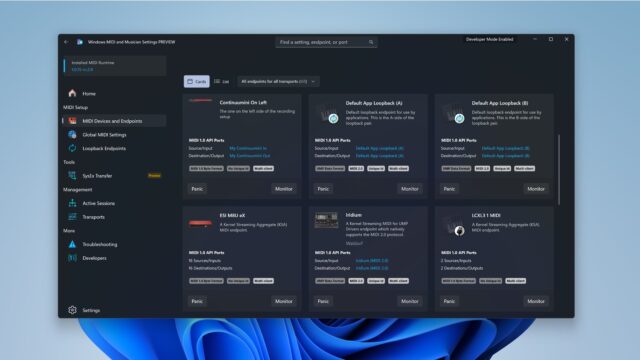
Windows MIDI Services now includes built-in loopback support, so that apps can communicate with each other, regardless of which API or SDK they use. Even WebMIDI pages in the browser can work with your loopback endpoints, all without any additional drivers or installs. When you first run the MIDI and Musician Settings app, you’ll be prompted to complete your MIDI setup, including optionally adding a set of standard loopback endpoints.
Taking it beyond simple loopbacks, we also natively include the ability for an application to be a full MIDI 2.0 “device,” complete with support for MIDI 2.0 concepts, protocol negotiation and discovery. Like other MIDI 2.0 endpoints, these are automatically translated and made available to classic MIDI 1.0 APIs at a MIDI 1.0 level.
You can create your own loopback endpoints using the MIDI Settings app in the upcoming Windows MIDI Services Tools download. The loopbacks are available to all MIDI 1.0 and MIDI 2.0 applications, without any additional drivers.
Microsoft says that this is far from being the end, promising:
In the coming months, we’ll release the updated MIDI App SDK Runtime and Tools package, which includes the MIDI Console, MIDI Settings app, PowerShell projections for scripting MIDI and much more.
For musicians, Microsoft’s blog post has a lot of further information that will be of interest. You can check it out in its entirety here.


