Veronika uses sticks to scratch herself, suggesting scientists have underestimated cow cognition
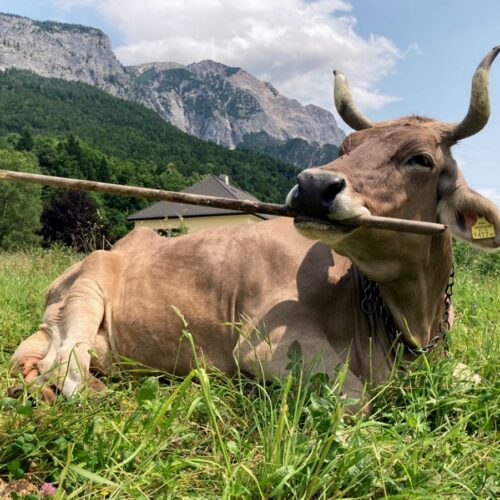
Far Side fans might recall a classic 1982 cartoon called “Cow Tools,” featuring a cow standing next to a jumble of strange objects—the joke being that cows don’t use tools. That’s why a pet Swiss brown cow in Austria named Veronika has caused a bit of a sensation: she likes to pick up random sticks and use them to scratch herself. According to a new paper published in the journal Current Biology, this is a form of multipurpose tool use and suggests that the cognitive capabilities of cows have been underestimated by scientists.
As previously reported, tool use was once thought to be one of the defining features of humans, but examples of it were eventually observed in primates and other mammals. Dolphins can toss objects as a form of play which some scientists consider to be a type of tool use, particularly when it involves another member of the same species. Potential purposes include a means of communication, social bonding, or aggressiveness. (Octopuses have also been observed engaging in similar throwing behavior.)
But the biggest surprise came when birds were observed using tools in the wild. After all, birds are the only surviving dinosaurs, and mammals and dinosaurs hadn’t shared a common ancestor for hundreds of millions of years. In the wild, observed tool use has been limited to the corvids (crows and jays), which show a variety of other complex behaviors—they’ll remember your face and recognize the passing of their dead.
In 2012, a captive cockatoo named Figaro was trying to retrieve a stone that had fallen behind a metal divider and picked up a stick to increase his reach. He failed but then the researchers placed a nut behind the divider as an added incentive. Figaro initially picked up a stick from the enclosure’s floor, but this proved to be too short to reach the food. So, he actually splintered off a piece of the enclosure’s wooden base, and successfully used that to pull the nut towards the wire until he could use his beak to grab it.
Figaro used a different tool in each subsequent trial, and in most cases made some modifications to it before successfully retrieving a nut. In at least one case, he performed four separate modifications before putting a stick to use in retrieving the nut. He also managed to use the tool in two different ways, often alternating dragging and sweeping motions in his efforts to pull the food within reach. Other cockatoos who repeatedly watched Figaro’s performance were also able to do so. By 2022, Figaro and his cockatoo cronies had learned how to combine tools—in this case, a stick and a ball—to play a rudimentary form of “golf.”
Meet Veronika
For all the scientific interest in animal tool use, there has been almost no research into the cognitive capabilities of livestock like cows, or their possible tool use, according to the authors of this latest paper. Alice Auersperg, a cognitive biologist at the University of Veterinary Medicine in Vienna, was intrigued when she watched the footage of Veronika’s scratching behavior. “It was clear that this was not accidental,” said Auersperg. “This was a meaningful example of tool use.”
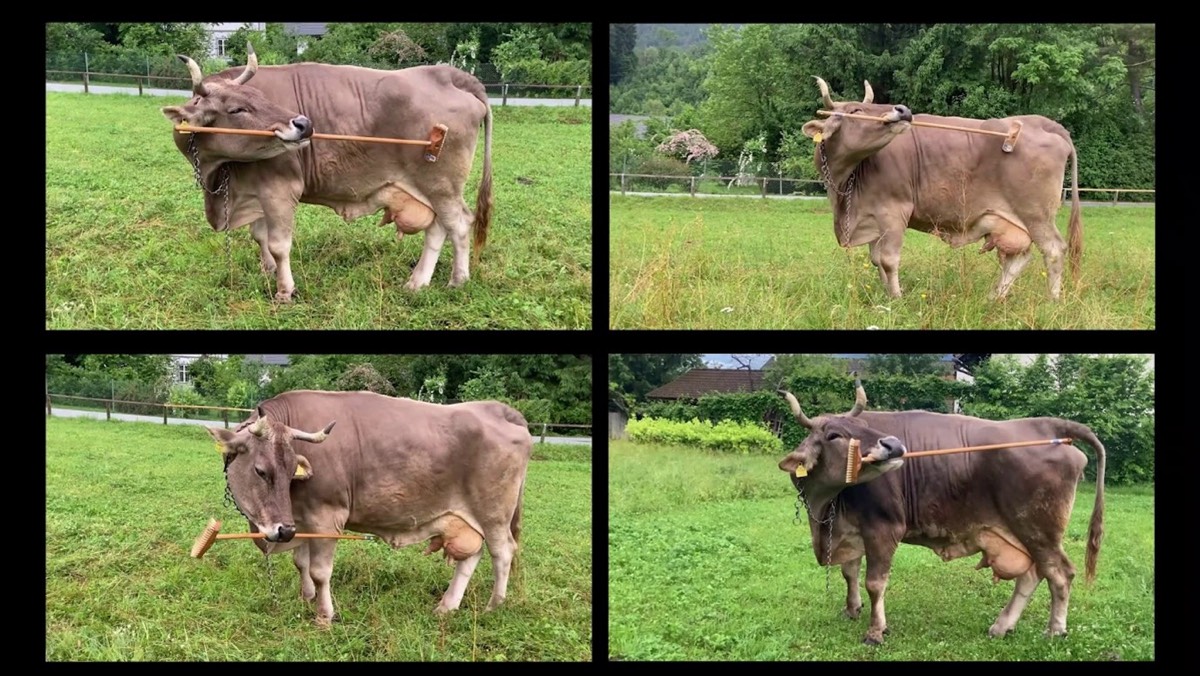
Veronika using a stick, applying different techniques and body areas.
Veronika using a stick, applying different techniques and body areas. Credit: Antonio J. Osuna Mascaró/CC BY-SA
To test the extent of Veronika’s tool use, Auersperg and her postdoc, Antonio Osuna-Mascaro, visited the farm where Veronika lives. Her owner, Witgar Wiegele, is an organic farmer and baker who keeps the cow as a pet. With Wiegele’s permission, they conducted a series of randomized trials with a deck scrub broom, chosen for its asymmetrical shape, placed in different orientations. The pair recorded 76 instances of Veronika using the broom over seven sessions of ten trials.
Each time, Veronika used her tongue to lift and position the broom in her mouth, clamping down with her teeth for a stable grip. This enabled her to use the broom to scratch otherwise hard-to-reach areas on the rear half of her body. Veronika seemed to prefer the brush end to the stick end (i.e., the exploitation of distinct properties of a single object for different functions) although which end she used depended on body area. For example, she used the brush end to scratch her upper body using a scrubbing motion, while using the stick end to scratch more sensitive lower areas like her udders and belly skin flaps using precisely targeted gentle forward pushes. She also anticipated the need to adjust her grip.
The authors conclude that this behavior demonstrates “goal-directed, context-sensitive tooling,” as well as versatility in her tool-use anticipation, and fine-motor targeting. Veronika’s scratching behavior is likely motivated by the desire to relieve itching from insect bites, but her open, complex environment, compared to most livestock, and regular interactions with humans enabled her unusual cognitive abilities to emerge.
The implication is that this kind of technical problem-solving is not confined to species with large brains and hands or beaks. “[Veronika] did not fashion tools like the cow in Gary Larson’s cartoon, but she selected, adjusted, and used one with notable dexterity and flexibility,” the authors wrote. “Perhaps the real absurdity lies not in imagining a tool-using cow, but in assuming such a thing could never exist.”
DOI: Current Biology, 2025. 10.1016/j.cub.2025.11.059 (About DOIs).

Jennifer is a senior writer at Ars Technica with a particular focus on where science meets culture, covering everything from physics and related interdisciplinary topics to her favorite films and TV series. Jennifer lives in Baltimore with her spouse, physicist Sean M. Carroll, and their two cats, Ariel and Caliban.