A receptor that’s used to find prey is also activated by progesterone.
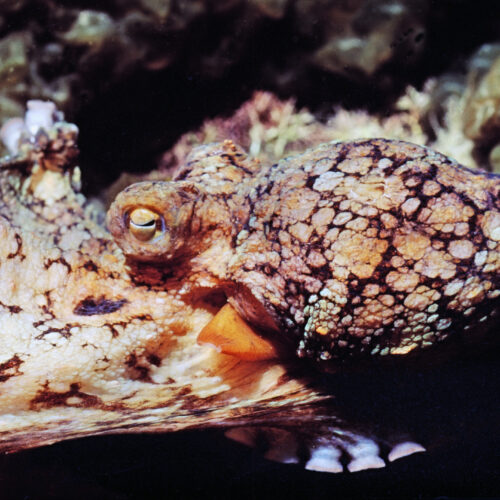
A two-spot octopus in its normal habitat. Credit: Hal Beral
Octopuses are one of the most alien creatures on Earth. The lack of bones makes them amazing shapeshifters, most of them can change color like chameleons, and they pump blue copper-based blood through their bodies using three distinct hearts. They rely on a decentralized nervous system, where two-thirds of their neurons reside in their arms, allowing each limb to independently taste, touch, and make decisions for itself.
Now, a team of scientists led by Pablo S. Villar, a molecular biologist at Harvard University, for the first time took a close look at octopuses’ sex life. It turned out it was just as weird.
Love in the dark
The deep ocean is a challenging place to find a partner, especially since octopuses are solitary animals that wander the seafloor alone, mating only during highly infrequent encounters. The exact mechanics of their reproduction when they do find each other have long puzzled biologists. We knew that male octopuses don’t rely on flashy plumage or complex mating calls and that they use a specialized appendage called the hectocotylus—basically a modified tentacle—to identify females.
Any details beyond that, as Villar and his colleagues write in their Science study, were based on anecdotal evidence more than on hard science. Villar designed an experiment to change that.
His team put a wild-caught pair of Octopus bimaculoides in a tank together; it’s a relatively small species known as the California two-spot octopus and lives in the eastern waters of the Pacific Ocean. They did take some precautions, though. “These animals are solitary, so we were not sure how they would react to each other,” Villar explains. “Would they get aggressive?” Despite their size, octopuses are surprisingly strong, and the team figured they would not be able to separate their tentacled subjects if their date concluded with a serious altercation. So, they put a barrier between them.
The barrier was opaque and had holes in it with a diameter large enough for the octopus’s arms to go through. “The idea was, we start with the barrier to let them feel each other out and get comfortable with each other’s presence. Then we wanted to remove it,” Villar says. But it turned out removing the barrier was not necessary—the octopuses consummated their newly found relationship through the available holes. And the act itself was just as otherworldly as you’d expect from an octopus. “We were quite surprised—we did not expect that,” Villar says.
The docking procedure
The mating started with the male octopus extending his hectocotylus through the barrier’s opening, maneuvering it toward the female, touching her skin first and then inserting the appendage deep within her mantle. “Octopuses have a cavity, an opening where all internal organs can be reached. The male can touch all internal organs of the female, which is quite invasive,” Villar explains. Once the hectocotylus got inside this cavity, both octopuses ceased all movement for about an hour.
What the male needs to find among all the female’s internal organs is the opening of the oviduct, where he can use the specialized appendage to deliver his sperm cells. And he has to do it without any visual cues or, apparently, much in the way of feedback from his partner. “When a male is inside the mantle and the female is receptive, she will stop all movement because it’s a fine motor control behavior,” Villar says, referring to the male’s search. The process may have more in common with a spaceship docking to the International Space Station or a jet fighter refueling mid-air from a tanker plane than with the usual idea of what sex looks like.
When the scientists paired two male octopuses in the same setup, the males interacted by touching arms, but they never attempted to mate. This suggested that a specific, female-derived chemical cue was acting as a biological green light for copulation. This immediately posed some questions.
What sensing apparatus might a male octopus have in his hectocotylus that enables him to unmistakably find the oviduct? And what is this female-derived cue that triggers the search?
Chemistry of touch
To figure out how octopuses’ sex life works at the molecular level, Villar’s team looked at the female’s reproductive organs first. They found that the female’s oviducts and ovary expressed high levels of biosynthetic enzymes critical for producing sex steroids. Specifically, the oviducts were packed with an enzyme responsible for the production of progesterone.
To check whether progesterone was the trigger, the researchers removed the female from the barrier tank and replaced her with conical plastic tubes coated with various chemical stimuli, sliding them into the small holes of the wall divider. When the male encountered the tube coated with progesterone, he actively explored it, demonstrating the same mating search behavior he used on the female’s mantle. By contrast, tubes coated with structurally similar steroids, bile acids, or bitter-tasting molecules failed to elicit the same response.
It seemed that evolution solved octopus sex by repurposing mechanisms they usually use for hunting. Octopuses use their regular, non-mating arms to hunt by relying on a taste-by-touch system to explore the seafloor for prey. This predation is driven by a distributed nervous system within the arms, studded with specialized chemotactile receptors. It turned out that the chemotactile receptor, a protein called CRT1, in the hectocotylus also responds to sex cues.
Scanning electron microscopy revealed that the tip of the hectocotylus is covered in small sucker cups that are structurally identical to the sensory suckers on their regular hunting arms. What’s more, these specialized mating suckers are densely packed with neural clusters. Just like the arms used for tracking down a crab, the hectocotylus expresses a high concentration of chemotactile receptors, alongside mechanoreceptors.
According to Villar’s study, these chemotactile receptors achieved complex chemical sensing in a different way than mammals. They are ligand-gated ion channels that diverged from ancestral neurotransmitter receptors. What was once an internal system for passing signals between neurons evolved to face the outside world and sense the chemical signatures of both food and mates, specifically detecting female-derived progesterone.
And the team found similar mechanisms in other cephalopods as well.
Gears of evolution
The team tested several diverse cephalopods, including two octopuses, Octopus rubescens and Abdopus aculeatus, and the hummingbird bobtail squid. All of their ovaries expressed the enzymes required to produce sex steroids. Even though the hectocotylus arms varied physically from species to species, they all contained similar sucker cups that responded robustly to exogenously applied progesterone.
In a perspective article accompanying Villar’s paper in Science, Anna Di Cosmo, a professor of biology at the University of Naples, writes that chemosensation is one of the most ancient sensory modalities on Earth. Organisms detected one another through molecules long before visual displays or acoustic courtship signals evolved.
Animals rely on sensory systems as a gateway for reproduction. Sensory receptors act as evolutionary hotspots that can either preserve recognition among members of the same species, or limit interspecies mating, playing a foundational role in Earth’s biodiversity. If an octopus population adapts to a new ecological niche with different chemical conditions, Di Cosmo argues, its sensory receptors might shift to better detect the available prey. But because the very same receptors are used to find mates, this adaptation could simultaneously modify their preferences to select better-adapted mates.
But there are still questions Villar’s study did not answer. So far, the team just put two random opposite-sex octopuses in the tank and watched them mate. Would the mating happen between different individuals? Are octopuses selective in their mating? And finally, wouldn’t being near-perfectly still for an hour make a pair of copulating octopuses ridiculously exposed to predators?
Compartmentalized lovemaking
“We did not train these octopuses to mate through the openings in the barrier, but they did it anyway,” Villar says. “The same happened with other octopus pairs we tested: they all did it. It looked like this was kind of natural for them.” The tentative explanation he offers is that octopuses live near the seafloor in crevices between the rocks. The octopuses can safely stand still during their hour-long mating process because, Villar speculates, both male and female can be hidden in their respective rocky hideouts. Since they don’t need to see each other, the male probably just navigates his roughly 30-centimeter-long hectocotylus to the neighboring female’s crevice. The other questions, though, seem like a tougher challenge.
“We used wild octopuses in the experiment, so we don’t know exactly at which stage in their reproductive cycle they were,” Villar says. The team just chose octopuses that seemed big enough to be adults. This left them with no data on how, if at all, the synthesis of the female chemical cues changes across her lifecycle. “Maybe the amount is different, maybe the type of molecules that are released is different,” Villar said, considering some options.
Assessing the selectivity in octopuses’ mating is also rather tricky. “You will have to set up breeding pairs, and that means we’d have to use lab-grown octopuses. That is a big effort,” Villar explains. Scientists would need to grow the little octopuses from the moment they hatch, make sure they survive, and feed them over a long lifecycle that lasts roughly two years, which is a lot of time and effort.
Villar and his colleagues, though, want to learn more about chemical cues driving the octopuses’ mating process first. “We know it’s about progesterone, but is there anything else? Like specific molecules that will be a fingerprint for a particular species,” Villar says. “We’d like to compare different species of females and see.”
Science, 2026. DOI: 10.1126/science.aec9652

Jacek Krywko is a freelance science and technology writer who covers space exploration, artificial intelligence research, computer science, and all sorts of engineering wizardry.