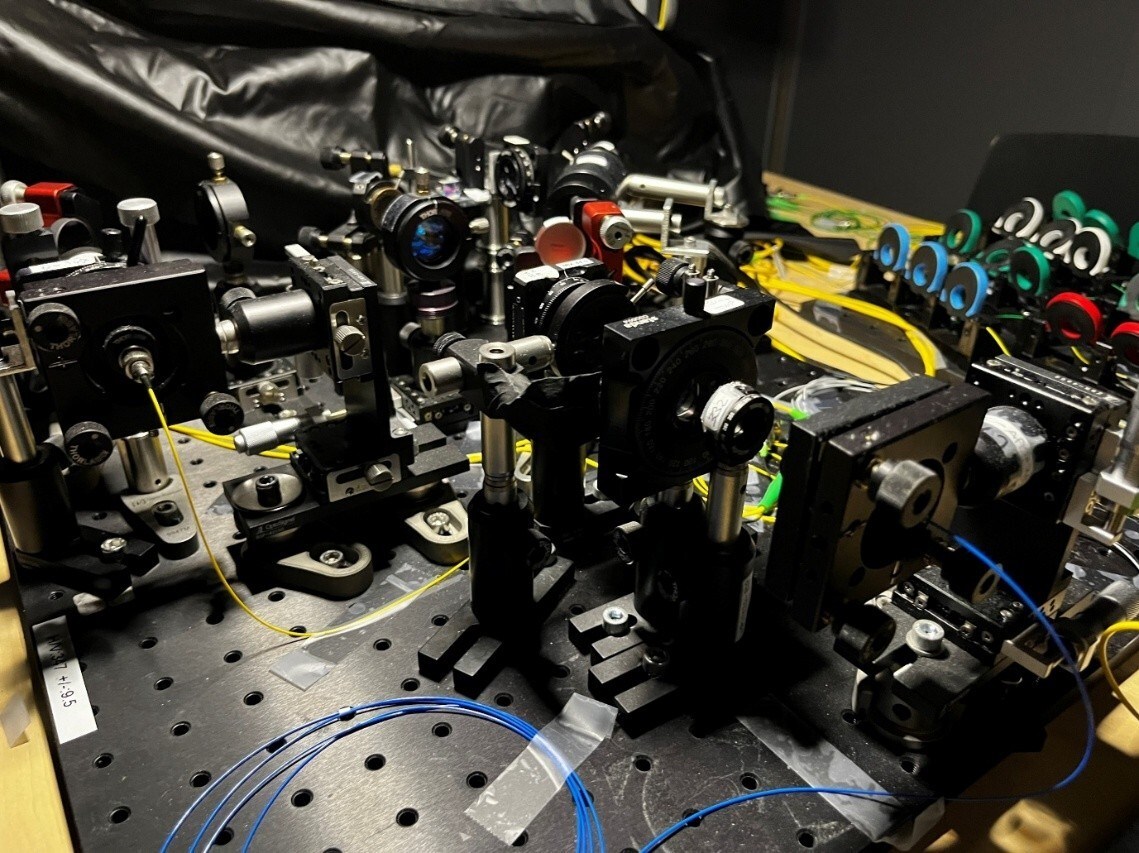
Researchers explore how reliable quantum entanglement states can be generated and distributed through off-the-shelf components
, /PRNewswire/ — Quantum entanglement links two particles, such as photons, so that measuring one instantly reveals information about the other. Reliable generation and distribution of entangled states are essential for quantum technologies like quantum key distribution (QKD)—a secure communication protocol using quantum randomness for encryption.
Most QKD systems use polarization-based entanglement, but this approach is unstable over long fibers due to birefringence. Time-bin entanglement, which encodes information in photons’ arrival times, offers a more stable alternative, though it has traditionally required complex, custom setups.
Now, a new study published in the IEEE Journal of Selected Topics in Quantum Electronics on February 6, 2025, has successfully demonstrated the generation and long-distance distribution of high quality entanglement in a metropolitan network, using off-the-shelf components. “We implemented a robust sequential time-bin entangled source for quantum key distribution across Vienna’s existing fiber network,” explains Martin Achleitner from Austrian Institute of Technology (AIT). The research team also included Dr. Alessandro Trenti and Dr. Hannes Hübel from AIT, and Dr. Philip Walther from University of Vienna, Austria.
To generate time-bin entangled photons, the team utilized modulated laser pulses in the GHz range, which were converted into a visible pump beam. This pump beam was injected into a special spontaneous parametric down-conversion (SPDC) crystal to generate the time-bin entangled photon pairs. To assess entanglement quality, the researchers used a commercially available Mach-Zehnder delay line interferometer (MZI) and a 50/50 beamsplitter setup.
“To the best of our knowledge, this is the first time a commercial MZI delay line has been used for a quantum application,” notes Dr. Trenti. The setup demonstrated strong entanglement and excellent visibility of about 93%, well above the requirement for secure key generation.
“Using such an entanglement source on photonic crystals will significantly improve scalability of quantum networks,” adds Dr. Hübel.
Reference
|
Title of original paper Journal |
Distribution of GHz Sequential Time-Bin Entanglement in a Metropolitan Fiber Network IEEE Journal of Selected Topics in Quantum Electronics |
|
DOI |
Media Contact:
Laura A. Lander
1 (732)-465-6479
[email protected]
SOURCE IEEE Photonics Society