

TechRadar Verdict
The Wave Speakerphone is really something new to me, but after just a day of using the Insta360 Wave, its potential is instantly apparent. Initial set-up was confusing, but once it was resolved, the ability to record and transcribe meetings, as well as record audio for online content, proved the device’s flexibility, and has made me seriously consider buying one.
Pros
- +
Exceptional voice clarity
- +
Flexible connectivity options
- +
Built-in smart features
Cons
- –
Some AI features require a subscription.
- –
Not great for musical instruments
- –
No voice assistant
Why you can trust TechRadar We spend hours testing every product or service we review, so you can be sure you’re buying the best. Find out more about how we test.
Insta360 Wave: 30-second review
Getting started with the Insta360 Wave isn’t as straightforward as simply plugging it in and getting started, as options on the device need to be selected. In the instructions, it says to plug the USB cable into your laptop or PC, and it should appear on the desktop with the relevant software ready to be installed. To make it appear, however, you need to activate USB mode on the device by navigating the touchscreen menu to settings, then to USB mode, and tapping file transfer. Once this is done, the unit will appear as a drive, and you can install the software; it’s just initially not that clear. Alternatively, you can download the software directly from the Insta360 website, which circumvents the issue.
After the Insta360 Wave Controller software has been downloaded and updated, you’re then set and ready to start using the speakerphone. The easiest use in most scenarios is to just hit record as soon as a call comes through or if you’re in a face-to-face meeting and need to record minutes for later reference. The small circular interface is well laid out, with a large record button that you simply tap to start and tap again to stop; it really couldn’t be simpler. You can also set it up to integrate with most conferencing apps, such as Teams and Zoom.
If you need to make any adjustments to the settings, that’s all easy enough. Just swipe up on the device menu, tap settings, and all the settings for the unit are there. If you’re connected to your computer, you can use the Insta360 Wave Controller to access the same.
One thing to point out, like with many devices these days, is that you need to sign up for an online account to fully utilise the device and features, especially the AI ones. You get 300 minutes of AI transcription free per month, but anything beyond that requires a subscription.
If you need more than 1,200 minutes a month, there are packages to add even more AI transcription time. Through this test, I found the 300 minutes to be more than enough as an individual; however, in a business environment, I can see that time quickly evaporates. The audio clarity when recording was exceptionally good, and I particularly liked the ability to choose how the microphones pick up audio, with Omni, cardioid, supercardioid, figure-of-eight, and stereo patterns available. These can be selected through the audio settings by switching from standard noise reduction to original sound.
Through the test, I was impressed with the clarity boost compared with using a laptop microphone. As I was testing the Insta360 Link 2 at the same time, the two paired exceptionally well, one boosting video streaming well beyond what was possible with the laptop webcam, and the speakerphone dramatically enhancing audio quality, not just when seated at the desk, but also when standing away from both the camera and speakerphone.
The Insta360 Wave is one of those devices you never realise you need until you start using it. The AI transcription is incredibly useful. While the 300-minute limit without a subscription may be restrictive, it should suffice for most people. What I really liked was the quality of the audio pickup, especially at a distance. This meant that if you’re standing in front of a whiteboard during a web meeting, the audio clarity remains exceptionally good. With different mic pickup styles, you can also maximise audio pickup quality in a variety of situations, be that face-to-face meetings, online phone calls, or lectures.
While the initial setup, especially connecting to Bluetooth and Wi-Fi, wasn’t as straightforward as with some other Insta360 devices (which are usually extremely simple), once everything was in place, the device worked seamlessly, and I didn’t have to think about it. It was just there, ready to be used whenever needed to record all the details and provide a transcription afterwards.
Insta360 Wave: Price and availability
- How much does it cost? £279 / $299
- When is it out? Now
- Where can you get it? Widely available
The Insta360 Wave is widely available for $299 / £279 from Insta360. It is also available in bundles, including one featuring the Link 2 webcam, so you have both an audio and visual option.
I’m also seeing it available via Amazon.com, Amazon.co.uk, and other online retailers.
- Value: 4 / 5
Insta360 Wave: Specs
CPU: AI DSP
Storage: 32GB internal
Ports: USB-C
Connectivity: USB-C, Bluetooth 5.0, optional wireless dongle
Audio: 8 MEMS microphones, beamforming, 5 pickup modes
Camera: Link 2 (Optional Extra)
Size: Ø64.3mm Raised: 248mm, Collapsed: 198mm
Weight: 580g
Accessories: USB-C cable, optional dongle, carry pouch (varies by bundle)
Insta360 Wave: Design
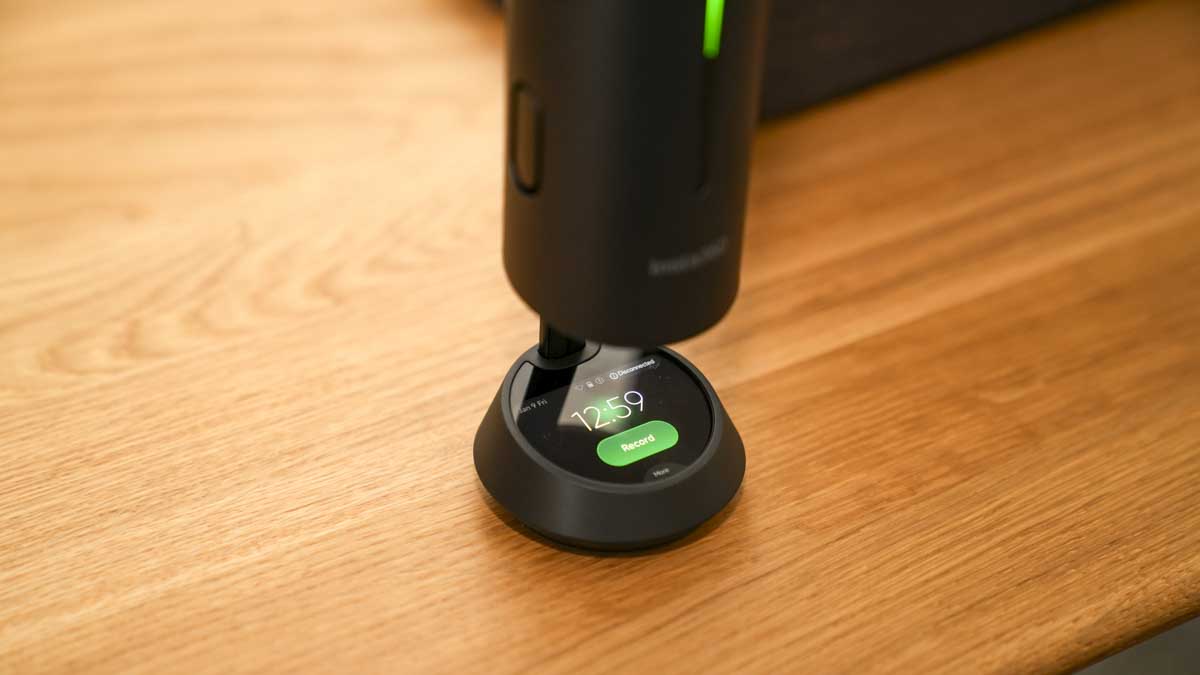
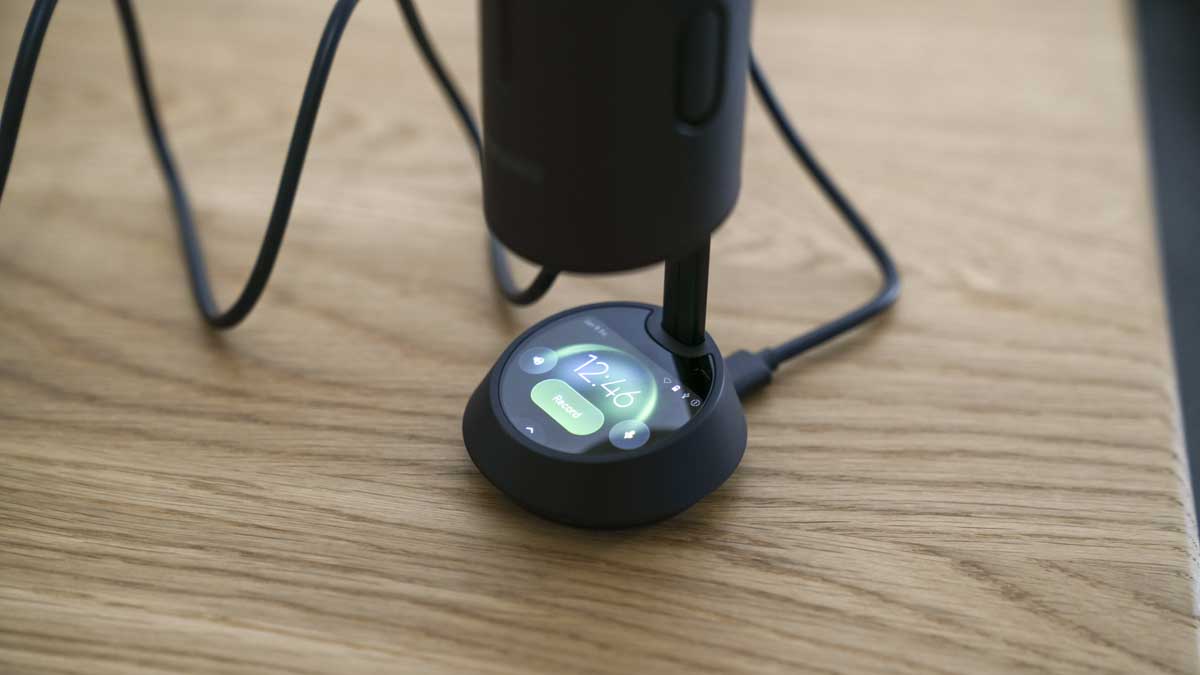
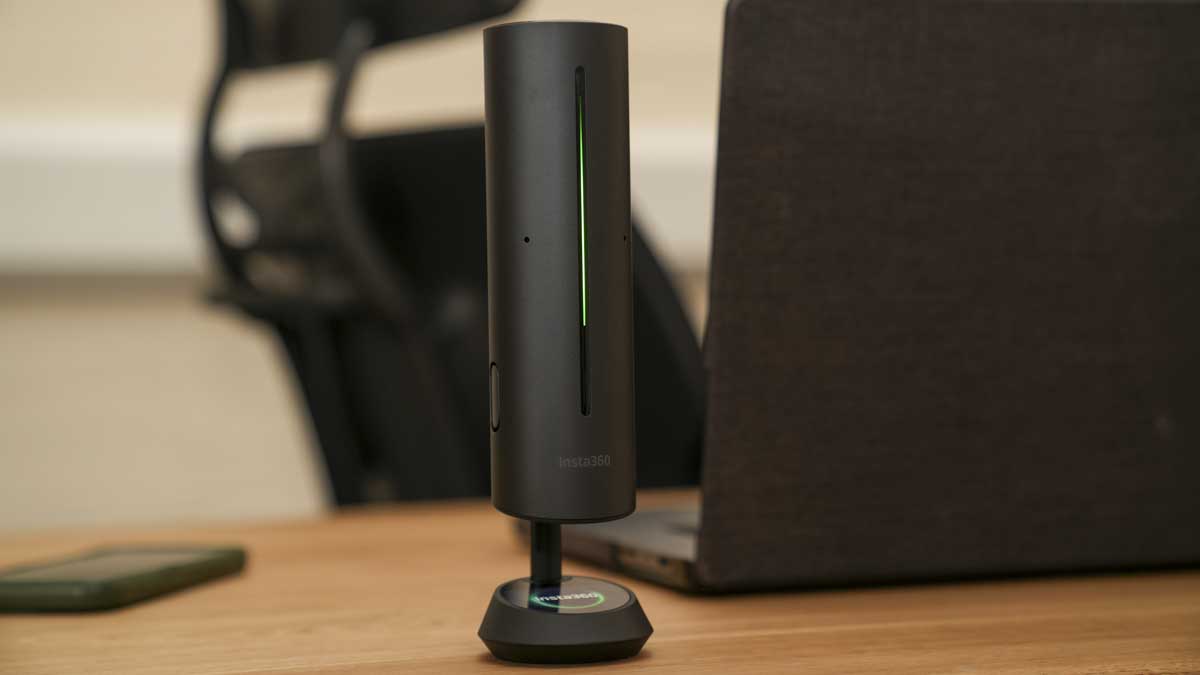
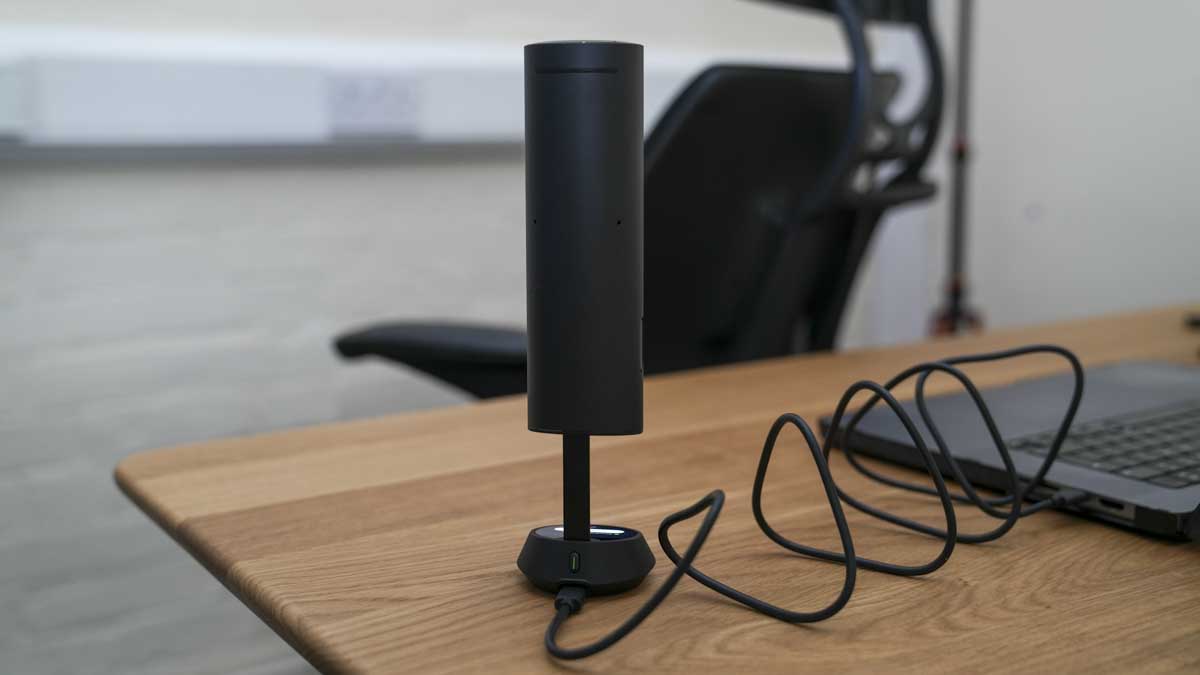
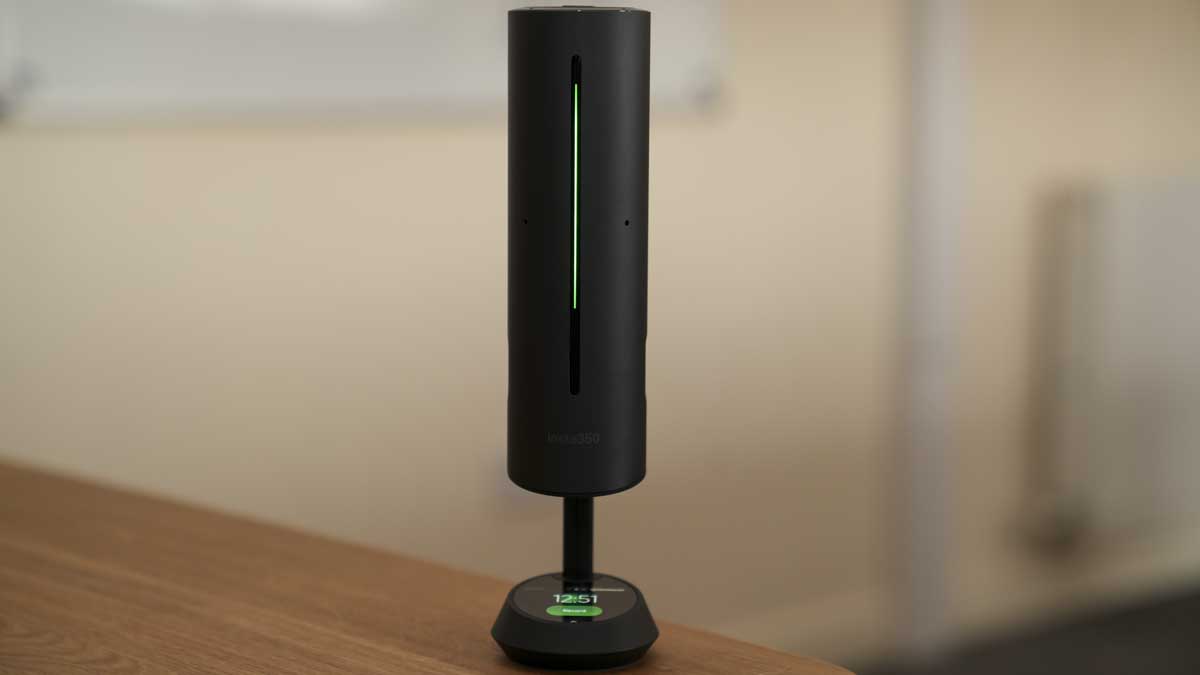
The design of the Insta360 Wave is quite unique. It’s clean, cylindrical black design looks exceptionally futuristic, and once powered on, the main column levitates, revealing a small touchscreen interface on the base.
In terms of size and weight, it’s a little heavier than expected for such a small device, measuring 64.3mm in diameter and 198mm in height, rising to 248mm when activated. The weight comes in at 490g, reinforcing the premium quality of the unit.
The touchscreen interface enables fast access to recording and audio settings. While it’s only 1.82 inches, it’s extremely responsive and clear.
The Insta360 Wave has been designed for the professional market, for conferencing and meetings, either online or face-to-face, and has several AI features built in. Packed inside the cylindrical design is an advanced AI chip, 8-MEMS microphones offering 48kHz for hi-fi quality audio, voice-optimised speakers suited to human voice rather than music, and a unique floating form factor.
The cylindrical design makes it extremely easy to position, ideal for meetings, whether seated around a boardroom table or presenting online. With AIGC (Automatic Gain Control) switched on, the speakerphone is able to pick up audio even at a distance, up to 16 feet. Through this test, even at a good 2–3 metres, audio pickup was exceptionally good.
The design is also sleek and compact, and Insta360 has included a carry bag in the package, highlighting that this device is not just for office use but can be taken out and about. Another great feature is that it’s not only powered via USB; it also features an internal battery, enabling use via Bluetooth with almost any compatible device.
One of the big features here is the audio pickup. By default, the speakerphone is set to noise cancellation, but switching to original sound allows you to choose from five precision-engineered pickup patterns: Omni, cardioid, supercardioid, figure-of-eight, and stereo, depending on your situation.
The design has also been developed to be fully compatible with the Insta360 Link 2, so if you want to enhance both visuals and audio, the two pair together to offer a far superior audiovisual experience than you’d expect from a standard laptop webcam.
Another big advantage is the 32GB of storage, allowing you to record meetings directly to the device for later playback. This audio can be transcribed into text using the AI features, and it’s clever enough to separate different speakers so you can assign them names.
The AI transcription goes further, generating smart notes and a summary of the entire meeting. If there’s something you need to ask about what was said, you can use the AI chat feature.
- Design: 4.5 / 5
Insta360 Wave: Features
On the surface, this just looks like a rather uniquely designed desktop speakerphone, something to pick up your audio and play it back. However, this is an AI-enhanced speakerphone that goes beyond traditional options.
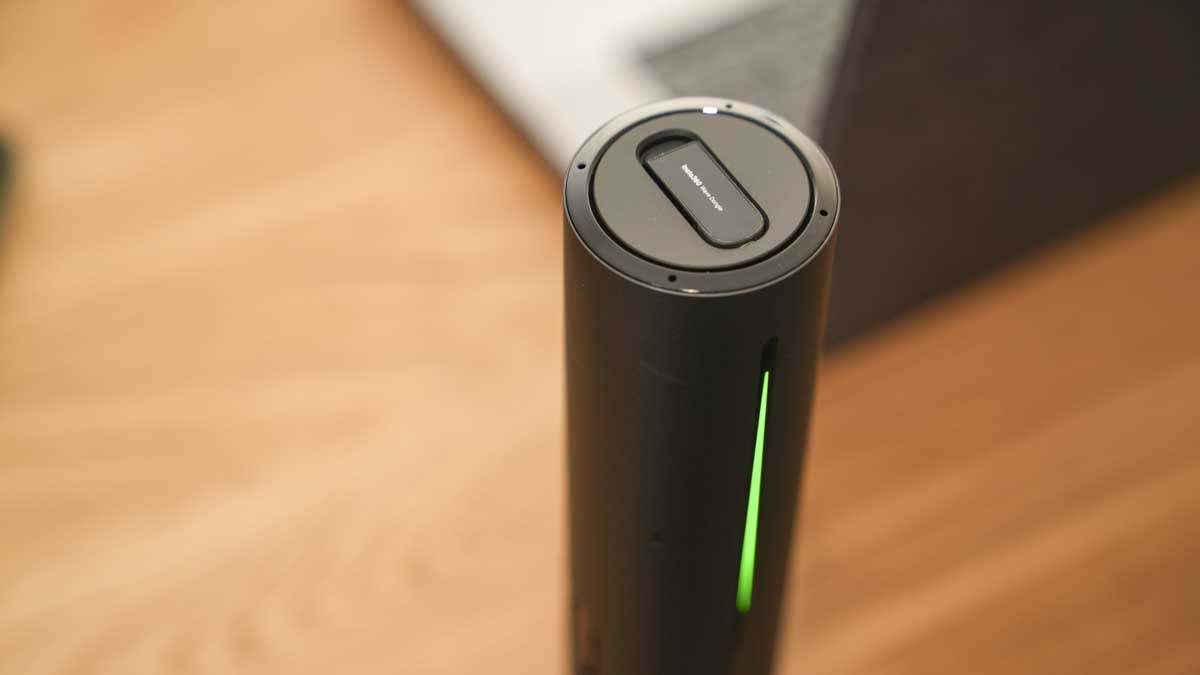
First and foremost, audio quality is essential. It has an 8-MEMS mic array with beamforming to pick up audio. You have a choice of five mic pickup patterns: omnidirectional (360° coverage), cardioid (front-focused, ideal for online meetings or podcasts), supercardioid (ambient noise suppression), figure-of-eight (interviews), and stereo (wider sound for personal music projects).
Through the test, one feature that impressed me from the outset was the AI noise suppression with AGC (auto gain control) and echo cancellation. Once activated, you can walk away from the mic, and the unit balances the audio, improving quality without the usual echo. You don’t need to stay near the mic; you can wander while talking, with little fluctuation in volume or clarity for those listening.
You can control settings either directly via the touchscreen or via the Insta360 Wave Controller software or app. These provide the same level of control. You can connect via USB-C, Bluetooth 5.0, or an optional wireless dongle.
This speakerphone also includes 32GB of onboard storage, allowing you to record conversations for playback or archiving, and it is exceptionally easy to use.
Most people, I would imagine, will connect via USB, but it also has a 9,800mAh battery for up to 12 hours of wireless use.
The Insta360 Wave can either be used standalone or integrated with the likes of Zoom, Teams, Meet, OBS, and more. In this review, I used it with Teams and Google Meet.
- Features: 4.5 / 5
Insta360 Wave: Performance
Over the years, I’ve looked at plenty of Insta360 devices and, generally, they’re exceptionally easy to set up and use. However, getting started with the Insta360 Wave was not initially as straightforward as I had anticipated.
Checking through the instructions, all I needed to do was plug the USB cable into my MacBook Pro, and it should have been instantly recognised and usable. But this didn’t seem to be the case. It also stated that once the USB cable is connected, the device should appear as a drive so the Insta360 Wave Connect application could be installed, which would give access to all the settings. However, all it seemed to do was activate the Wave, play its dramatic start-up sound, and display the touchscreen and options, but no connection to the Mac.
The touchscreen is exceptionally well laid out and highlights the software you need to install, prompting you to connect via USB. As I’d already done this and nothing was working, I was at a bit of a loss. Then I noticed the settings option, tapped it, scrolled down, found the USB mode option, tapped that, and instantly it connected to my laptop. I could then download the software and get started.
To be honest, once the software was installed, everything from that point was straightforward, and when rechecking, I noted that downloading the software directly from the Insta360 website also circumvented this setup issue. Once connected, the device was ready to use. As I started to record a voice call coming through on Teams, it was extremely easy and straightforward, and the audio quality at the other end was reportedly excellent.
After the meeting had finished, I was able to take the recording through to the AI features. This requires unlocking and activating the AI, at which point you start to realise it’s also a subscription-based model. However, to start with, you do get 300 minutes of transcription that you can activate. Even though I used this device quite heavily during the review, I didn’t exceed that limit. I do, however, try to keep my meetings short.
The first part of the test was checking the connectivity options. Using the USB, once I’d figured out the USB mode, was straightforward. Pairing the device with Bluetooth devices was equally easy. Included in the box was a wireless dongle you can plug into your desktop or boardroom machine, giving you a faster connection than Bluetooth. There was a bit of working out to do regarding connectivity, but it wasn’t too difficult. USB-C was by far the easiest, once I’d worked it out.
From that point on, all the features were straightforward to use. While the speakerphone is the main feature, the AI integration is exceptional. Testing this after a meeting, I clicked on the Insta360 Wave Connect icon on my MacBook Pro, then clicked the ‘AI View Recordings’ button. This took me to the Insta360 page online, which lists all the files recorded on the Wave. I could then click the file I wanted and was given an instant summary of the meeting and a full transcript of what was said. On the right-hand side, the AI assistant allowed me to ask, for example, “At what time did someone say ‘time for lunch’?”, and it highlighted that moment, and what they wanted for lunch.
What I really liked was that you could use the AI system to format the content of the meeting the way you wanted. During one discussion with a colleague online, we set out the action points. After the meeting, I asked the AI assistant to list out my colleague’s action points, copied them, and emailed them across. I’d already noted them on paper, but this quick copy-paste streamlined the process, and there was an option to share directly.
I also liked that afterwards I could switch to USB mode, now that I’d found it, and copy the recorded file over to the archive for future reference, essentially recording my business practices.
Another feature I found interesting was the ability to change the mic pickup with those five presets. Switching between them through the touchscreen was relatively easy. They do make a difference, although not as much as I’d hoped. Still, the level of audio pickup was exceptionally good. While echo and noise reduction are included, the audio quality is clearly tuned for speech, not music. Playing any kind of guitar or instrument to record sounded okay, but not as good as a dedicated mic.
While I used the option to manually adjust the mic, I found that, for the most part, the auto mode, AI beamforming, did a great job. Whether I was sitting in front of the mic or in a small boardroom-style meeting with three people, it adapted to our audio needs exceptionally well. I also really liked the fact that it’s small and compact. While it was mostly used in the studio, we took it out with us, even during lunch. We popped it on the table and used it as a dictaphone, then transcribed our lunchtime meeting with exceptional clarity, especially using the AI assistant to cut out anything irrelevant to work.
Essentially, the AI transcription is what makes this unit so powerful. It not only transcribes spoken words into searchable text that can be interrogated, but it can also identify different speakers, enhanced through voiceprint training. It can generate smart summaries and action points, which I personally find extremely useful, and you can export the transcription text to send to everyone in the meeting.
It’s worth pointing out what it can’t do. While it can play back audio recordings, it doesn’t have text-to-voice functionality, so it won’t read the text aloud. It also won’t act like a voice assistant. A few people asked whether it was like Alexa or Siri, but it’s not. This is a speakerphone with AI enhancements. It also doesn’t transcribe in real-time without recording first, and that recording needs to go to the cloud; it’s not done on-device.
- Performance: 4.5 / 5
Insta360 Wave: Final verdict
When the Wave first arrived, I was unsure about how useful a device like this would be. But in reality, once you start using it, the ability to record meetings is handy, and to then get an almost instant transcription you can interrogate via AI is extremely useful.
While this is aimed at businesses, anyone who works for themselves or in a small business environment would find a unit like this very helpful. The only things that may hold some people back are the price and the initial setup, which can be a little confusing but ultimately isn’t complex.
There are a few things to consider: first, the setup. It’s not complicated, but it’s not well documented in the manual. Then there’s the subscription model. While you get a decent amount of transcription and AI features for free, after 300 minutes, you’ll need to upgrade. For most small businesses, 300 minutes a month of meeting time isn’t a huge amount. This will only suffice for those working solo or self-employed before the paid upgrade is required.
Even with these small drawbacks considered, I feel this is still an exceptional device. The final thing to really consider is the price, nearly £300 / $300 is expensive, even more so if you factor in the Link 2 on top for a complete solution.
Where the Insta360 Wave’s strengths lie is in voice-focused tasks: meetings, content creation, or any professional who needs to record audio. It’s a great solution. With AI enhancement, noise cancellation, and the ability to switch between mic patterns, it will provide far better audio than your laptop. When you combine it with the Link 2, while expensive, it becomes a superb all-round audiovisual solution for online and face-to-face meetings or content creation.
Should I buy a Insta360 Wave?
Swipe to scroll horizontally
|
Value |
For friends and virtual teams, this is an expensive device; however, for business, it’s a good value |
4 |
|
Design |
The design is ultra-futuristic, and with the levitating column and touchscreen interface, it’s eye-catching and stylish. |
4.5 |
|
Features |
Beyond the basic speakerphone features, the AI enhancements and mic patterns make this one of the most feature-packed mics available |
4.5 |
|
Performance |
Once set up, the overall performance is excellent, with clear, crisp audio and fast transcription |
4.5 |
|
Overalls |
Designed for professional business users and content creators, on its own or with the Link 2, this provides a powerful audiovisual solution |
4.5 |
Buy it if…
For more conferencing essentials, we’ve reviewed the best webcams and the best cheap webcams around.
“>
You must confirm your public display name before commenting
Please logout and then login again, you will then be prompted to enter your display name.
Related Posts

Wait, what? The Lenovo Legion Go 2’s first performance impressions are supposedly already here – it doesn’t look like a major improvement over its predecessor
(Image credit: Lenovo) The Lenovo Legion Go 2 is still a prototype, but a new YouTube video showcases its potential […]

GMKtec NucBox M5 Plus mini PC review
TechRadar Verdict Nothing special from a performance perspective, but the GMKtec NucBox M5 Plus is much better than its relatively […]
Quordle hints and answers for Sunday, October 19 (game #1364)
(Image credit: Getty Images) Looking for a different day? A new Quordle puzzle appears at midnight each day for your […]