, /PRNewswire/ — A news report from China Daily:
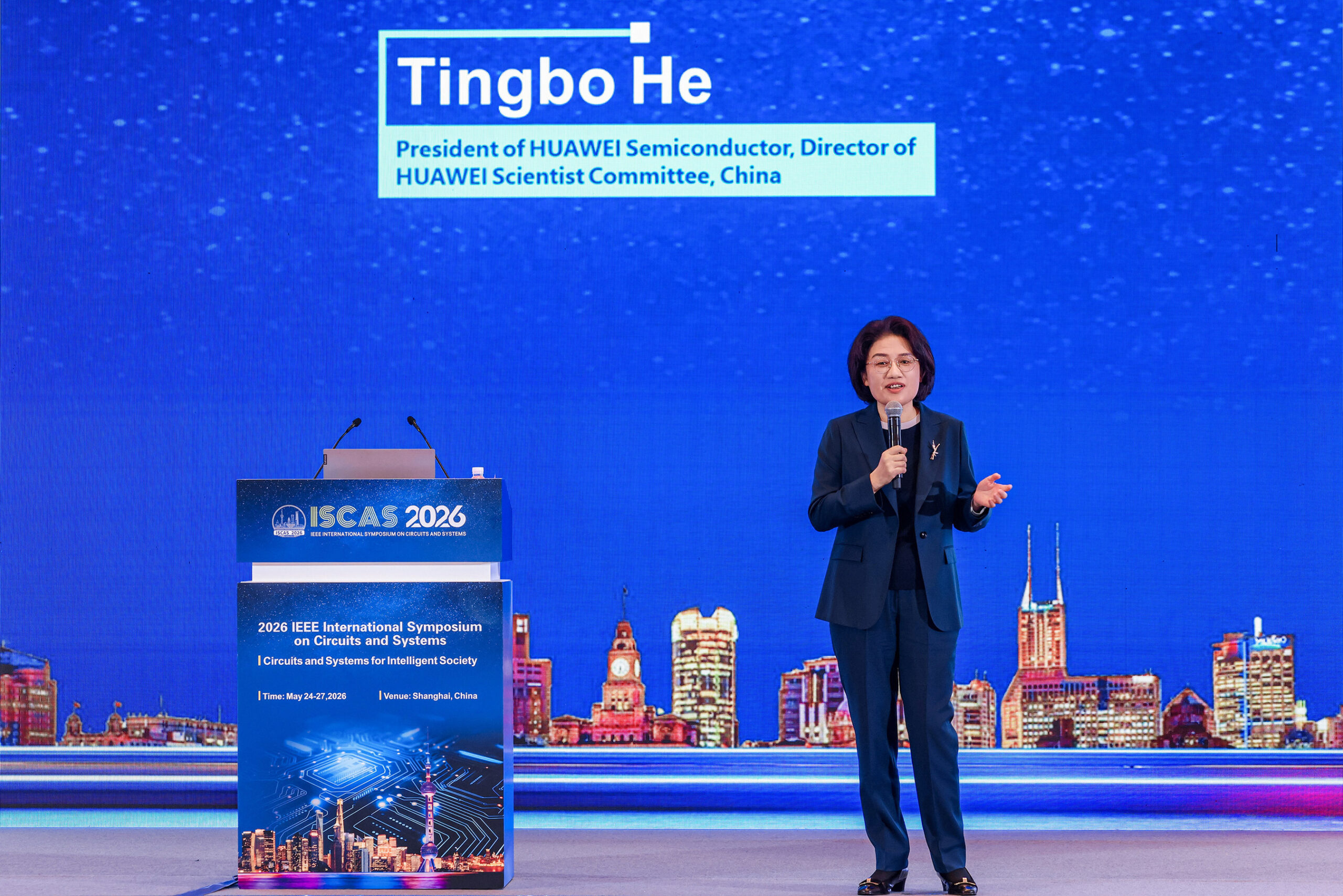
On Monday, at the 2026 IEEE International Symposium on Circuits and Systems in Shanghai, He Tingbo, President of HUAWEI’s Semiconductor Business Department, presented the Tau (τ) Scaling Law, a successor to Moore’s Law for guiding semiconductor development.

The new principle replaces traditional geometric transistor scaling with time scaling as the core measure of progress. The Tau Scaling Law reduces signal propagation delay and system execution time to improve performance, energy efficiency and transistor density.
For decades, the semiconductor industry relied on shrinking transistors to increase computing power and lower costs. However, continued scaling has become increasingly difficult, while gains in cost-per-transistor and performance have slowed.
According to He, the Tau Scaling Law offers an alternative path for semiconductor evolution with HUAWEI developing technologies such as LogicFolding and a multi-level optimization framework spanning devices, circuits, chips and systems.
The company aims to reduce transistor and interconnect resistance and parasitic capacitance to minimize physical-layer delay. At the circuit level, the LogicFolding architecture restructures layouts to shorten critical signal paths, reducing resistive and capacitive loads while improving transistor density and circuit performance.
At the chip level, HUAWEI applies coordinated software, architecture and silicon design to optimize instruction and data flow, increasing parallelism and reducing end-to-end execution time. At the system level, the company’s UnifiedBus interconnect protocol enables unified memory addressing and native memory semantics for SuperPods, reducing communication latency across large-scale computing systems.
He said HUAWEI has applied the Tau Scaling Law to smartphones and AI computing. Over the past six years, the company has designed and mass-produced 381 chips based on the new framework for multiple industries and markets.
HUAWEI also revealed that its Kirin processors scheduled for release in fall 2026 will be the first chips to use the LogicFolding architecture, which will significantly improve chip performance.
Tau Scaling Law is also referred to as “Her’s Law” named after He Tingbo by peers and her colleagues.
HUAWEI projects that by 2031 its high-end chips developed under the Tau Scaling framework could achieve transistor densities comparable to 14-angstrom (1.4 nm) process technologies.
He concluded by emphasizing that collaboration will be essential for future progress, saying no single company can solve the challenges of semiconductor evolution alone.

Also from this source