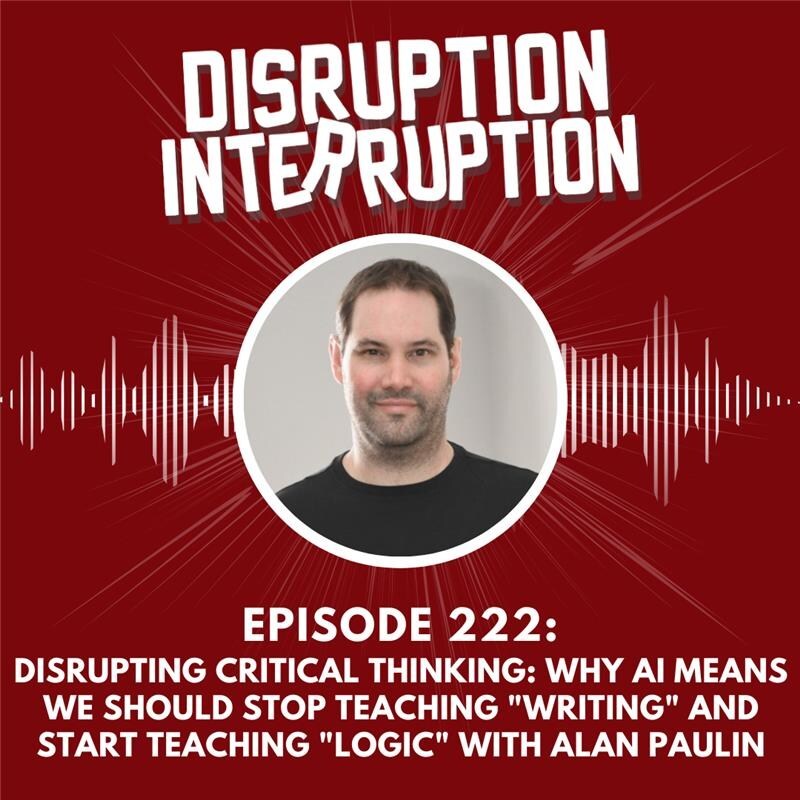
On this episode of Disruption Interruption, Alan Paulin discusses how AI is moving faster than the workflow built around it. Instead of supporting how humans think, which is through iteration, revision, and context, most tools still trap users in a rigid one-shot process that breaks the moment they leave the prompt box.
, /PRNewswire/ — We’re using 2026 AI on writing workflows built for the 1990s. Professionals still bounce between chat windows and word processors, copying, pasting, editing, and re-prompting in a process that breaks the moment they leave the prompt box. On the Disruption Interruption podcast, host Karla Jo Helms (KJ) interviews Alan Paulin, co-creator of Mavis, about why today’s AI writing workflows fail the way humans actually think. “Most of us work iteratively,” said Paulin. “We don’t write a document in one shot. We massage our thoughts; we edit as we go.” Instead, he says, current tools force a big prompt and produce one document and an issue: “Once you remove it from that chat interface, you’re kind of on your own.” Through Mavis, Paulin is working to replace that broken handoff with a more collaborative workflow that keeps context, iteration, and AI assistance in the same place.
Why Industry is Stuck
The problem, Paulin argues, is bigger than user experience. The dominant writing platforms were built for a different era. “Google Docs and Microsoft Word haven’t changed that much,” Paulin says, noting that companies at that size are simply “not in this position to innovate quickly.” As KJ puts it, trying to change them now is “like steering the Titanic.”
That inertia matters because professionals are no longer just writing inside documents. They are moving constantly between AI systems and traditional software, generating ideas in one place, refining them in another, and rebuilding context every time they cross that divide. The workflow is not simply inefficient. It interrupts thought.
For Paulin, that is the real opening in the market. The AI boom did not eliminate friction in writing, it exposed how much friction was already there. As long as legacy platforms remain slow to change, users will stay trapped between new intelligence and old infrastructure. That creates space for startups willing to rethink the process from the ground up, not by replacing human judgment, but by building tools that can preserve context, collaboration, and continuity as the work evolves.
What May Come Next
If AI can already generate competent language, then output alone becomes less valuable. The competitive advantage moves to how well someone frames a problem, structures a thought, and directs the machine toward a useful result. That is the shift Paulin believes both work and education have been slow to recognize. People with the strongest edge will not be those who simply prompt faster, but those who can think more clearly with intelligent systems in the loop.
“The future belongs to AI-native thinkers who use AI as an extension of themselves,” Paulin says. In his view, the real challenge is not teaching people to compete with machines at producing language but teaching them how to use machines without outsourcing thought.
That belief is also shaping what Mavis is building. Rather than treating AI as a one-off generator, Paulin’s company is betting on a more collaborative model where context stays intact, iteration happens naturally, and AI remains inside the writing process instead of outside it. For him, that is where the next frontier lies: not in replacing human thinking, but in building tools that sharpen it.
Links
Disrupting Critical Thinking: Why AI Means We Should Stop Teaching “Writing” and Start Teaching “Logic” with Alan Paulin
Disruption Interruption is the podcast where you will hear from today’s biggest Industry Disruptors. Learn what motivated them to bring about innovation and how they overcame opposition to adoption.
LinkedIn: http://www.linkedin.com/in/alanpaulin
Company Website: https://mavislabs.ai
About Disruption Interruption™
Disruption is happening on an unprecedented scale, impacting all manner of industries— MedTech, Finance, IT, eCommerce, shipping, logistics, and more—and COVID has moved their timelines up a full decade or more. But WHO are these disruptors and when did they say, “THAT’S IT! I’VE HAD IT!”? Time to Disrupt and Interrupt with host Karla Jo “KJ” Helms, veteran communications disruptor. KJ interviews badasses who are disrupting their industries and altering economic networks that have become antiquated with an establishment resistant to progress. She delves into uncovering secrets from industry rebels and quiet revolutionaries that uncover common traits—and not-so-common—that are changing our economic markets… and lives. Visit the world’s key pioneers that persist to success, despite arrows in their backs at www.disruption-interruption.com.
About Alan Paulin
Alan Paulin is the co-founder of Mavis, an AI-powered document writing platform built to help people and teams turn ideas into polished documents faster through past-work context and a collaborative AI assistant. He is focused on solving one of the biggest workflow problems in modern knowledge work: how to make AI useful inside the actual writing process, not just at the prompt stage.
Paulin brings more than 25 years of engineering and leadership experience across startups and high-growth technology companies. He was one of the founding engineers at Cash App, helping scale the platform from a hackweek concept to 40 million monthly active users. He also co-founded Flint and later served as VP Engineering at MobileCoin, building teams and systems in environments where speed, scale, and innovation were critical.
With Mavis, Paulin is applying that experience to the next generation of human-AI collaboration, building tools designed to help users draft, edit, and refine documents more naturally while keeping context, continuity, and control intact.
About Karla Jo Helms
Karla Jo Helms is the Chief Evangelist and Anti-PR® Strategist for JOTO PR Disruptors™. Karla Jo learned firsthand how unforgiving business can be when millions of dollars are on the line — and how the control of public opinion often determines whether one company is happily chosen, or another is brutally rejected. Being an alumnus of crisis management, Karla Jo has worked with litigation attorneys, private investigators, and the media to help restore companies of goodwill into the good graces of public opinion — Karla Jo operates on the ethic of getting it right the first time, not relying on second chances and doing what it takes to excel. Helms speaks globally on public relations, how the PR industry itself has lost its way, and how, in the right hands, corporations can harness the power of Anti-PR to drive markets and impact market perception.
References
- Bick, A., Blandin, A., & Deming, D. J. (2024). The rapid adoption of generative AI (NBER Working Paper No. 32966; rev. February 2025). National Bureau of Economic Research. Doi.org/10.3386/w32966
- Brynjolfsson, E., Li, D., & Raymond, L. R. (2023). Generative AI at work (NBER Working Paper No. 31161). National Bureau of Economic Research. Nber.org/papers/w31161
- OECD. (2026). OECD digital education outlook 2026: Exploring effective uses of generative AI in education. OECD Publishing. doi.org/10.1787/062a7394-en
Media Inquiries:
Karla Jo Helms
JOTO PR™
727-777-4629
SOURCE Disruption Interruption