Shang Dynasty oracle bones and modern weather models feature in the same study.
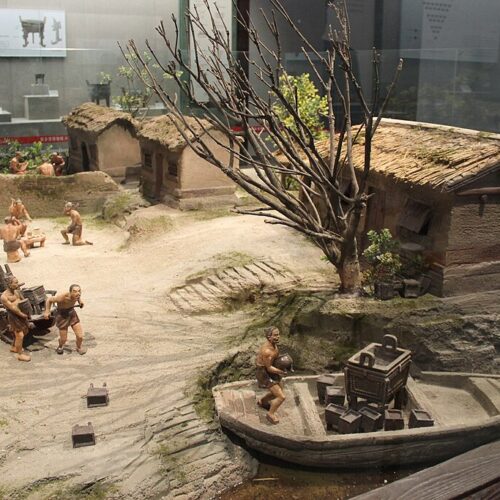
This diorama at Xinxiang City Museum, Henan Province shows what a Shang Dynasty village might have looked like. Credit: Gary Todd, CC0, via Wikimedia Commons
Warmer waters in the Pacific Ocean may have brought devastating floods to the cradle of ancient Chinese civilization, according to a recent study in which its authors link three wildly different lines of evidence to tell the story.
People in Shang Dynasty China, around 3,000 years ago, probably didn’t realize that the massive floods sweeping through their heartland were the product of typhoons battering the southern Chinese coast hundreds of kilometers away. They certainly couldn’t have seen that the sheer intensity of those typhoons was fueled by a sudden shift in temperature cycles over the Pacific Ocean thousands of kilometers to the south and east. But, with the benefit of 3,000 years of hindsight and scientific progress, Nanjing University meteorologist Ke Ding and colleagues recently managed to connect the dots. The results are like a handwritten warning from the Shang Dynasty about how to prepare for modern climate change.
Typhoons, oracle bones, and abandoned settlements
Around 3,000 years ago, two great civilizations were flourishing in central China. In the Yellow River Valley, the Shang Dynasty rose to prominence, producing the first Chinese writing and also sacrificing thousands of people in ceremonies at the capital, Yinxu. Meanwhile, on the Chengdu Plain in southwestern China, the Shanxingdui culture built a walled capital city and sculpted large bronze heads, gold foil masks, and tools of jade and ivory, which they buried in huge sacrificial pits.
Archaeological sites across central China reveal that at various points between 2,500 and 4,000 years ago, disasters rocked these thriving societies, decimating the population, forcing settlements to relocate, and causing major cultural shifts and political upheaval.
Both civilizations rebounded after these disruptions; it didn’t take long, in the archaeological scheme of things, for populations to swell and settlements to rebuild. But for a little while, life was clearly disrupted.
A few wildly different clues point to the cause—or at least, one of the causes—of this upheaval: modern weather simulations, archaeological sites hundreds of miles from the Chinese coast, coastal sediments in Japan and South Korea that record the intensity of ancient typhoons, and even Shang Dynasty divination texts. All three of these lines of evidence converged on the same dates, telling a single horrifying story.
Reconstructing ancient storm seasons
We have a pretty good idea of how the size and intensity of a storm determines what kind of footprint it leaves on coastal sediments. Researchers look for similar traces in ancient sediments and use them to reconstruct what tropical storm seasons were like in the past (the field is called paleotempestology, which is your faithful correspondent’s new favorite word).
Based on paleotempestology records not only in China, but also along the coasts of South Korea and southwestern Japan, typhoons moving west across the Pacific Ocean tended to be more intense during the storm seasons around 2,800 years ago. Typhoons that curved northward had more intense seasons around 3,800 years ago and again around 3,300 years ago.
Those bouts of more intense typhoons may be related to something that happened off the coast of Peru around 3,000 years ago, when El Niño events suddenly got more frequent, more extreme, and longer-lasting. Paleoclimate researchers know this because around this time, shellfish species that live in cool water (but can’t take the heat) all but disappear from the Peruvian archaeological record, replaced by more heat-tolerant species. Around the same time, people living along the coast gave up building huge monumental temples, and villages shrank. You’re going to want to keep those dates in mind, because…
Ding and colleagues charted radiocarbon dates from sites across China’s Central Plains and Chengdu Plain, hoping to pinpoint changes in population and potential signs of a society in crisis. They noticed that the number of sites on the Central Plain, home to the Shang Dynasty, decreased sharply around 3,800 years ago and again about 3,300 years ago; at the sites that weren’t abandoned, changes suggested smaller populations overall. On the Chengdu Plain, something similar happened around 2,800 years ago. Villages, towns, and cities shifted toward higher ground; layers of mud left behind by flooding hint at the reason.
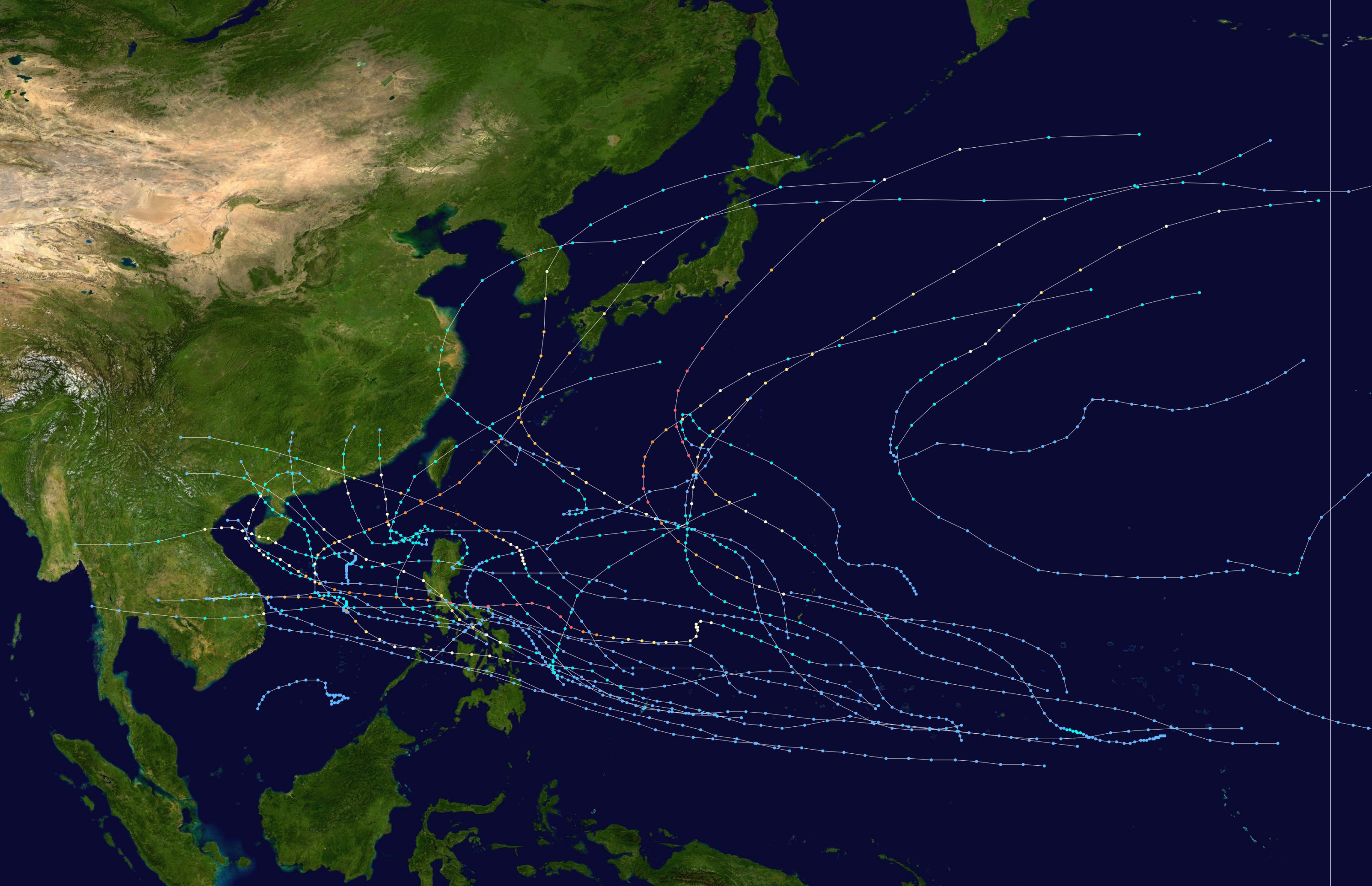
This map shows the tracks of typhoons during the 1995 storm season; note that some plow straight west, while others veer northward.
Credit: By Nilfanion – Created using Wikipedia:WikiProject Tropical cyclones/Tracks. The background image is from NASA [1]. The tracking data is from the Joint Typhoon Warning Center’s best track database, Public Domain, https://commons.wikimedia.org/w/index.php?curid=2505757
This map shows the tracks of typhoons during the 1995 storm season; note that some plow straight west, while others veer northward. Credit: By Nilfanion – Created using Wikipedia:WikiProject Tropical cyclones/Tracks. The background image is from NASA [1]. The tracking data is from the Joint Typhoon Warning Center’s best track database, Public Domain, https://commons.wikimedia.org/w/index.php?curid=2505757
How does a typhoon in the Pacific flood inland China?
Seeing how well those dates lined up with when coastal sediments suggest more intense typhoons had been churning through the Pacific, Ding and colleagues ran some computer simulations using an LLM-based program called Pango-weather. The goal was to figure out how a typhoon on the coast could bring torrential rains and flooding to communities hundreds of miles inland. The answer wasn’t that the typhoon swept across the entire country; often, the typhoons in question never even made landfall. But they didn’t have to make landfall to stir up easterly winds that carried more water vapor across hundreds of miles to the plains.
Both the Shang Dynasty and Shu civilizations set up their capitals on plains just to the east of large mountain ranges. Normally, that works out very well for farmers, because the mountains force eastbound air upward, where it cools; water vapor condenses and rain falls. But settlements on the windward side of mountain ranges are also vulnerable to extreme rainfall events—like the ones caused by typhoons messing with the region’s airflow patterns.
Ding and colleagues’ results suggest that an increase in the average intensity of typhoons (which means that the researchers boosted the storms’ starting wind speed from about 54 kilometers per hour to about 126 kilometers per hour) caused more moisture to gather over regions like the Chengdu Plain and the Central Plains. Specifically, the Chengdu Plain was more impacted by typhoons moving west, while the Central Plains caught more flooding from typhoons that followed northward tracks. The effects were on the order of an extra 51 millimeters of rain a day in the Central Plains and extra 24 millimeters a day on the Chengdu Plain.
Consulting the oracle bones
The people of the Shang Dynasty and the Shu civilization probably didn’t know that large-scale weather systems, or even larger-scale climate shifts, were to blame for their woes, but they were definitely aware that they were living through periods in which serious floods were more likely. Writings on more than 55,000 pieces of burned bone from the late Shang Dynasty (2,996–3,200 years ago) reveal that Shang royals and nobles were very worried about heavy rains and floods during the period—worried enough to ask oracles to try to predict them.
Shang Dynasty rulers took their most pressing questions to oracles, who would throw oxen shoulder blades (scapulae) or the bony undersides of turtle shells (plastrons) onto a fire, then interpret the pattern of cracks in the burned bone. Fortunately for modern historians, those oracles also inscribed both the question and the answer into the bone itself, producing some of China’s first systematic writing.
Ding and colleagues counted the references to “upcoming rain” and “upcoming heavy rain” in the texts and found that Shang nobility asked their diviners about downpours much more often during the exact time periods when sediments suggest more intense typhoons and archaeological evidence suggest major social and political upheaval. And you don’t tend to keep asking if there’s going to be a big flood unless you have good reason to think that there might be.
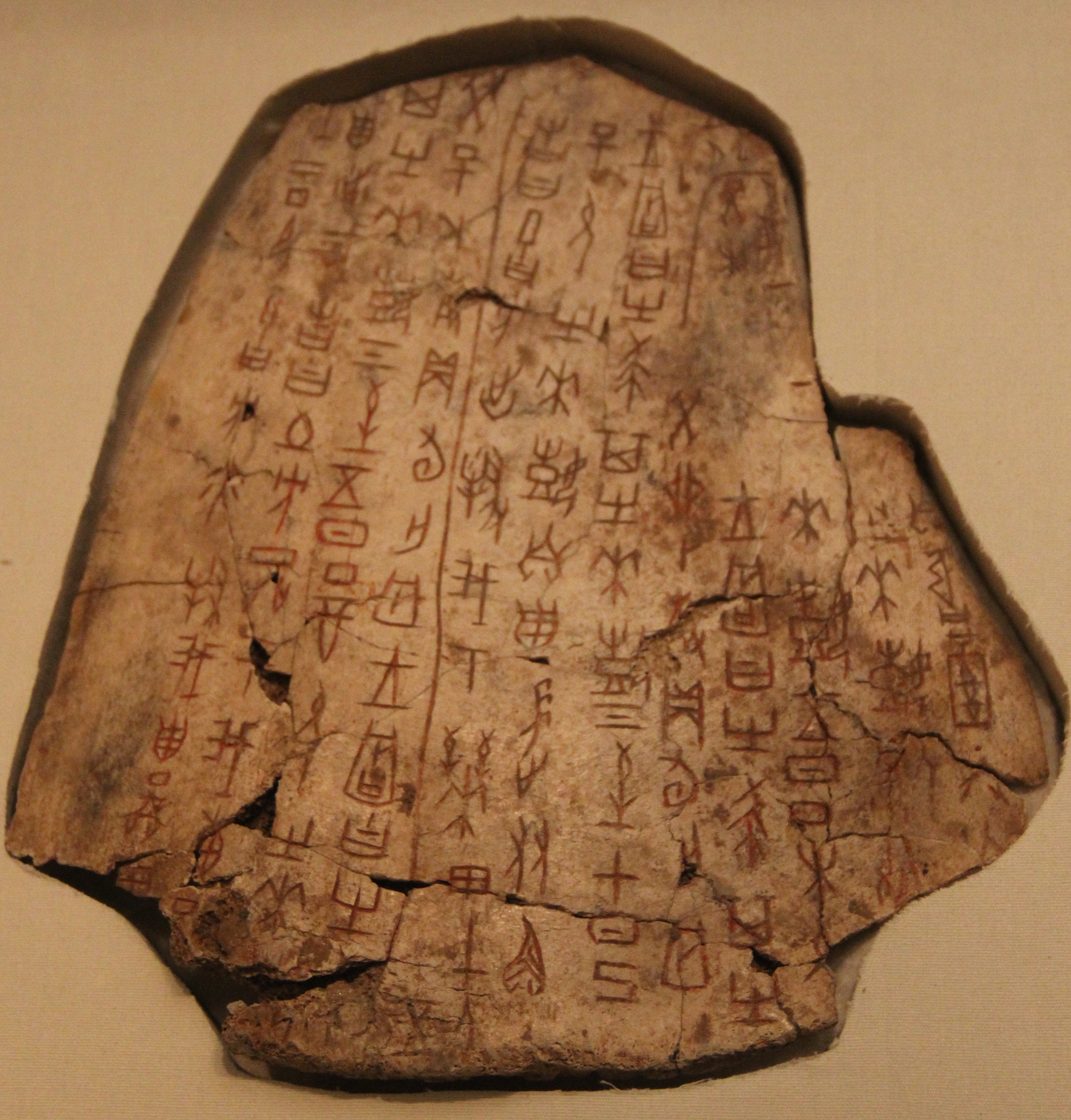
3,000 years ago, a Shang Dynasty oracle tossed this ox scapula into a fire, looking for hints about the future in the way the burned bone cracked.
Credit: By Gary Lee Todd 2011-09-01 12:34:54 https://www.flickr.com/photos/101561334@N08/9830601816/, CC0, https://commons.wikimedia.org/w/index.php?curid=96430584
3,000 years ago, a Shang Dynasty oracle tossed this ox scapula into a fire, looking for hints about the future in the way the burned bone cracked. Credit: By Gary Lee Todd 2011-09-01 12:34:54 https://www.flickr.com/photos/101561334@N08/9830601816/, CC0, https://commons.wikimedia.org/w/index.php?curid=96430584
When it rains, it pours
Of course, it’s not possible to say that these periods of unrest and struggle in ancient China happened entirely thanks to more intense typhoons, but the cycle of worsening storm seasons probably played a role. And in between floods, the lack of water may have been another major factor.
Paleoclimate records in ancient sediment reveal that even as typhoons were getting more intense, central China was baking under a drought—also thanks to the same cycle that drives El Niño today (recent studies suggest that El Niño years lead to severe droughts in central China and more intense typhoons in the Pacific). And the oracle bones reflect Shang dynasty rulers’ concerns about drought, too: references to prayers for rain and plagues of locusts closely match the periods of El Niño conditions identified in previous studies. The Shang Dynasty was getting hit with a one-two punch of climate disasters: years of drought, punctuated by heavy rains and devastating floods.
“This pattern bears similarities to the climatic challenges faced by the Maya civilization,” wrote Ding and colleagues, “where prolonged El Niño-like conditions may reduce overall rainfall while intensified cyclone activity could increase extreme rainfall, ultimately contributing to social declines.”
Why it matters today
Those 3,000-year-old oracle bones hold a warning for modern China. The character for “disaster” in the oracle bone scripts is a set of squiggly horizontal lines that immediately calls to mind floodwaters, and floods are still one of the deadliest and costliest disasters that China faces. Not only are floodwaters destructive, but they can leave behind too much salt in the soil and can also lead to outbreaks of insects and other pests (for both people and crops).
The mechanics that connect typhoon intensity to flooding in inland China work the same way they did during the Shang Dynasty. Current climate models predict that typhoons could be 14 percent more intense, on average, by the end of this century, thanks to humans and our pollution habits.
But the message from the oracle bones isn’t about despair; it’s about planning. As Ding and colleagues put it: “This study urges better preparation against the disastrous impact of intensified typhoons, especially in inland areas where facilities to mitigate extreme rainfalls and floods are relatively inadequate.”
Science Advances, 2026 DOI: 10.1126/sciadv.eaeb1598 (About DOIs).

Kiona is a freelance science journalist and resident archaeology nerd at Ars Technica.