

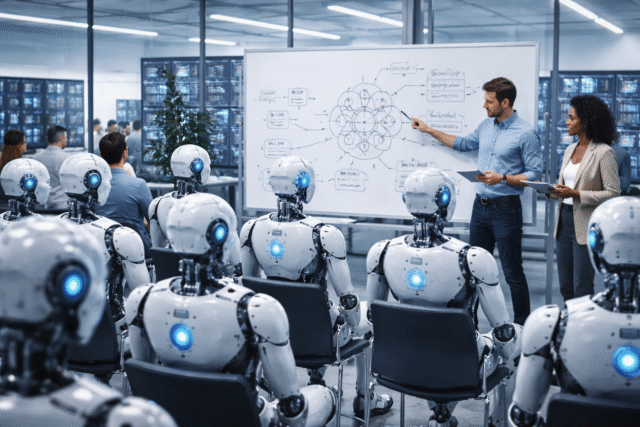
New research from Pearson suggests that artificial intelligence alone isn’t enough to raise productivity across the workforce. The study concludes that economic gains depend on whether employers invest in workforce training that helps workers use AI as part of their jobs, rather than treating the technology as a standalone solution.
The report examines why large investments in AI haven’t yet translated into broad productivity gains outside a limited set of roles. While companies continue to spend heavily on AI, the research finds few clear examples of enterprise wide improvements that directly benefit workers and generate long term returns.
Pearson’s analysis focuses on what it describes as a gap between AI adoption and workforce readiness.
According to the findings, many organizations deploy AI tools without thinking about how people are trained to use them, leaving employees unsure how the technology fits into their daily routines.
The research models scenarios in which AI is used to augment existing roles instead of replacing them. In those cases, workers receive training that evolves alongside the technology, allowing AI to support tasks such as analysis, decision making, and routine work.
Pearson estimates this approach could add between $4.8T and $6.6T to the U.S. economy by 2034, equal to roughly 15 percent of current GDP at the lower end of that range.
Without the focus on learning, the report suggests productivity gains will remain limited. Time savings reported by individual workers don’t necessarily translate into measurable economic growth, particularly when AI tools are introduced without changes to how people work or their expectations.
Workforce training
The study also points to rising tension inside workplaces. As companies promote AI adoption, many workers worry about losing their jobs to the new technology, while at the same time lacking opportunities to develop skills that would help them work with it.
Pearson frames this mismatch as both an economic and human problem, with consequences for morale, employee retention, and long term competitiveness.
To address the issue, the report offers a framework for integrating learning directly into AI deployment. Rather than introducing new tools first and training later, skill development should happen at the same time, linked to specific tasks and roles.
Pearson’s suggested framework calls on employers to define how AI is meant to support particular jobs, embed learning into everyday work, measure skill progress over time, and treat training as a core investment rather than a secondary expense.
Pearson believes that productivity gains are more likely when learning is continuous instead of delivered as a one-off.
The report also looks at the issue in a wider labor context. AI tools have reached widespread adoption quickly, but training systems haven’t kept pace.
External data cited in the research shows the majority of the global workforce will need some form of reskilling by the end of the decade, increasing pressure on employers to rethink how they approach AI adoption.
Pearson’s findings are based on a combination of economic modeling, academic and industry research, and expert interviews. The analysis attempts to quantify both the potential economic impact of AI supported work and the organizational practices required to achieve it.
The research doesn’t argue against AI investment, but rather suggests that technology spending without parallel investment in people limits potential returns. According to the report, the productivity question isn’t whether AI works, but whether company employees are prepared to work with it.
You can view the Pearson’s full report here.
What do you think about the idea that AI deployment should go hand in hand with workplace training? Let us know in the comments.
![how-cognitive-load-measurement-can-increase-trainee-performance-[q&a]](https://thetechbriefs.com/wp-content/uploads/2025/05/12580-how-cognitive-load-measurement-can-increase-trainee-performance-qa.jpg)

