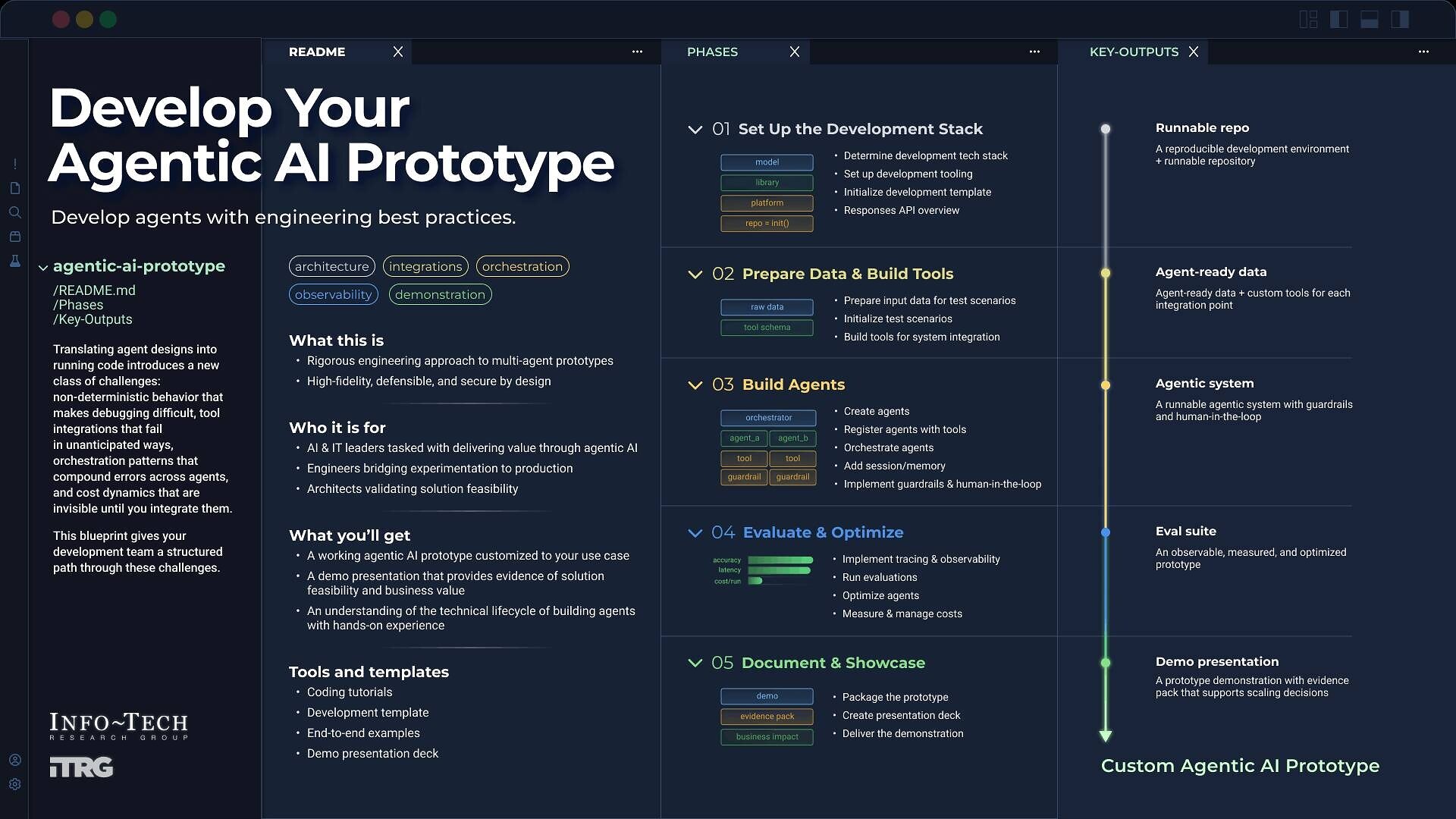
Organizations that successfully design agentic AI prototypes often stall at implementation, with many enterprises struggling to move agents from design concept to working prototype. Info-Tech has published a new blueprint, Develop Your Agentic AI Prototype, that provides a five-phase methodology to help teams engineer reproducible, observable, and defensible agentic AI prototypes with the guardrails, observability, and evaluations leaders need to make confident scaling decisions.
, /PRNewswire/ — As interest and experimentation in agentic AI continue to accelerate, many organizations are finding that the gap between a promising design and a working, evidence-generating prototype is wider than expected. New findings from Info-Tech Research Group reveal that in order to produce evidence of solution feasibility, viability, and security, agentic AI prototypes require sound architecture, observability, evaluation, cost controls, guardrails, and governance built into the engineering process from the start.
To help organizations move from concept to implementation, the global research and advisory firm has released Develop Your Agentic AI Prototype, a technical blueprint designed for teams that are ready to engineer agentic AI prototypes. The framework provides a structured pathway for transforming agentic AI concepts into measurable, investment-ready systems that leadership can confidently assess and scale.
As organizations race to capitalize on agentic AI opportunities, many teams encounter implementation barriers that prevent promising concepts from advancing beyond isolated demos. Fragile demos often fail when exposed to real-world conditions, cannot scale beyond individual developer environments, or lack the performance evidence required to justify additional investment. According to Info-Tech’s analysis, building sustainable agentic AI systems requires new engineering patterns to address hurdles such as environmental fragility, invisible costs, security gaps, and what the firm describes as “evaluation theater,” when a demo is treated as a meaningful evaluation.
“Organizations have discovered that building an impressive agentic AI demo is relatively easy, but engineering a system that is observable, reliable, secure, and defensible is a very different challenge entirely,” says Meagan Peters, senior research analyst at Info-Tech Research Group. “The organizations that succeed will be the ones that treat agentic AI development as an engineering discipline, not just an experimentation exercise.”
Info-Tech’s research highlights three critical insights organizations must embrace to successfully operationalize agentic AI initiatives:
- Autonomy isn’t a substitute for architecture – Production readiness doesn’t come from the model; it comes from the architecture underneath it.
- You can’t optimize what you can’t see – Every run requires tracing for what the agent saw, what it did, where it failed, how long it took, and what it cost.
- Evaluation turns a demo into a decision – Clear evidence on performance, cost, and reliability turns a demo into an approved investment.
Info-Tech’s Five-Phase Framework to Develop an Agentic AI Prototype
Info-Tech’s blueprint outlines a practical five-phase methodology for developing defensible agentic AI prototypes:
- Set up the development stack – Establish a reproducible development environment and runnable repository.
- Prepare data and build tools – Develop agent-ready data and custom tools for each integration point.
- Build agents – Create a runnable agentic system with guardrails and human-in-the-loop controls.
- Evaluate and optimize – Create an observable, measured, and optimized prototype.
- Document and showcase – Deliver a prototype demonstration and evidence pack that support scaling decisions.
The blueprint is designed specifically for organizations that have already completed Info-Tech’s Develop Your Agentic AI Prototype blueprint and are ready to transition into technical implementation. Supporting resources include coding tutorials, a development template, end-to-end examples, and presentation materials that help teams clearly communicate evaluation results, risk analysis, cost projections, and ROI considerations to leadership stakeholders.
In addition to implementation guidance, the research emphasizes embedding observability, cost controls, guardrails, and human oversight directly into the engineering process rather than layering them on afterward. By integrating these controls from the start, organizations can improve reliability, strengthen governance, and increase stakeholder confidence in agentic AI systems.
The blueprint also provides organizations with a structured approach to demonstrating measurable value. Through evidence packs that include evaluation results, cost projections, and validated demonstrations, leadership teams gain the transparency needed to make informed scaling and funding decisions.
For timely and exclusive commentary from AI implementation expert Meagan Peters of Info-Tech Research Group and access to the complete Develop Your Agentic AI Prototype blueprint, please contact [email protected].
About Info-Tech Research Group
Info-Tech Research Group is the “get things done” partner for over 30,000 IT, HR, and marketing leaders worldwide. The fastest growing research and advisory firm, Info-Tech enables leaders to make well-informed decisions and transform their organizations through AI, strategic foresight, step-by-step methodologies, practical tools, industry-leading advisory, and training programs. For nearly 30 years, tens of thousands of private and public organizations have trusted Info-Tech to lead their most important initiatives through periods of change and deliver outcomes that truly matter.
To learn more about Info-Tech’s HR research and advisory services, visit McLean & Company, and for data-driven software buying insights and vendor evaluations, visit the firm’s SoftwareReviews platform.
Media professionals can register for unrestricted access to research across IT, HR, and software, and hundreds of industry analysts through the firm’s Media Insiders program. To gain access, contact [email protected].
For information about Info-Tech Research Group or to access the latest research, visit infotech.com and connect via LinkedIn and X.
SOURCE Info-Tech Research Group