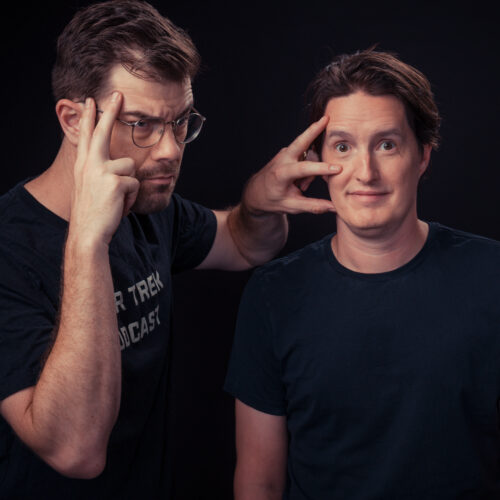
How two podcasters turned a Star Trek side project into a full-time career.
A decade is a long time for a TV series; no single iteration of Star Trek has made it that far.
But “a Star Trek podcast by two guys just a little bit embarrassed to have a Star Trek podcast” has now passed the milestone. January 25, 2026, marks a full decade since The Greatest Generation, my favorite podcast, debuted. Like a bottle of Château Picard, the show has only improved with age. (I interviewed the guys behind the show back in 2016 when they were just getting started.)
The podcast helped me rediscover, and appreciate more fully, Star Trek: The Next Generation—which is also my favorite TV show. The Greatest Generation continues to delight with its irreverent humor, its celebration of the most minor of characters, and its technical fascination with how a given episode was made.
Over the last decade, hosts Ben Harrison and Adam Pranica have both moved to Los Angeles and become full-time podcasters. They have completed an episode-by-episode recap of all of The Next Generation, Deep Space Nine, and Voyager, and they’re now nearing the end of Enterprise. When finished, they’re threatening/promising to start over again.
The podcast has spawned its own (sometimes NSFW!) lexicon (a “friend of DeSoto” means a listener to and fan of The Greatest Generation), its own recurring and hilarious segments (“Drunk Shimoda,” “Bad Bit Moment,” and “Polo? Polo? Or Pollo?”), and most importantly, its own delightful fandom. It’s the coolest and dorkiest secret club that I will ever be a part of.
In 2016, the podcast was folded into the Maximum Fun organization. Harrison and Pranica formed their own company, Uxbridge-Shimoda LLC, that takes its name from two obscure TNG-era characters.
Like the original Star Trek, the podcast even spawned its own 2017 spinoff—now called The Greatest Trek—entirely devoted to the newer series in the Star Trek universe.
Harrison and Pranica also produce two irregularly released, members-only podcasts called Santa Monica Mountains (about the 1980s and 1990s TV show Baywatch) and Factory Seconds (where they eat at various Cheesecake Factory restaurants). Last year, they also started—in conjunction with YouTube cooking star Adam Ragusea—yet another podcast, called Wholesome, which is only available to Patreon subscribers.
In a world replete with chaos and awfulness, I’m just here for the hang.
(This interview, which was conducted earlier this month, has been lightly edited for clarity and flow.)
Ars: When I first spoke to you guys back in 2016, Adam was living in Seattle. Ben, I believe you were living in New York. You guys were still working in film production. As best as I could tell, this was just a fun little side project. Who knew how long it would run?
Ben: I think that us talking to you has a lot to do with it taking over our lives.
Ars: Sorry, not sorry? I don’t know! [laughs]
Adam: Your Ars article was one of the reasons we catapulted into the sort of audience we got afterward. It’s an audience that has meant we’ve been able to do the show professionally for 10 years.
Ben: Yeah. And when we meet people—all the time—people will say: “Oh, I’ve been listening to you guys since the beginning. Like, I was on at episode five because of that Ars Technica article.”
Ars: Do you feel like you are over it? It’s been a decade now. Is Greatest Gen as we know it going to continue?
Adam: I think the thing that’s changed is that in the beginning, it felt like a fun hobby. But when you professionalize a thing and you hire employees and you are depended on for the thing that you make in a way that you’ve never been before, it’s serious business.
It’s serious funny business, you know?
This is the best job I’ve ever had, but it’s also the most seriously I’ve ever taken a job because it means so much to our well-being, but also the folks who appreciate what we do.
Ben: Yeah, one thing that Adam has said many times is we’re going to die in these chairs.
And I think also, as we come toward the end of Enterprise and have sort of run out of the well of Old Trek, as it were, I have been thinking about [what] if I hadn’t had this show? I would still be about ready to start my next TNG rewatch.
Loving Star Trek is a lot about watching it over again, you know? In the same way that I’ll put on an old rerun of The Simpsons or Seinfeld. And I love rewatching those shows. I love rewatching Star Trek.
I think Adam and I have grown as both a comedy duo but also as observers of Star Trek and what it means on an ongoing basis. So I feel like it would be unfair for us not to go back and start painting the bridge from the beginning.
Adam: I think one of the things that we’ve learned from doing the show, especially live in front of people, is that we are told by the people who enjoy this show that it’s about Star Trek, sure, but that’s not the thing that people love the most about the show.
And I think that’s what makes a return to the beginning of it make so much sense in the way Ben’s describing. It’s about the hang and your life as it relates to a Star Trek rerun that you’re watching in that moment.
Ars: I have watched zero minutes of Baywatch in my life. But I have listened to every single episode of the Santa Monica Mountains. I enjoy hearing you guys talk about it.
I think you’ve hit on a format: “Let’s talk about a thing in the way that we like to talk about it and make jokes in the way that we like to make jokes about it.” Which for me really resonates more than the format of a podcast that’s like: “Let’s get comedians to talk about a thing.”
Adam: Or let’s get celebrities in a room to talk about anything and have that be good enough.
Ben: The format that our shows tend to follow is something that I think just kind of was an emergent property of the way Adam and I talked to each other, much more so than it was us attempting to create a show that was our version of anything else.
I don’t really listen to other recap podcasts. It’s kind of a funny thing, but we weren’t really inspired by any recap podcasts in particular. I guess the Flop House a little bit for me, but what they do is so different and such its own thing.
It’s hard to feel like we are connected to the universe of recap podcasts. Like when we go to add our show to a podcast service like iTunes or Apple Podcasts, you have to pick the category that you’re going to be in, and we’ve always picked comedy.
Properly, I guess we probably would be in the television recap podcast section. We just never really thought of ourselves as being that. We were just doing what we wanted to do.
You know, we’re just making a show that makes us laugh. Making each other laugh has always been the primary goal of the show. So it’s very funny to me that we’re in a category that we’ve never really aspired to be in or compared ourselves to in any way.
Ars: Any favorite moments, perhaps at live shows, that have happened to you over the last 10 years?
Ben: Getting to do live shows at all has been a total shock to me. When we talked to you for that first article, we barely knew what we were doing as entertainers. And I’ve taken improv classes and stuff but never really had any personal aspirations to be someone who gets up on a stage and does something. And I found that I fucking love it!
I really love doing the show in front of an audience! And we just have had so many amazing adventures getting to go all over the country doing that.
And all over the world—we’ve done the show in Canada and London now. That was a total surprise to me.
Like, if you grabbed me on the street 15 years ago and said, “Hey, you’re going to have a show that you get to travel around and do in front of audiences of 300 people someday!” I would have said, “Get the hell out of here! That’s not possible. That’s not something I am working toward in any way.”
Adam: There’s an unexpected quality to the type of—I mean, barf, right? I’m going to say the word “celebrity.” But David Letterman said that when you achieve a certain amount of notoriety, the world becomes a neighborhood to you.
A week ago, I was at a bar with friends, and a stranger came up and told me that they really like our show and they thanked me for making it. And that is something that happens in my life in a way that I never could have anticipated at all.
It’s those little moments that you have with people. Those perfect interactions where it’s just like: “I like what you do and thanks for doing it.”
That makes my life seem meaningful in a way that any previous job did not create the conditions for, you know? You do the work and you think it matters and it’s important, and largely it is in its own way, in its own ecosystem.
But to have a broad interest from folks in what you do and that it matters to them and what they do in their lives? That’s the very best part of this entire thing: knowing that the times that I can make Ben laugh are also the times that I can make 500 people laugh in a room or 25,000 people laugh on a Monday when the episode drops, you know?
That’s really powerful stuff! And it keeps me on my best behavior when I’m out in public in case an FOD is out there watching what I’m doing.
Ben: Oh, yeah. You don’t want to see all the videos of Adam on Worldstar.
Adam: Exactly. Yeah. So lock it up!
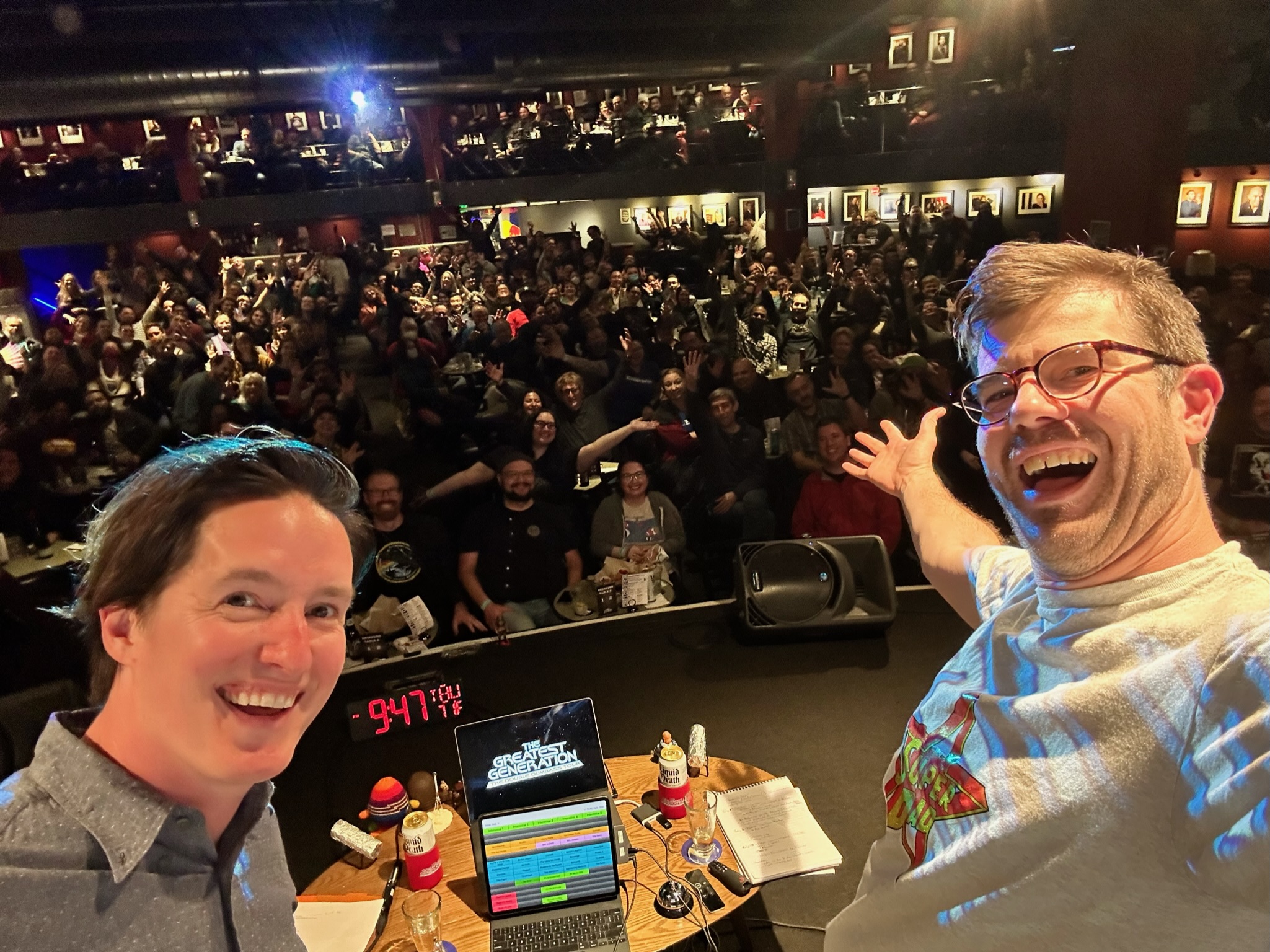
Adam and Ben at a live show.
Adam and Ben at a live show.
Ars: You try really hard to make the show sound great, which it does. It is well-engineered. It is well mixed. You guys put a lot of care into the production of the show.
But also, to my knowledge, you have never missed a show’s publish date. I’m curious about how you balance all of that with whatever else is going on in your lives. Ben, you have two young kids. I know Adam has martinis to drink and golf to play.
Ben: I think the best thing that has happened to us as a duo over the years has been all of the people who have been here to help us along the way.
You know, for a while, we were working with a producer named Rob Schulte, who was really great. And we’re now very fortunate to have a full-time producer named Wynde Priddy, who is so good at anticipating things that are coming up and keeping our minds on what we need to be prepping for the future. And also taking all of the stuff off of our plate that involves the day-in, day-out of editing and producing the shows.
So when it’s all running as it should be, which is most of the time—Adam and I get to focus on prepping, sitting down and recording, and then listening back to basically finished episodes. At that point, we’re just pitching jokes. Like: “Hey, we could add a little audio here to illustrate this point or whatever.” But 90 percent of the time we listen to an episode that’s pretty much ready to go and are just signing off on it for Wynde.
I think that the logistics of making this are complex in some ways. But at its core, it’s just me and Adam having to watch a TV show and then talk to each other about it. And that period of the day, that period of the week where I’m talking to my buddy about a thing we both really love is still the best part of my week.
Adam: We’ve been doing this for 10 years. If you need to take some time off, we know about it usually a month before, and we prepare for it. We know that we record two or three or four episodes a week, every week.
We know that if one of us gets sick, we will have to record more than that in a given week. And I think part of it is if you know that’s what your life is, it’s not stressful or disappointing when that’s your responsibility. That’s just what it takes.
We were both in alignment right away initially that you cannot miss a week doing this because people depend on it for the rhythm of their own weeks. But also, be a fucking professional! Are you telling me you don’t have an afternoon in a given week to do the thing that you’re doing professionally? Get out of here. Of course you do! Find a way.
And this is why, when people over the years have told us, “I really want to do a podcast,” the first advice is: “The same time, the same day, every week. Forever.” And that’s the only advice I give because if you can do that for a year and you ask me what else you need to do, then we can have that conversation.
But if you’re not willing to be a pro like that, good luck. I doubt your ability to get traction with an audience, because I think so much depends on that.
Ben: The podcasts that I listen to throughout the week are something I really look forward to—those shows being there at that time when I do the thing that I do when I listen to them. And so we’ve been very lucky to burrow under the skin of a lot of people—
Adam: I wonder if that’s how we know, Ben? Like, we’re not just the president of Hair Club, we’re also the clients? I think we know what’s meaningful to a podcast listener because we are them ourselves. In a way, I feel like nouveau podcasting right now is often made up of hosts who are doing it because it’s lucrative in their niche, you know?
Ben: Wait, this can be lucrative? Shit, what have we been doing?
Ars: I’m at a place in my life right now—and maybe you guys are, too—where I find it very hard to emotionally engage with the news. I find myself turning off the news on the radio, on my phone, in ways that I didn’t three years ago, five years ago. I used to be hyper-on: all the news, all the things, all the time. And I just can’t now. I just want to hear some guys talk about martinis.
Ben, you mentioned earlier that this is a show about the hang, and it’s sort of loosely anchored around the thing that you love, Star Trek.
Do you have that same feeling when it’s chatting with Adam Pranica about Baywatch? Does the subject for you, both of you, matter at all? Or does Star Trek have a particular emotional resonance in a way that, you know, lawns don’t?
Ben: I think that the Trek of it all is still really important to the show. And I think that we’re in an era where the news is devastating and exhausting in equal measure, and, you know, Trek has a lot of politics in it.
Adam and I share a lot of politics, but we also, I think, are pretty conscious of this being a place where the horrors of the world aren’t the center of attention.
So we’ve been pretty intentional about trying to make a thing that is a refuge and not a giant bummer.
And I think in its own way, that is an act of defiance. Still being able to have the hang despite all of the horrific shit going on is a sort of powerful statement—no, we’re not going to be ground into bummer pulp.
Adam: Yeah, I agree. I mean, I’m not interested in introducing that into our programs at all. I think a person’s politics is largely their behavior, and I don’t want to compare the things that I’m watching to the things that are happening in the real world generally.
But I think I might take a different side than Ben, about how Star Trek-located the project needs to be for it to be—I don’t know—fun or enriching.
I think those other projects, whether they’re about Baywatch or food or whatever—I’m interested in interesting conversations that are challenging or comedically interesting to me. It largely doesn’t matter what the subject is at its core. I want to be the sort of person that could make anything funny in conversation and through our various other types of shows, that’s become the truth, I hope.
Ben: That’s very fair. I still sort of think it’s the on-ramp for a lot of people. Like, oh, yeah, I like Star Trek. I’ll give that a try. And then it becomes about more than that.
Ultimately, I couldn’t make a show with Adam Pranica and Adam Ragusea if I wasn’t delighted by their perspective on things on an ongoing basis. The thing that’s amazing about this is we’ve made 600-something episodes of The Greatest Generation and 300-something episodes of Greatest Trek and dozens and dozens of episodes of Wholesome, and Adam says stuff every single time we sit down that surprises and delights me. That’s a complete magic trick.
Adam: You can’t do this for 10 years if it’s a bummer-hate show with a bunch of politics in it. That would have been exhausting nine years ago, you know? I don’t listen to any news or politics podcasts. Why would you? Look for the light where you can find it.
Ars: Going back to our original interview, you guys didn’t have very much in the way of established bits and jokes in the way that you do now.
I’m looking here at the Wikia and there’s a long list of bits and phrases: 50-year-old Ensign. Anybody Canyon. Bangers. Ball-kicking machine. Big Rod. McLaughlin Group. Miriam. Mount Armis. Natural Yeager.
Do you feel like any bits are played out? As I read through this, I’m like, “Oh yeah, I totally forgot about ‘Fuck Bokai.’ That’s pretty funny!”
Ben: Oh man, Fuck Bokai. That may have been the high-water mark! I think that one of the cool things about some of these is that they sort of ebb and flow depending on what we’re covering, you know?
There were things that were kind of jokes that stayed within the confines of Deep Space Nine or Voyager that sometimes you get an idea and you can pull one out of the cold storage.
But often the group of active working runners is very influenced by what we are actively covering. I think it’ll be very interesting to see how that long list of old inside jokes interacts with the show when we start going back through the second time.
Because I’m kind of tempted to not reference any of that stuff. I don’t know. I will have to see what happens when we start doing it.
Adam: I feel the same way, Ben. I think we don’t do a bit just because it’s “time to do the bit.” I have felt for a long time that it’s not funny if you’re trying to be funny. If we choose to turn it around and go back from the beginning—these are going to be new experiences for the time that we record them.
And they’re going to feel brand new. I wouldn’t expect a retread of much of anything. Because that doesn’t sound funny to me.
Ben: Well, also 10 years older. Our lives are different. Our world is different.
We will see new things in the show. And that’s one of the things that’s so cool about Star Trek: I feel like I experience it in new ways each time I watch it. So I think it’s kind of inevitable that it will get something that is really different and novel. And maybe some of those old runners will find their way back because they happen to be the funny thing at that moment.
But generally speaking, I’m really excited for crumpling up the paper and throwing it away and writing something fresh, you know?
Adam: Cyrus, you mentioned the Wiki, and I just want to say, one of the best things that’s happened to us over the 10 years of making the show has been the community that formed around it to do things, like making the wiki, making the Discord, that have formed groups where they watch movies together and date each other and marry each other and whatever.
This is a thing that we didn’t intend—imagine doing a thing so important that a large audience would enjoy it—but this large audience has their own lives, and they’re enjoying this thing that we do completely separate from us in their own way.
In a way, that’s great. Neither Ben nor I have the time or the inclination to make a wiki about our show, for example. And yet the folks that put in the effort here to make the experience of listening to the show better for everyone—that’s selfless and good and appreciated.
Ars: Given that there’s such a large body of work that you guys have produced, do you ever get people asking: “You guys have done a thousand episodes. Where do I start?”
I’ll give my answer first. I always tell people who are Star Trek fans but who have maybe not listened to Greatest Gen, “Choose a Star Trek episode that you love or that is memorable to you in some way and listen to the podcast episode about that episode.”
Adam: That’s my answer, too.
Ben: I like that, too. I also get the question “Oh, you know a lot about Star Trek. I want to get my kid into it. Where should we start?” And I don’t really think that there’s a right answer to that kind of question. Like, going back to the beginning doesn’t necessarily work for me or doesn’t necessarily work as an answer for everybody.
So I like the suggestion to jump in somewhere where you feel like you’ve got some fluency, but I also think it’s totally cool to jump in midstream on the show now or, you know, start at the beginning of one of the series that you really like or jump around. We hear from people that do it all different kinds of ways.
We’ve heard from people who got into the Greatest Generation because of Greatest Trek. We’ve heard from people who started listening to the Greatest Generation and were like: “Well, there’s a lot of references to old stuff in here. So I better go back and listen from the beginning.”
And then they binge the entire thing in three months. And I’m concerned that there may be some kind of exposure toxicity!
Adam: It’s an interesting quality to consider because a lot of the podcasts I listen to are about sports, and the sports that just happened over the weekend. No one listens to that show a month after it comes out.
But 10 years of our conversations are still being listened to in a way that I feel [isn’t the case] if you’re podcasting about the football game.
Ben: As many things as we’ve done in the past of the show, they stay in the present for a lot of people—I think more than half of our downloads in a given week are old episodes.
So that is a place where people hang out, and I think a lot of people that have jobs where they’re working with their hands but they don’t need to be processing language—[they] love podcasts. So we hear from a lot of graphic designers and truckers who like the show.
And that huge back catalog is such a boon to them because by the time you’re on your second listen through, you’re not going to remember exactly how the bit went from episode 324. So the comedy works again for that person.
Ars: I presume you guys have received screeners for Starfleet Academy. How are you feeling about Starfleet Academy as a show? And how are you guys feeling about doing it for your own show?
Ben: I’ve watched two episodes now. And I remain pretty optimistic about Starfleet Academy as a show. I think that there is some melancholy to it being the only one that’s actively being made now of any of the shows. I think they’ve wrapped on Strange New Worlds, even though they haven’t released season four. And none of the others are, like, in production at this point.
Adam: I’m also two episodes in—two very long episodes. I think that one of the qualities to Starfleet Academy that’s been surprising is the hour-long nature of it.
I think many years ago I coined the phrase “Star Trek is a place.” And what that means definitionally is that it’s not a ship or a particular captain or a planet or a federation. It’s a place to tell stories.
That’s just my way of saying that Starfleet Academy at this point, two episodes in, feels like the expression of that idea. Like, Starfleet Academy exists in a place that is Star Trek.
So I don’t hate it because they put out a cheesy poster. I don’t hate it at all! I am enjoying what I’ve seen so far. It’s interesting and new. I think the feeling that I have about it is something that Ben touched on a little bit there, which was like, are we getting near the end of it? Are we going to go back into the desert of ten years without Star Trek?
I hope not because I think my preference is going to always be that I would rather have Star Trek even if it’s difficult or disliked by folks or whatever, than to go without it at all because it provokes thought. I mean, even when it’s not your Star Trek, I think it’s still fun to talk about.
Ars: One of your greatest wishes—maybe the greatest wish of your lives—is to be blown out of an airlock in a new episode of Star Trek. How close are we to seeing that on screen?
Adam: It’s happened in comic books.
Ars: Have you actually pitched this to somebody who could make it happen?
Ben: There are people inside the walled garden that are aware that a lot of people are invested in this idea. And yeah, it’s happened in comics, it’s happened in fan productions several times now.
We leap at every opportunity we have to get blown out of an airlock. If and when the call comes from inside the Star Trek house, it will be the thrill of a lifetime. That remains the overarching goal of the show, I would say.
We’ve gone so far as to say that if the offer is made, we will fly ourselves to Toronto. If [Paramount is] obligated by some kind of agreement with the union to pay us, we will donate that money to a charity.
This is not about fame or fortune for us. It is about getting blown out of an airlock, which…
Adam: It’s about finally experiencing the sweet, sweet peace of death.