

Europe is moving faster than other regions to shut down older mobile networks, and new research from Omdia explores how regulators are handling the phase-out of 2G and 3G services. Millions of users and devices still rely on legacy networks, which is raising concerns about access, continuity, and consumer protection.
Omdia’s research looks at regulations and policies shaping how mobile network operators retire older technologies while allocating resources toward newer networks. It finds that Europe is currently leading global decommissioning activity, with most efforts focused on shutting down 3G while keeping 2G active for specific uses.
SEE ALSO: Global smartphone market grows 4% in Q4 2025 as Apple takes top spot
That might seem strange but it reflects the continued role of 2G in machine to machine and IoT deployments. In several European markets, operators have already turned off 3G but retained limited 2G coverage to support both legacy devices and long life industrial systems.
The pace and order of the shutdowns varies widely by region. In North America, operators have already completed the switch-off of 3G networks, clearing the way for spectrum reuse and network simplification.
In Asia-Pacific, the focus has been different. Japan is the first country in the region to fully decommission 2G.
3G is expected to be retired before 2G in many African countries, largely because a large share of users still depend on 2G for basic voice calls and SMS services.
Across regions, switch-offs are often down to operators rather than governments. Although in some cases regulators play a direct role by approving, and supervising the process.
Sarah McBride, Principal Analyst for regulation at Omdia, said the motivation is largely economic and technical. “With the growing adoption of 4G and 5G, mobile network operators are switching off their 2G, 3G, or both networks to free up resources, reassign spectrum, reduce complexity and save costs, as the cost of operating all four networks simultaneously is extremely high.”
The research points to consumer protection as a growing regulatory priority. As shutdowns accelerate, vulnerable users are increasingly at risk of losing service if they rely on older devices or coverage in remote areas.
“As the phase-out of 2G and 3G networks accelerates, consumer protection has emerged as a major concern for regulators,” McBride said, adding that groups like elderly users, rural populations, and those running legacy or IoT equipment face the highest risk of disruption.
Regulators are responding by requiring clearer communication from operators, including detailed timelines, migration plans, and information about alternative services. In some cases, operators are also expected to provide technical support to ease the transition.
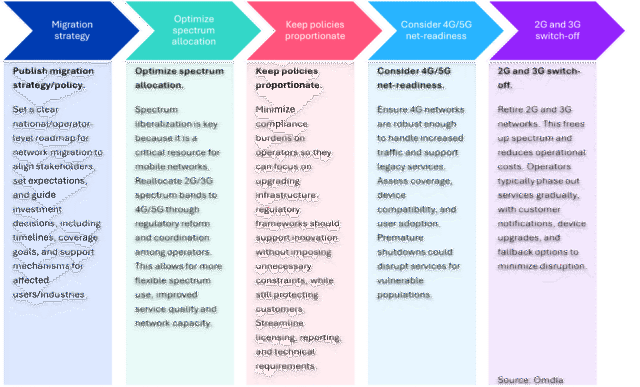
The report argues that closer coordination between regulators and mobile network operators is needed to manage shutdowns without cutting users off unexpectedly.
“Proactively implementing consumer protection measures is essential to ensuring inclusive and disruption-free legacy network shutdowns,” McBride concluded.
What do you think about the pace of 2G and 3G shutdowns and how they’re being handled? Let us know in the comments.
Image Credit: DepositPhotos