Study: Moai were created by small, decentralized working groups, not managed by one central “chieftain.”
Credit: ArcGIS
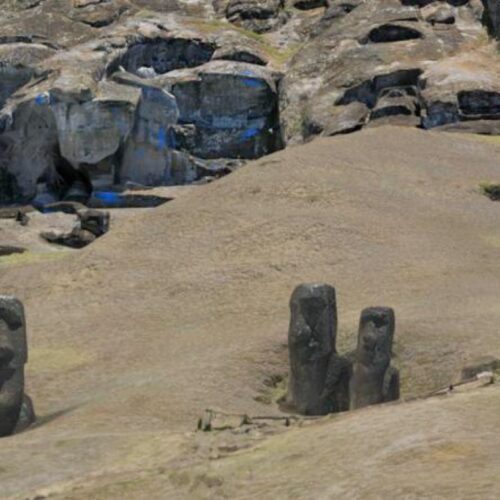
Easter Island is famous for its giant monumental statues, called moai, built some 800 years ago. The volcanic rock used for the moai came from a quarry site called Rano Raraku. Archaeologists have created a high-resolution interactive 3D model of the quarry site to learn more about the processes used to create the moai. (You can explore the full interactive model here.) According to a paper published in the journal PLoS ONE, the model shows that there were numerous independent groups, probably family clans, that created the moai, rather than a centralized management system.
“You can see things that you couldn’t actually see on the ground. You can see tops and sides and all kinds of areas that just would never be able to walk to,” said co-author Carl Lipo of Binghamton University. “We can say, ‘Here, go look at it.’ If you want to see the different kinds of carving, fly around and see stuff there. We’re documenting something that really has needed to be documented, but in a way that’s really comprehensive and shareable.”
Lipo is one of the foremost experts on the Easter Island moai. In October, we reported on Lipo’s experimental confirmation—based on 3D modeling of the physics and new field tests to re-create that motion—that Easter Island’s people transported the statues in a vertical position, with workers using ropes to essentially “walk” the moai onto their platforms. To explain the presence of so many moai, the assumption has been that the island was once home to tens of thousands of people.
Lipo’s latest field trials showed that the “walking” method can be accomplished with far fewer workers: 18 people, four on each lateral rope and 10 on a rear rope, to achieve the side-to-side walking motion. They were efficient enough in coordinating their efforts to move the statue forward 100 meters in just 40 minutes. That’s because the method operates on basic pendulum dynamics, which minimizes friction between the base and the ground. It’s also a technique that exploits the gradual build-up of amplitude, suggesting a sophisticated understanding of resonance principles.
So the actual statues could have been moved several kilometers over weeks with only modest-sized crews of 20 to 50 people, i.e., roughly the size of an extended family or “small lineage group” on Easter Island. Once the crew gets the statue rocking side to side—which can require 15 to 60 people, depending on the size and weight of the moai—the resulting oscillation needs only minimal energy input from a smaller team of rope handlers to maintain that motion. They mostly provide guidance.
The evidence of the quarry
For this latest paper, Lipo’s team conducted a series of low-elevation drone flights over the Rano Raraku quarry between June 2023 and January 2024, taking some 20,000 high-resolution photographs at 30-meter increments to capture subtle archaeological features, including hundreds of moai in various stages of completion. Those images were then stitched together to create their 3D model. “As an archeologist, the quarry is like the archeological Disneyland,” said Lipo. “It has everything you can possibly imagine about moai construction because that’s where they did most of the construction. It’s always been this treasure of information and cultural heritage, but it’s remarkably underdocumented.”
Credit: ArcGIS
The team’s initial analysis revealed 341 trenches with outlined blocks for carving, 133 voids where statues had been removed, and five bollards that the authors believe were used as anchor points to lower completed moai down slopes, as well as another bollard system serving large bedrock pits to make it easier to move moai down steep terrain. Most carvings started with cutting trenches into the bedrock to create rectangular blocks—a kind of moai “pre-form,” per the authors.
Most moai were carved from the top down in a supine position. The model also enabled Lipo et al. to identify three distinct quarrying procedures. The most common method was to define facial details before carving the outlines of the head and body of a moai. The second most common was to outline blocks completely before carving details. There were also a handful of cases where carvers worked sideways into a near-vertical cliff face.
Given that the carving techniques differed from site to site, the authors concluded that those sites represented separate workshops associated with specific family clans. Lipo’s confirmation that moai could be transported with far fewer people than previously believed also supports this interpretation. “It really connects all the dots between the number of people it takes to move the statues, the number of places, the scale at which the quarrying is happening and then the scale of the communities,” said Lipo.
Lipo’s interpretation has met with mild skepticism from other archaeologists. Dale Simpson of the University of Illinois, Urbana-Champaign, told New Scientist that while he agreed that Easter Island natives did not have a single chief, there was likely considerable collaboration between tribes or clans, rather than being highly decentralized and separate. “I just wonder if they’re drinking a little too much Kool-Aid and not really thinking about the limitation factors on a small place like Rapa Nui, where stone is king, and if you’re not interacting and sharing that stone, you can’t carve moai just inside one clan,” said Simpson.
PLoS ONE, 2025. DOI: 10.1371/journal.pone.0336251 (About DOIs).

Jennifer is a senior writer at Ars Technica with a particular focus on where science meets culture, covering everything from physics and related interdisciplinary topics to her favorite films and TV series. Jennifer lives in Baltimore with her spouse, physicist Sean M. Carroll, and their two cats, Ariel and Caliban.