Tool to Help Staffing and Recruiting Professionals Strengthen
Workforce Solutions Offerings
, /PRNewswire/ — A new tool from the American Staffing Association will allow hiring professionals to examine the impact of artificial intelligence across occupations and workplace tasks.
Drawing on data from Anthropic and the U.S. Department of Labor’s O*NET, the Index examines the share of each task in an occupation automated and augmented by AI. Occupation-level measures are weighted by the importance of each task with the overall job.
As a result, the ASA AI Impact Index provides a snapshot of AI’s impact on tasks, occupations, and broader segments of the labor market. The AI Impact Index will be released periodically based on the releases of the Anthropic and O*NET data.
“In a sea of AI predictions, the ASA Impact Index allows hiring professionals a timely forecast of changes in labor demand based on what AI is taking off the plate of human workers,” said Noah Yosif, chief economist at the American Staffing Association. “Staffing and recruiting professionals can use the ASA Impact Index to anticipate client needs and position themselves as true workforce solutions partners.”
Initial results highlight AI’s uneven impact across industries and jobs.
Major Occupation Groups
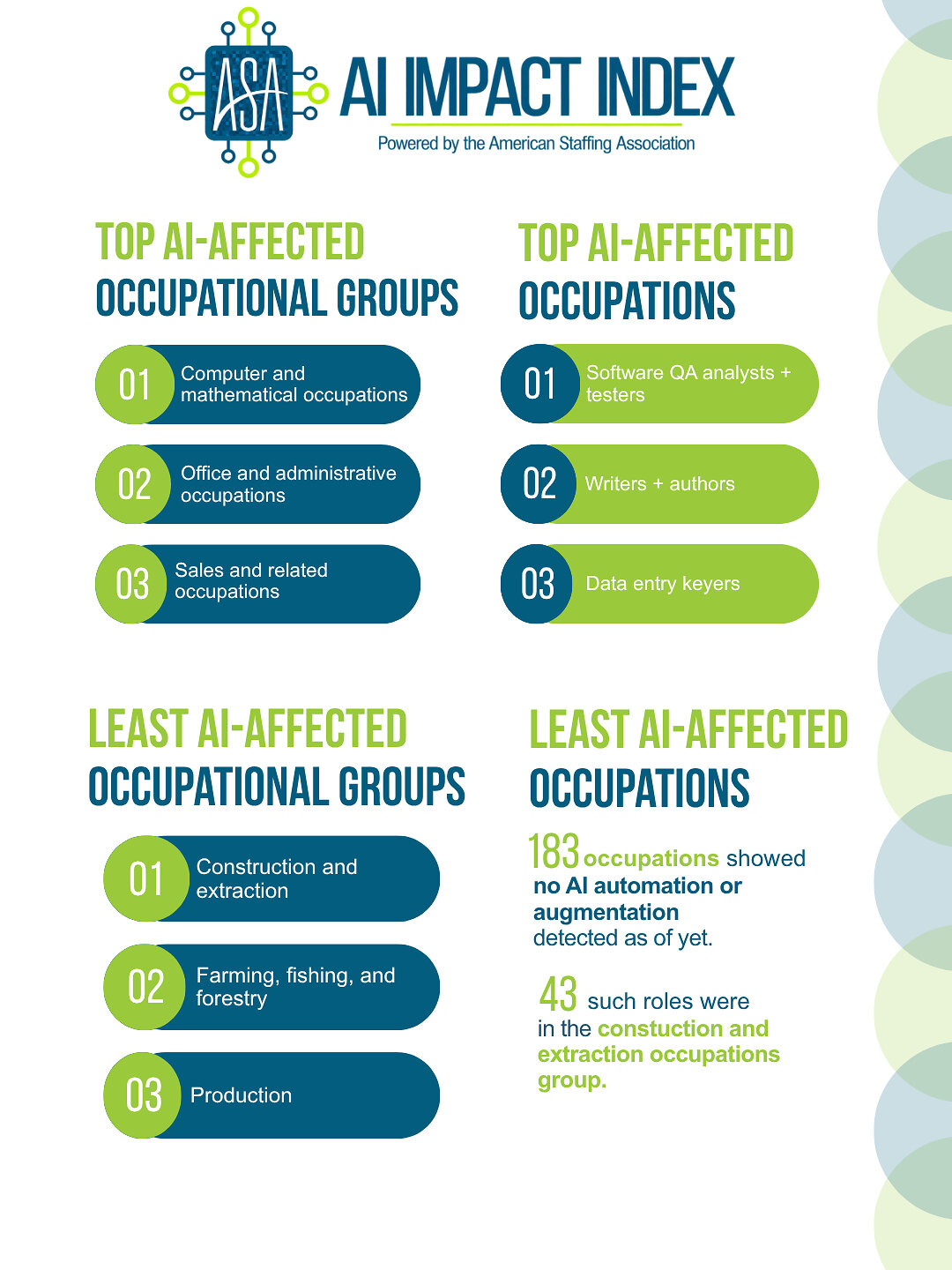
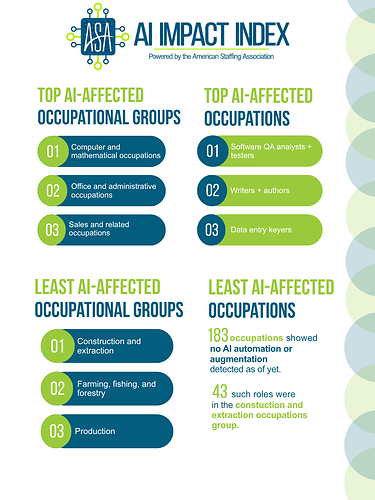
Computer and mathematical occupations show the greatest impact from AI automation and augmentation, followed by office and administrative support occupations and sales and related occupations. Construction and extraction occupations, farming, fishing, and forestry occupations, and production occupations show the least effects from AI.
Occupations
Software quality assurance analysts and testers, writers and authors, and data entry keyers are the three occupations most greatly affected by AI automation and augmentation. There were 183 occupations with no automation or augmentation detected as of yet, with 43 such roles in the construction and extraction occupations group.
Contact: Megan Sweeney, [email protected]
SOURCE American Staffing Association