Longstanding FouAnalytics capability provides page-text analysis, exact page URLs, and surrounding keyword context, giving human practitioners evidence for review rather than opaque automatic brand-safety blocking.
, /PRNewswire/ — FouAnalytics today announced global availability of its premium feature Content-Level Brand Safety Analytics with Full Page-URL Reporting, a longstanding capability of the FouAnalytics platform that provides practitioners with transparent, reviewable evidence of potential brand-safety incidents at the specific webpage level.
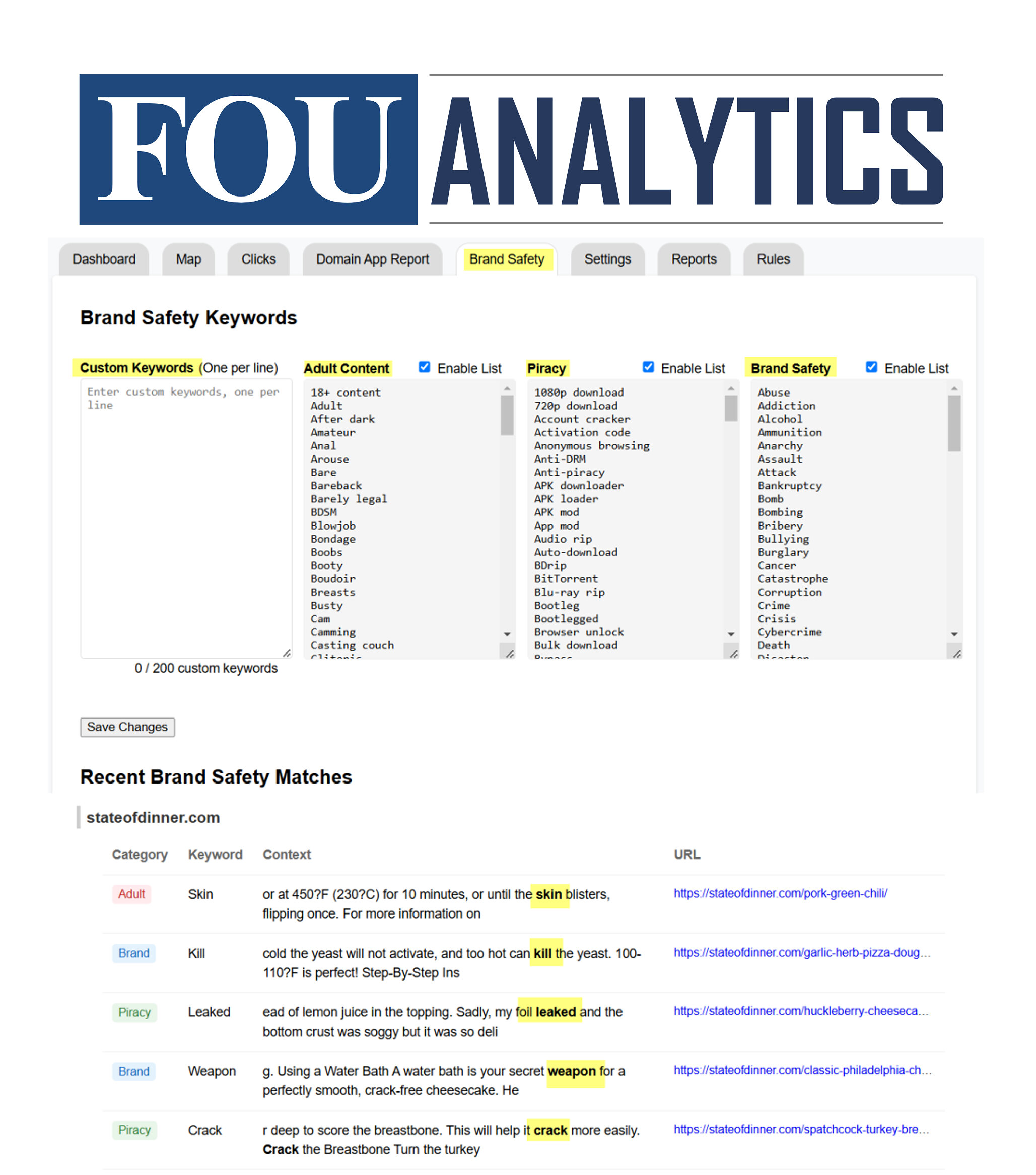
Unlike conventional blocking-based approaches that may classify an entire domain or property as safe or unsafe, or infer risk from keywords, text, or language signals without enabling users to examine a particular page, FouAnalytics scans the text content of the individual webpage, reports the full page URL, and shows 10 words before and 10 words after each configured keyword match.
FouAnalytics does not scan images or video, does not claim to provide image- or video-based safety measurement, and does not automatically block advertising. Instead, it enables advertisers, agencies, publishers, practitioners, and analysts to inspect the reported page and determine whether a match is a genuine brand-safety concern, a policy-relevant issue, or an obvious false positive.
“Advertisers should not have to accept an opaque ‘brand safe’ label while being denied the exact URL and evidence behind it,” said Dr. Augustine Fou, founder of FouAnalytics. “We have always believed that the proper approach is transparency: show the actual page, show the surrounding context, and let qualified people see Fou themselves before deciding whether an incident warrants action.” This prevents the problems observed repeatedly over the years of legacy brand safety vendors defunding legitimate news sites due to incorrect blocking of ads – for example on pages with “covid-19” in the url. See We’ve Known Brand Safety Tech Was Bad, Here’s How Badly It Defunds The News [https://www.forbes.com/sites/augustinefou/2020/12/06/weve-known-brand-safety-tech-was-bad-this-is-how-badly-it-defunds-the-news/]
MRC clarified the distinction
In October 2025, the Media Rating Council issued its Policy for Property-Level Ad Verification Representations after acknowledging confusion in the marketplace over the meaning and scope of brand safety and ad vertification capabilities.
The policy distinguishes property-level ad verification, which can use crawling or scraping of keywords and text plus language-based contextual classification to categorize sites at a domain or property level, from content-level brand safety. The MRC stated that the earlier property-level guidelines do not include requirements for the measurement or classification of image, video, or audio content and provide no assurance for those formats.
The MRC policy was aimed at vendors that had positioned property-level verification as “Brand Safety” or as content-level measurement despite lacking the corresponding content-level capabilities. It requires property-level vendors to stop using “Brand Safety” and content-level representations in service and metric names, definitions, client materials, marketing materials, external releases, methodology, reporting, and related disclosures unless they are accredited for content-level brand safety under the MRC’s Enhanced Content Level Context and Brand Safety Supplement.
After a six-month grace period, the MRC stated it would no longer continue accreditation for a vendor that represented property-level verification based on text, keywords, or language-based contextual classification as “Brand Safety” or content-level measurement until those references were removed or modified to comply with the policy. The policy also requires clear disclosure that images, video, and audio are excluded from property-level measurement and that the service does not provide content-level brand-safety measurement or assurance.
The full MRC policy is available at: https://mediaratingcouncil.org/sites/default/files/News/Ad%20Verification%20Representation%20Policy%20102025.pdf.
Evidence, not automatic suppression
FouAnalytics takes a different approach. It does not collapse an entire site into a broad safe-or-unsafe classification, nor does it silently block inventory simply because a sensitive word appears in an otherwise benign sentence.
Consider this example:
“If the water was too hot, it [kills] the yeast and your bread won’t rise.”
A simplistic keyword-driven system could interpret “kills” as a violence-related signal and block or demonetize the page. FouAnalytics instead reports the matched term, the complete page URL, and 10 words on either side of the match. A human practitioner can immediately see that the phrase is a baking instruction, not a safety violation.
This is particularly important for responsible media governance. Journalism, health information, educational material, historical reporting, literature, and public-interest content often include terms found on sensitive-word lists. Treating every word match as an automatic violation can deny quality publishers revenue, narrow the information environment, and create unreviewable decisions that advertisers and publishers cannot effectively challenge.
FouAnalytics preserves the useful signal while restoring context, judgment, and accountability. The workflow is straightforward: identify a text match, disclose the exact page, provide surrounding context, enable a qualified human to review the evidence, and then allow the organization to apply its own documented brand-suitability policy.
For further details, examples, and screen shots, see https://www.linkedin.com/pulse/content-level-brand-safety-page-url-reporting-fouanalytics-fou-l6wwe/
Why page-level reporting matters
The importance of page-level visibility became unmistakable after the Adalytics report from 2025. The report described explicit material on the sites, cited NCMEC notifications involving CSAM, and reported evidence of major-brand ads adjacent to explicit content. The report underscored the consequences when advertisers cannot readily inspect the exact page where their ads appeared. The full report is available at: https://adalytics.io/blog/adtech-vendors-csam-full-report.
After years of documented failures of their brand safety offerings, the legacy verification vendors finally came under scrutiny by legislators and senators:
- Amazon, Google and verification vendors among ad tech cohort under fire from U.S. senators over child safety shortcomings, February 2025 – https://digiday.com/media-buying/amazon-google-and-verification-vendors-among-ad-tech-cohort-under-fire-from-u-s-senators-over-child-safety-shortcomings/
- Senators Accuse Google, Amazon, and Others of Monetizing Site That Hosts Child Abuse Content – https://www.adweek.com/media/senators-accuse-google-amazon-monetizing-child-abuse-content/
- Legislators ask DoubleVerify, IAS for answers after new report finds ads next to explicit content – https://www.marketingbrew.com/stories/2025/02/10/legislators-ask-doubleverify-ias-for-answers-after-new-report-finds-ads-next-to-explicit-content
Following the scrutiny, Amazon announced plans to add page-level reporting through its Traffic Events API. Amazon stated that its prior Inventory Report had provided site- or domain-level transparency, and said it had blocked the sites in question and refunded affected advertisers. DoubleVerify also announced expanded URL-level reporting for clients using Brand Safety and Suitability measurement. See Adweek’s reporting at: https://www.adweek.com/programmatic/doubleverify-url-level-reporting/.
FouAnalytics had page-URL-level reporting and contextual text evidence all along. Its approach was built on the principle that analysts should not be asked to trust a binary classification without being able to inspect the page that generated it.
Governance through transparency
Proper governance of digital media requires more than a dashboard label or a blocking list. It requires an auditable record of what was detected, where it was detected, the evidence underlying the finding, the limitations of the measurement, and the person or team responsible for the ultimate decision.
FouAnalytics provides that record:
- The exact page URL associated with each keyword match.
- Text-content analysis of that specific page.
- Ten words of preceding and following context for rapid review.
- A clear limitation: the feature does not scan images or video.
- A reporting-first workflow that leaves final decisions with accountable human practitioners.
“Automated systems are useful for identifying potential issues at scale,” Fou added. “But governance requires transparency and judgment. If users cannot see the page, see the context, and understand the system’s limits, they cannot govern the decision.”
Availability
FouAnalytics Content-Level Brand Safety Analytics with Full Page-URL Reporting is available globally as a premium feature. The capability is designed for organizations that seek practical visibility into page-text risk signals, less indiscriminate blocking of legitimate content (like news), and a transparent record for media-quality and brand-suitability review for proper governance of digital media investments.
About FouAnalytics
Created by Dr. Augustine Fou, FouAnalytics is the most trusted, and the only truly independent analytics platform for digital ads, websites, and mobile apps. The platform provides detailed analytical data so practitioners can “see Fou themselves”™ why something is “high humanness,” and troubleshoot what is not good quality. Today FouAnalytics is used globally by advertisers like Microsoft, Beiersdorf and Georgia Pacific, independent agencies and every agency holding company, as well as more than 10,000 SMBs and site owners. More details at www.fouanalytics.com.
Media Contact
Dr. Augustine Fou, CEO, FouAnalytics
[email protected] | (212) 203-7239
SOURCE FouAnalytics