Before a deployment goes out, there is one question worth asking: will this code actually work in the environment it is heading into?
How useful that question is depends on how honestly the sandbox can answer it. A sandbox that reflects current production conditions answers the question reliably. A sandbox built on assumptions about how external services behaved six weeks ago answers a different question – one about whether the code works in a historical version of the environment that no longer fully exists.
Traditional API mocking is the most widely used approach to building sandbox environments, and it has a structural limitation that most teams discover at exactly the wrong moment: in production, after a deployment that passed every sandbox test confidently.
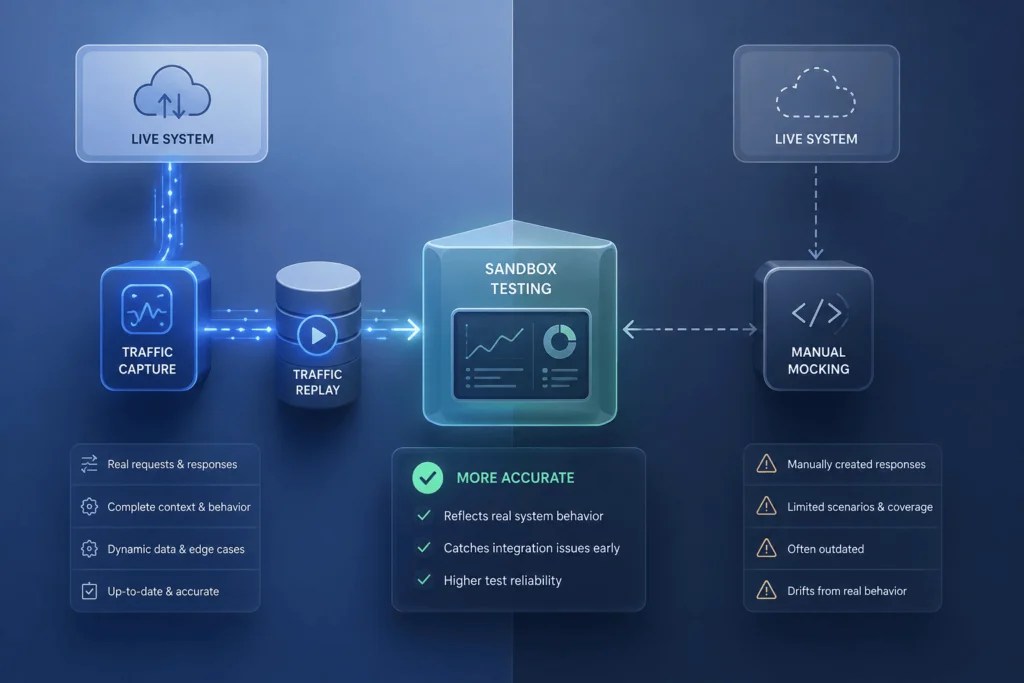
Traffic capture and replay addresses this limitation at the mechanism level rather than at the process level. Understanding why requires being precise about what traditional mocking does, where it fails, and what traffic capture changes about the accuracy equation.
Also Read: Best 6 Automated Pentesting Platforms for SaaS Security Teams
What Traditional API Mocking Actually Does
Traditional API mocking works like this: a developer reads the documentation for an external service, figures out how it responds to various requests, and writes files that return those responses during testing. The files stand in for the real service. Tests run against the files instead of the actual API.
Those mocks become the foundation of the sandbox. When the mocks accurately represent the external API, the sandbox testing accurately predict production behavior.
The problem is the gap between “when the mocks accurately represent” and “always.”
External APIs change. Payment gateways update their error response formats. Inventory systems add required fields to their request schemas. Authentication services change how they communicate token expiration. Marketing automation platforms restructure their webhook payloads. These changes are routine from the perspective of the teams maintaining the external services. From the perspective of teams whose sandbox environments depend on mocks of those services, each change is a potential accuracy event – a moment when the mocks become less accurate without producing any visible signal that this has happened.
The mocks do not update themselves when the external API changes. Someone on the consuming team has to notice the change, understand its implications for the sandbox configuration, locate the relevant mock files, and update them correctly. In practice, some changes get caught promptly. Others get missed during busy sprints. Others are partially caught – the success response mock gets updated but the error response mock does not – because the developer who made the update only had visibility into the subset of changes that were explicitly documented in the release notes.
The cumulative result is sandbox drift: a sandbox environment that accurately represented the external services it was built around at some point in the past and has been accumulating small inaccuracies ever since. The tests still pass because they are validating against the mocks, not against the actual current external services. The sandbox still looks healthy. The production failures that result when deployments encounter external service behavior the mocks did not capture are the first visible signal that the drift had been accumulating.
How Traffic Capture Changes the Source of Mock Data
Traffic capture and replay replaces the human specification step with direct observation of real system behavior. Rather than a developer encoding their understanding of how an external API responds, the tool observes actual HTTP exchanges between the service being tested and its external dependencies and generates mock responses from those real interactions.
The difference in accuracy is structural. A developer writing a mock encodes behavior that was documented or observed at a point in time. A traffic capture records behavior that is actually occurring right now. When the external API has changed since the last time a developer studied its documentation, the developer-written mock describes the old behavior and the traffic capture describes the current behavior.
For payment gateway sandbox testing, this distinction matters in specific and valuable ways. Payment APIs expose dozens of response scenarios – successful transactions, declined cards, insufficient funds, expired cards, network timeouts, invalid card numbers, fraud flags, regional restrictions. Writing accurate mocks for all of these scenarios requires either access to a comprehensive test account or extensive documentation study. Traffic capture generates accurate mocks for every scenario that actually occurs during the capture window, including edge cases that the documentation does not prominently feature and that a developer writing mocks from scratch would not have prioritized.
For marketing automation software sandbox testing, where the external service may be triggering webhooks, modifying contact records, and updating campaign states asynchronously, traffic capture records the actual sequences of events that the external service produces under real conditions. Traditional mocking of asynchronous webhook flows requires accurately predicting the timing, ordering, and content of events that the external service will produce. Traffic capture observes what the service actually produces and replays it accurately.
For inventory system testing, where external systems are updating stock levels, triggering reorder notifications, and communicating fulfillment status, the accuracy of the sandbox depends on whether the mock responses reflect the actual data schemas the external systems use. Schema drift – where an external system adds required fields or changes field types between API versions – is one of the most common sources of sandbox inaccuracy in inventory integrations. Traffic capture automatically reflects current schemas because it is capturing current responses.
What Replay Adds to the Accuracy Equation
Capture addresses the accuracy of individual mock responses. Replay addresses the accuracy of the test scenarios that use those responses.
Traditional sandbox testing requires test authors to write scenarios – specific sequences of API calls and responses that represent meaningful test cases. What gets tested is what someone thought to write down. The scenarios nobody thought of are not in the suite – not because they are unimportant, but because you cannot write a test for something you have not imagined yet.
Traffic replay generates test scenarios from actual request sequences that occurred during real usage. Real users do things in sequences that nobody planned for. An expired card, a retry with a different card, a second decline because the billing address did not match, then a successful transaction on the third attempt. That specific four-step flow exists in production traffic. A developer writing test scenarios from scratch might write each of those failure modes individually, but probably not that exact sequence in that order. Traffic replay captures it because it actually happened.
The completeness of replay-generated scenarios comes from the same source as the accuracy of capture-generated mocks: they are derived from real behavior rather than from specifications of expected behavior. Real behavior includes the sequences that nobody thought to specify because they emerged organically from real usage.
Also Read: How Black Box Testing Catches the Bugs That Developers Cannot See From the Inside
The Sandbox Drift Problem and How Traffic Capture Addresses It
Sandbox drift – the accumulation of inaccuracies between mock configurations and current external service behavior – is the primary reason that traditional mocking-based sandbox environments lose accuracy over time.
The mechanism of drift is simple. External services deploy. Their behavior changes. Mock files do not update automatically. Each upstream deployment that is not reflected in the mock configuration adds a potential divergence between what the sandbox tests and what production encounters.
Traffic capture addresses this mechanism directly by changing when mock data is generated. Traditional mocking generates mock data at specification time – when a developer writes the mock – and the data ages from that point forward. Traffic capture generates mock data at test time – by observing current real behavior immediately before or during testing – and the data reflects current reality by definition.
Modern tools like Keploy implement this traffic capture and replay approach for API-driven systems, recording real HTTP traffic between services and their external dependencies and generating sandbox test fixtures from those actual interactions. When an external service changes its behavior between test runs, the next capture reflects the updated behavior. The mock files do not need to be manually updated after each upstream service deployment because the capture process regenerates them from current observed behavior. Sandbox drift does not accumulate at the same rate because the source of the mock data is current system activity rather than a historical specification.
This makes a practical difference in several common scenarios. When a payment gateway updates its declined transaction response format, the capture reflects the new format in the next test run. When a marketing automation platform adds a required field to its webhook payload, the capture includes the new field because it is recording real webhook traffic. When an inventory system changes how it communicates partial fulfillment, the capture records the new communication pattern. None of these require manual mock updates because the mocks are not manually written.
What Sandbox Testing Looks Like With Traffic Capture
The operational experience of sandbox testing with traffic capture is different from sandbox testing with traditional mocking in ways that compound over time.
In the early weeks of a project, the difference is modest. Traditional mocks are freshly written and accurate. Traffic captures and freshly written mocks describe similar behavior. The accuracy gap is small.
As the project ages and external services continue deploying, the difference grows. Traditional mocks require increasingly frequent maintenance to stay current. Teams that maintain discipline about updating mocks after each upstream change keep their sandbox accurate but spend increasing engineering time on mock maintenance. Teams that allow maintenance to slip accumulate sandbox drift that produces production failures.
Traffic capture-based sandboxes stay current without the same manual maintenance overhead. The accuracy of the sandbox is tied to how recently traffic was captured rather than to how recently a developer updated a mock file. In active systems where traffic flows regularly, the sandbox reflects current external service behavior by default.
The categories of production failure that sandbox testing is supposed to prevent – failures originating from external service behavior that changed after the sandbox was configured – become significantly less common. Not because external services stop changing. Because the mechanism by which their changes invalidate sandbox accuracy has been addressed at the source rather than managed through ongoing manual maintenance.