Researchers have developed off-stochiometric anode materials capable of safe, ultra-fast charging
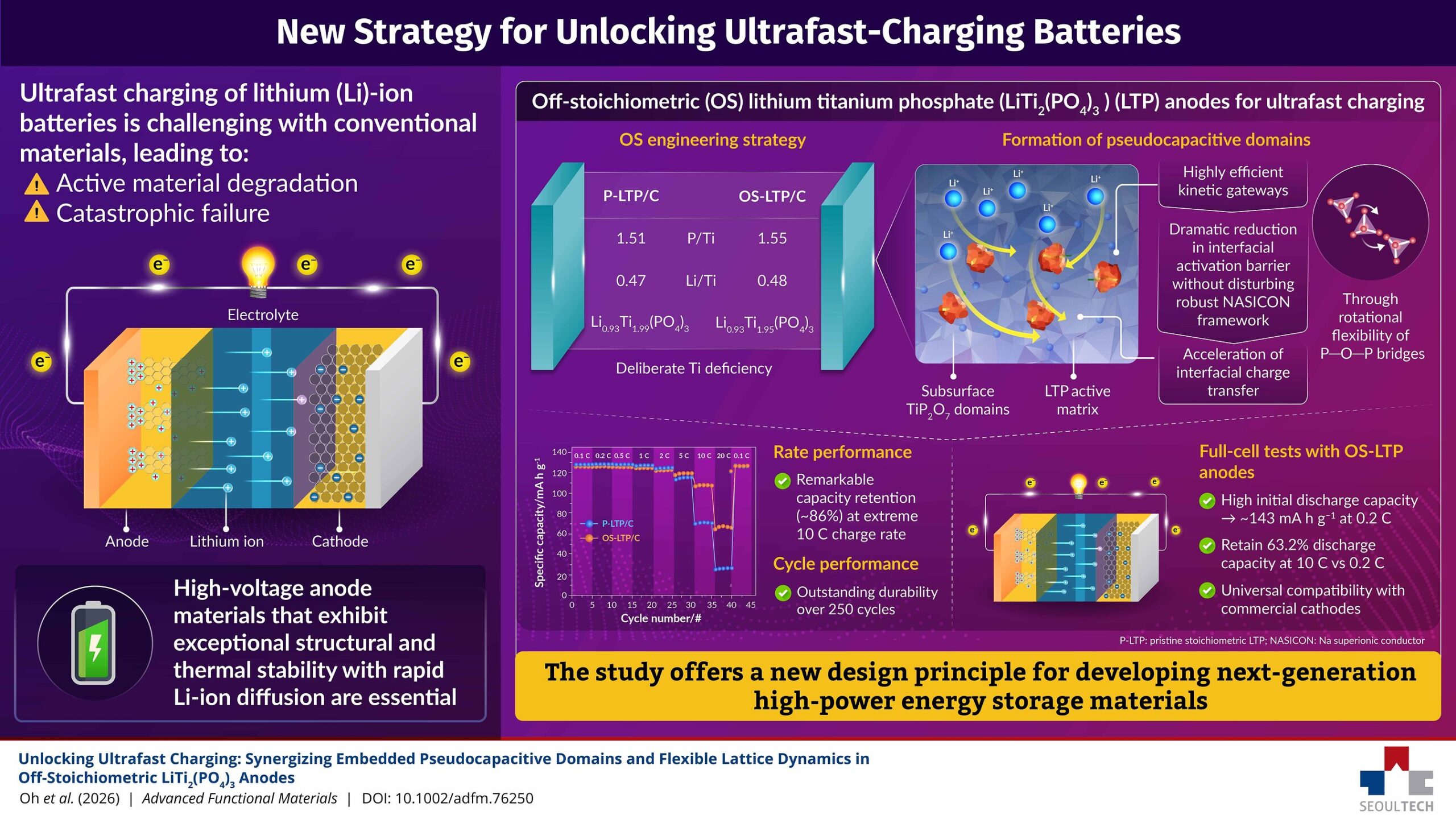
, /PRNewswire/ — The rapid progress in electric vehicles and high-power electronics has increased the demand for ultra-fast charging lithium-ion (Li-ion) batteries. However, during fast charging, current Li-ion rechargeable batteries suffer from severe degradation in power and potential catastrophic failure, increasing safety risks. This is mainly due to electrochemical instability that occurs at the anode-electrolyte interface, causing hazardous Li metal plating on their surface and poor thermal stability.
Recently, high-voltage anode materials have emerged as promising alternatives because they prevent excessive lithium plating and formation of unstable solid-electrolyte interface layers. Despite these advantages, current state-of-the-art materials are limited by poor ionic conductivities and thermal stability, reducing power output and long-term reliability.
To address these issues, a research team led by Associate Professor Dongwook Han from the Seoul National University of Science and Technology in South Korea developed a novel strategy. “We have developed an off-stoichiometric (OS) anode composition based on the NASICON-structured lithium titanium phosphate, renowned for its exceptional structural and thermal robustness,” explains Dr. Han. “This design induces spontaneous phase transformations at the subsurface of active material particles, overcoming kinetic limitations and thus enabling stable, fast-charging.” Their study was published in Advanced Functional Materials on June 01, 2026.
Lithium titanium phosphate (LTP) exhibits a sodium superionic conductor (NASICON) structure that offers exceptional structural and thermal stability, as well as rapid Li-ion diffusion pathways. To unlock their full potential, the researchers implemented an off-stochiometric design strategy, where they deliberately increased the phosphorus (P) to titanium (Ti) ratio. This Ti-deficiency leads to the formation of titanium phosphate (TPO) domains near the surface of LTP particles.
These TPO-rich domains act as highly efficient kinetic gateways, lowering the energy barrier for Li ions to cross the anode–electrolyte interface while creating rapid ion transport pathways near the particle surface. In addition, the highly unconstrained P–oxygen(O)–P linkages within the TPO framework provide structural flexibility that preserve the NASICON structure against irreversible damage by accommodating the volume changes that occur during rapid charging.
As a result, in rate capability tests, representing a key metric for fast-charging performance, the OS LTP-carbon (OS-LTP/C) composite anode retained an impressive 86% of its initial capacity at a demanding charging rate of 10C, whereas the capacity of the pristine LTP/C composite anode declined sharply. The material also demonstrated outstanding cycling stability over more than 250 cycles. Full cell configurations also demonstrated similarly high rate capability and universal compatibility with high-voltage cathodes.
“Our approach represents a new paradigm for designing fast-charging batteries and is broadly applicable for a wide range of future energy storage systems, including all-solid-state batteries,” notes Dr. Han. “This strategy could help make electric vehicles more practical by reducing charging times while improving safety and supporting renewable energy grids.“
Overall, this OS design strategy addresses one of the key challenges facing rechargeable batteries and offers a promising pathway toward practical ultra-fast-charging energy storage technologies.
Reference
Title of original paper: Unlocking Ultrafast Charging: Synergizing Embedded Pseudocapacitive Domains and Flexible Lattice Dynamics in Off-Stoichiometric LiTi2(PO4)3 Anodes
Journal: Advanced Functional Materials
DOI: https://doi.org/10.1002/adfm.76250
About the institute Seoul National University of Science and Technology (SEOULTECH)
Website: https://en.seoultech.ac.kr/
Media Contact
Eunjung Son
82-2 – 970 – 9166
[email protected]
SOURCE Seoul National University of Science and Technology