Christopher Nolan’s impressionistic remix of Homer’s epic poem finds the man behind the myth.
Credit: Universal Pictures
Christopher Nolan’s The Odyssey has been a lightning rod for controversy ever since the first casting and design reveals, igniting afresh with each new trailer. The film has garnered plenty of well-deserved accolades (and earnings) since its release, and yet somehow the debates rage on between classicists and the general public alike—all this over an adaptation of an epic poem that’s been around since roughly the 8th century BCE.
My take: the IMAX scale might be epic, but Nolan gives the story an intimate feel, weaving a captivating, nearly three-hour cinematic spell. While the magic slowly starts to dissipate once one leaves the theater, the powerful imagery will resonate for days. And the film gave me, personally, a fresh perspective on the central character of Odysseus.
(Spoilers below.)
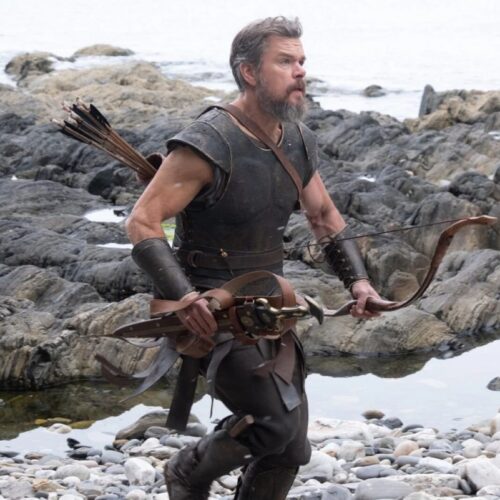
Most of us read some version of The Odyssey in high school, so we’re familiar with the story: Odysseus (Matt Damon), legendary Greek king of Ithaca, begins the long journey home after 10 years of fighting in the Trojan War. But the journey does not go smoothly, as Odysseus and his men encounter the cyclops Polyphemus (Bill Irwin), the Sirens, and an enchantress named Circe (Samantha Morton), among other obstacles. Meanwhile, his long-suffering wife, Penelope (Anne Hathaway), is warding off hundreds of suitors eager to usurp Odysseus’ throne back home. And the wandering king’s son and heir, Telemachus (Tom Holland), is convinced his father is still alive and sets off to find him.
Nolan sets the tone by opening with a bard (Travis Scott) beginning to tell the tale of the fall of Troy—at least the idealized heroic version that the bard’s audiences are hungry to hear. It’s not meant to reproduce ancient Greek oratory tradition, just to evoke some sense of it, and the device is surprisingly effective.
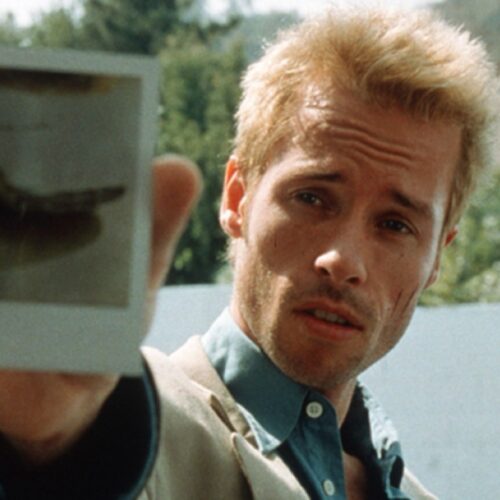
The director has also preserved Homer’s nonlinear narrative structure, with tales nesting within tales. His depiction of Odysseus is that of a seemingly broken man slowly regaining his fractured memories of the Trojan war and its aftermath in bits and pieces, after spending years under the intoxicating effects of the lotus fruit with Calypso (Charlize Theron) on the island of Ogygia. What has he tried so hard to forget, and why? What difficult truth must he finally face before he can find his way home at last?
Fractured memories
We only get the briefest of flashbacks at first, little more than fleeting impressions, because the Ithacan king can’t yet face his memories whole. As the film progresses, we gradually cycle through increasingly detailed memories of what transpired before Odysseus washed up alone on Calypso’s island—the sole survivor among all his men. It all builds up to a powerful moment of self-revelation with Penelope, where he finally admits that his long absence was driven in part by his stricken conscience at the horror his cleverness had unleashed on Troy.
This approach gives the audience a sense of what Odysseus is experiencing, but it also led to complaints that Nolan had wasted his talented cast of major Hollywood stars. Theron’s Calypso gets just a few minutes of screen time. Ditto Lupita Nyong’o in her dual role as Helen of Troy and Clytemnestra; Jon Bernthal’s Menelaus; and Benny Safdie’s Agamemnon, among others. It’s true that Nolan presumes his audience is familiar with Homer’s epic poem and hence many of these characters primarily exist in the margins of Odysseus’ memories. But minutes of screen time are not necessarily indicative of the relative importance of any given role to Nolan’s vision.
For instance, Zendaya’s Athena only appears to Odysseus in brief dream-like sequences, but those moments are critical. As he regains his memories, her mood shifts from calm neutrality to sadness, disappointment, disapproval, and ultimately to horrified grief as the invading Greek army chops off the head of her statue in a Trojan temple—along with the head of a young Trojan woman with Athena’s face. Athena represents the personal reckoning Odysseus is so loath to face.
Similarly, Elliot Page is only in a couple of small scenes as Sinon, a character who doesn’t even appear in Homer’s Odyssey; his story can be found in Virgil’s Aeneid. He’s the soldier left behind with the Trojan horse, whose lies convince the Trojan army to bring this “gift” to honor Athena into the walled city. Nolan has retooled the character into an innocent victim, unaware of Odysseus’ scheme, who nonetheless gives his life for it. His accusatory shadow shows up when Odysseus and his men travel to the underworld to consult with the blind prophet Tiresias (James Remar)—yet another example of the human toll exacted for violating “Zeus’s law” of hospitality in order to end the siege and win the war.
Nobody makes more of their limited screentime than Samantha Morton as the sorceress Circe in one of the film’s most powerful sequences. Once again, Nolan has reinvented the character to fit his themes. This is not the beautiful creature who seduces Odysseus in the poem. This Circe has suffered terribly at the hands of men; she turns Odysseus’ men into pigs because to her, they are swine wearing human masks. We don’t need to know all the gory details of what happened to Circe (and her sister), the trauma that fuels her rage and thirst for vengeance. We see the effects etched into every microexpression on her ravaged face.
The Odyssey has garnered both critical and audience raves and has already topped $700 million at the box office—more than enough to cover its $250 million production budget and surpassing Oppenheimer‘s entire haul. It’s going to be nominated for tons of Oscars and will likely win several, both for technical achievement and for the many terrific performances—especially Morton, Damon, Hathaway, Holland, and Robert Pattinson’s deliciously villainous suitor, Antinous. So another backlash was inevitable.
A scholar weighs in
The manufactured online trolling/culture war campaign that preceded the film’s release isn’t even worth the electronic space to rebut. The Odyssey‘s dominance at the box office is rebuttal enough. But then classicist Emily Wilson—no stranger to controversy as the author of a much praised and also unjustly maligned translation of Homer’s epic poem—decided to stir the waters by penning her own harsh critique of the film for the London Review of Books. Nolan quoted the opening line of Wilson’s translation in a couple of interviews—“Tell me about a complicated man”—so I guess she felt compelled to weigh in.
My issue is not that Wilson didn’t like the film; nobody is required to like it. And Wilson wields her poison pen with great skill. Her essay is the quintessential death by a thousand withering cuts that is a noxious hallmark of academia. Even her more complimentary remarks are pointedly condescending. I’m sure Nolan is sobbing all the way to bank. But for all her throat-clearing assurances that she wanted to assess Nolan’s film on its merits and the director’s artistic intent, Wilson fails spectacularly to do so.
Consider her main critiques. She’s bothered by the fact that the film “centers” Odysseus’ point of view—it’s literally called The Odyssey—and dismisses the race-neutral casting not because it’s “woke” but because the non-white cast members are just playing variations on the “Black best friend.” (To her credit, Wilson did walk back that ill-advised line on BlueSky.) She both criticizes the film’s “implicit values” as being inconsistent with the mores of Homer’s original poem, and dings Nolan for not explicitly showing that war is bad, and for not giving us the perspective of the victims of the fall of Troy, which she deems essential for “any serious depiction of violence.”
Wilson is further disappointed by the lack of sex scenes, given that Odysseus had affairs with both Circe and Calypso during his wanderings, and by the fact that many of the female roles are relegated to the sidelines. She’s unhappy that the gods don’t play a larger role, as they do in Homer’s original poem. This was a deliberate choice by Nolan; he has said that he wanted to humanize the gods and convey supernatural events primarily through natural phenomena that would once have been considered evidence of divine influence on human events. If one claims to be assessing the film in part on Nolan’s artistic intent, it’s strange not to acknowledge that intent.
There’s more. Wilson hates the dialogue. (“I would be ashamed to have written any part of this script.”) And she criticizes Nolan’s “unethical” decision to film part of the movie in Western Sahara, an occupied territory where there has been much violence against the indigenous people. This may be a valid critique, but it has nothing to do with an objective assessment of the film.
The best praise Wilson can muster is that the film is “not boring” and a “family-friendly audiovisual spectacle” that her teenagers really enjoyed. (Implication: only young or unsophisticated audiences could possibly like this film.) And for some reason she seems to think it’s an escapist action movie with exploding vehicles. Perhaps she wandered into a screening of Motor City by mistake.
If Nolan’s Odyssey is so simplistic and shallow and fleetingly forgettable as Wilson claims, why are we still arguing so passionately about it? Why did she pen that entire essay?
A timeless story
Wilson is among our foremost classical scholars and has likely forgotten more about Homer’s works than most of us ever knew. But Nolan is a creator, not a scholar. He did not set out to make a historically accurate, 100 percent faithful adaptation of The Odyssey. He created his own contemporary remix of a foundational text through the lens of his favorite personal themes. He succeeded brilliantly, even if the film falls shy of masterpiece status.
Is the dialogue a bit clunky? Sometimes, but if bad dialogue were enough to sink a film, Star Wars: A New Hope would have bombed at the box office and fallen into oblivion, instead of becoming the cultural touchstone it is today. It’s true that there are a lot of untethered big ideas wafting about Nolan’s dreamily impressionistic take on Homer, but Wilson is simply incorrect that the film lacks “solid specific human experience.” And while Nolan clumsily tries to shoehorn a Message For Our Times in at the end, his Odyssey nonetheless provides a fresh take on the core myth and reminds us anew why Homer’s epic deserves its place in the literary pantheon.
Ultimately that’s what every translator does, Wilson included, whose translation uses iambic pentameter rather than Greek dactylic hexameter, among other innovations. They put their personal stamp on it. Every translation requires its own tradeoffs, reflecting the unique choices of the individual, which in turn are driven by their own values and perspective. (As I was writing this, both novelist Joyce Carl Oates and Wilson’s fellow classicist, Theo Nash, made a similar point, which merely demonstrates how patently obvious it is.) Wilson claims to understand this, but her essay undercuts it repeatedly.
It’s abundantly clear that Wilson simply doesn’t like Nolan’s style as a director, specifically calling out his “usual combination of grandiosity and superficiality.” That’s fair enough. At the end of the day, Nolan’s gonna be Nolan, and if you disliked Oppenheimer, Tenet, Inception, etc., this probably isn’t The Odyssey for you.
There is no such thing as the One True Take on Homer’s Odyssey. The core myth transcends any specific place and time. So each incarnation finds its own imperfect truth in this enduring tale, yielding different insights into the characters, their choices, their motivations. One can appreciate one without diminishing the others—and ideally find something to savor in all. Nolan’s The Odyssey very much deserves to take its place among them.
The Odyssey is now playing in theaters. It’s definitely worth seeing in IMAX if you can.

Jennifer is a senior writer at Ars Technica with a particular focus on where science meets culture, covering everything from physics and related interdisciplinary topics to her favorite films and TV series. Jennifer lives in Baltimore with her spouse, physicist Sean M. Carroll, and their two cats, Ariel and Caliban.