The 53rd annual conference presents peer-reviewed breakthroughs in simulation, vectorization, and physics modeling across animation, visual effects, design, and engineering
, /PRNewswire/ — Behind every breakthrough in film, games, and product design lies a quieter evolution in the tools themselves. The SIGGRAPH 2026 Technical Papers program highlights emerging solutions to some of the most persistent challenges in computer graphics and interactive techniques — promising more accurate, scalable, and dependable workflows. A cornerstone of SIGGRAPH, it spans areas including animation, simulation, imaging, geometry, modeling, rendering, human-computer interaction, VR/AR/MR, haptics, fabrication, robotics, visualization, audio, optics, programming languages, immersive experiences, generative AI, and machine learning for visual computing.
The program, which offers sessions 19–23 July in Los Angeles, creates connections and fosters collaborations through computer graphics and interactive techniques, highlighting how research breakthroughs can influence industries ranging from entertainment and design to engineering, manufacturing, healthcare, and scientific research.
“What stands out to me about these papers is that they address real problems facing the community. Whether it’s improving simulation, solving long-standing challenges in vectorization, or helping researchers better understand existing methods, they provide insights that are useful today while helping shape future research,” said Mirela Ben-Chen, SIGGRAPH 2026 Technical Papers Chair.
Among this year’s accepted papers selected for presentation in Los Angeles, three examples showcase trends emerging across the program. These examples include topics ranging from fluid simulation, 3D vectorization, and thin-shell physics modeling, each targeting problems that have limited the scale, reliability, or accuracy of tools used throughout visual effects, animation, product design, game development, and scientific computing.
A Faster Path to Large-Scale Fluid Simulation
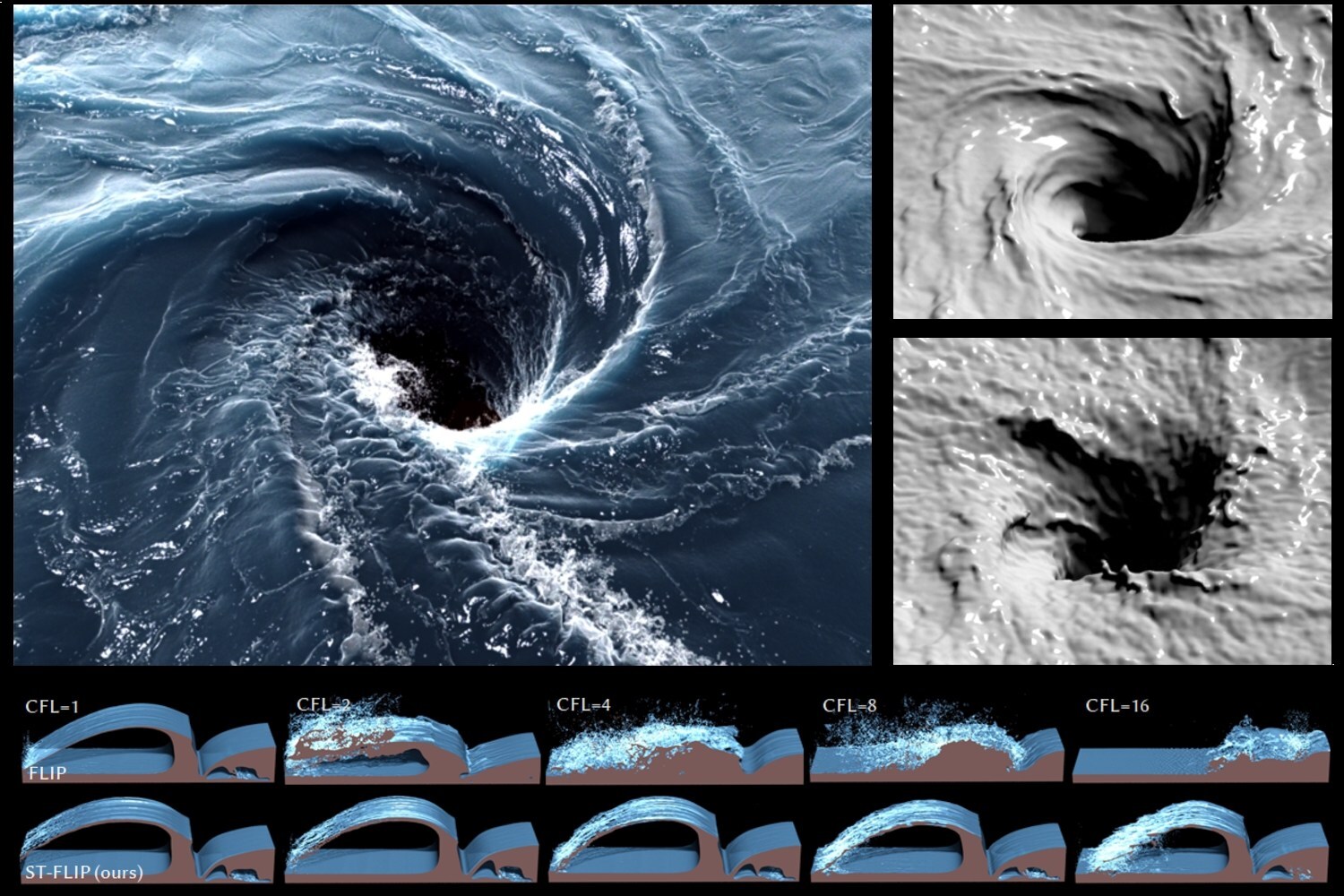
A team of researchers from Technical University Munich and RWTH Aachen University presents “Spatiotemporal FLIP for Fast Free-Surface and Two-Phase Simulation With Very Large Time Steps“, which received an Honorable Mention in this year’s Technical Papers Awards. The work offers a spatiotemporal extension of the widely used Fluid-Implicit Particle simulation method. By treating particles as samples in four-dimensional space-time, ST-FLIP enables time steps up to an order of magnitude larger than those used by conventional solvers, delivering several-fold speedups on multi-billion-particle simulations run on a single workstation while preserving detailed surface structure and visual fidelity. Designed as a lightweight plug-in to existing FLIP, PIC, and APIC solvers, ST-FLIP lowers the barrier to large-scale fluid simulation in production environments.
“For a film or visual-effects team, this can mean faster high-resolution previews, more creative iterations, and final simulations that fit more comfortably within a production schedule,” said Bernhard Braun with Technical University Munich. “Our approach can reduce one of the major computational bottlenecks in high-quality liquid simulation.”
The team behind “Spatiotemporal FLIP” includes Braun, Rene Winchenbach, and Nils Thuerey with Technical University Munich, and Jan Bender with RWTH Aachen University.
Turning 3D Scenes Into Clean Vector Art
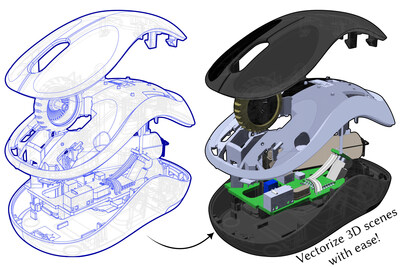
A team at Carnegie Mellon University introduces “Robust Planar Maps for 3D Vectorization“, a SIGGRAPH 2026 Technical Papers Best Papers Award winner that features a geometry-agnostic method for converting 3D scenes into clean, scalable 2D vector images with accurate occlusion handling. The approach tackles a longstanding reliability problem by replacing numerically difficult curve-curve intersection calculations with more tractable curve-line intersections, enabling it to handle the imperfect, disconnected curve descriptions common in real-world files while running orders of magnitude faster than existing techniques, bringing 3D vectorization within reach for production pipelines.
“Like a lot of good algorithms, this one came out of personal frustration with existing tools,” said Keenan Crane with Carnegie Mellon University. “We were still often having to trace out 3D renderings by hand in order to get quality vector graphics.”
The resulting method was built around a real production challenge rather than a theoretical exercise. “From the start, we had a production use case that we built our method around,” added Robert Fuchs with Carnegie Mellon University. “I hope practitioners understand that our method is complete and not just a tech demo. We’re already able to vectorize scenes like you might want to in production.”
Getting the Bend Right in Cloth, Paper, and Metal
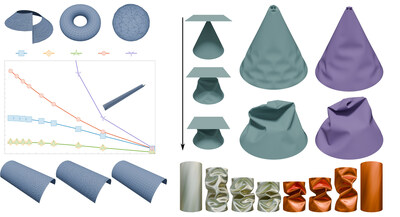
“Better Bending: Analysis, Construction and Verification of Discrete Bending Models for Kirchhoff-Love Shells“, from Zhen Chen and Danny Kaufman with Adobe Research, and Etienne Vouga with The University of Texas at Austin, takes a systematic look at one of simulation’s most persistent open questions: how to best discretize the bending behavior of thin shells. While the graphics and mechanics communities have worked on shell models for well over four decades, the question has remained largely unaddressed. To better answer it, Better Bending proposes and evaluates a state-of-the-art “leaderboard” benchmark of 10 of the most deployed bending models in computer graphics. The evaluation highlights critical gaps that the work then addresses with Bending-Active Cosserat (BAC), a new and significantly improved shell model, along with clear, benchmark-backed practical recommendations for users for when and how each model is suitable, or not, based on application needs. The work takes a step toward closing a long-standing gap in best practices for simulating diverse thin-shell materials, from cloth and paper to rubber and formed metal sheets.
The results cut against the team’s own initial expectations. Models that are accurate in theory still broke down in practice on the high-resolution meshes used in production. “This challenged us to reconsider what suitable verification benchmarks should be and motivated us to design the ‘sharp-creasing’ benchmark. In turn, this benchmark led us to the insights necessary to construct our new BAC bending model,” said Kaufman.
Another result turned on a subtle implementation choice. “Our experiments revealed that the vertex-based quadratic bending formulation (QB-PL) exhibits significantly better convergence behavior. This was not something I anticipated going into the study, and it highlights how much the choice of discretization can matter, even for well-established bending energies,” said Chen.
Work that audits and validates existing tools rather than replacing them is not the field’s usual headline material. “I did feel some trepidation sending a paper to SIGGRAPH that is both very long and different than the usual fare. But I do think papers like ours are important to the health of the field,” said Vouga.
SIGGRAPH 2026 offers an opportunity to spotlight groundbreaking research like the papers highlighted here, helping artists, engineers, and researchers across all avenues of computer graphics through this internationally recognized program. Once again, the Technical Papers program features two integrated paper tracks, Journal (ACM Transactions on Graphics) and Conference.
“The whole review process is built so that the good ideas and the lasting ideas come up and stick around. In the end, you have a mix of research areas represented in the program, from foundational topics like geometry, simulation, and rendering to emerging areas such as generative AI, and that balance happens naturally through the review process,” said Ben-Chen.
Whether published through the Journal or Conference track, each accepted paper reflects SIGGRAPH’s commitment to showcasing research that advances the state of the art in computer graphics and interactive techniques through innovation, technical rigor, and real-world relevance.
As a foundation of the SIGGRAPH conference, the Technical Papers program demonstrates how innovation continues to expand what artists, engineers, researchers, and creators can achieve. To learn more about SIGGRAPH 2026 and the Technical Papers program, view the full schedule to explore the breadth of interactive techniques grounded in rigorous research with real-world impact, celebrate the SIGGRAPH 2026 Technical Papers Best Papers, Honorable Mentions, and Test-of-Time awardees on the ACM SIGGRAPH Blog, and register now to discover all the programs offered at SIGGRAPH 2026.
About ACM, ACM SIGGRAPH, and SIGGRAPH 2026
ACM, the Association for Computing Machinery, is the world’s largest educational and scientific computing society, uniting educators, researchers, and professionals to inspire dialogue, share resources, and address the field’s challenges. ACM SIGGRAPH is a special interest group within ACM that serves as an interdisciplinary community for members in research, technology, and applications in computer graphics and interactive techniques. The SIGGRAPH conference is the world’s leading annual interdisciplinary educational experience showcasing the latest in computer graphics and interactive techniques. SIGGRAPH 2026, the 53rd annual conference hosted by ACM SIGGRAPH, will take place live 19–23 July at the Los Angeles Convention Center.
SOURCE SIGGRAPH 2026