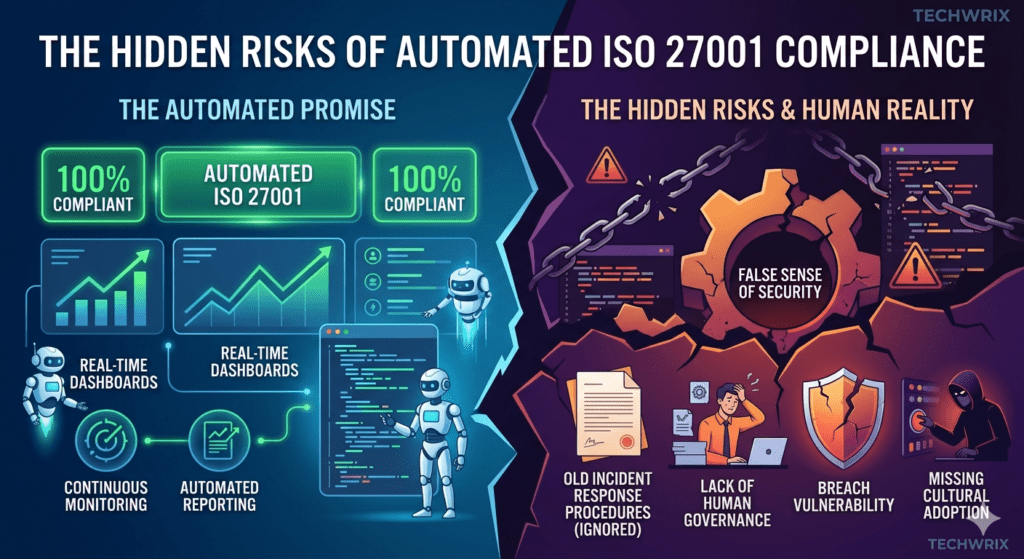
Your compliance officer just returned from a vendor presentation glowing with excitement. They’ve found a platform that promises to automate your entire ISO 27001 compliance program. Twenty-four-hour monitoring. Real-time dashboards. Automated reporting. No more manual audits.
The price tag? Reasonable. The promise? Magical.
The reality? You’re throwing away £50,000 every year on software that gives you a sense of false security while leaving genuine security threats unattended.
Also Read: ISO 27001: The Security Standard Every Business Needs Right Now
The Automation Trap No One Is Talking About
Let’s discuss what happens once you sign the contract. Usually, the team has to do integration work, and after some time, you get a nice dashboard showing compliance. This makes your CEO happy and also makes your board happy. People can go home and suggest that the problem is solved.
The problem is, that’s not the case.
ISO 27001 compliance isn’t a technical problem that software can solve. It’s a governance problem. A cultural problem. A human problem. And that’s exactly why most organizations that rely exclusively on automated monitoring tools wake up one day to discover they’re not actually protected at all.
The vendors know this. They know the difference between continuous data collection and continuous risk management. Understanding the product doesn’t increase sales, so they use marketing lingo to manipulate perceptions. They will say things like “automated compliance,” “continuous governance,” or “real-time ISMS monitoring” but really, none of those terms actually mean what you might assume they mean.
What Automation Can Actually Do (And What It Cannot)
It’s time we just told the truth and outlined the actual GRC product. Let’s say it’s Vanta, Drata, Secureframe, or any competitor you like. They’re all just advanced clipboards that do an excellent job of documenting and tracking compliance by pulling evidence through APIs and tracking and documenting activities.
But a clipboard doesn’t understand context. It doesn’t know the difference between a low-risk server running non-critical internal tools and a database server holding customer payment information. It can’t read your latest business contract and extract the buried security requirement your enterprise client added at the last minute. It certainly can’t sit in your quarterly business review and debate whether your company’s risk appetite has shifted.
These judgments require a human brain. They require people who understand your business, your industry, and your genuine security posture. Not just the picture your dashboard paints.
The Real Cost of False Confidence
Imagine this scenario: Your dashboard shows 100% compliance for twelve consecutive months. Every control is green. Every audit finding is closed. Your management team is delighted. Then your company gets breached.
The attacker didn’t exploit a technical vulnerability your GRC platform missed. They exploited the fact that your incident response procedures, written eighteen months ago, no longer reflect how your business actually operates. Your team structure has changed. Your systems have evolved. Your documented process doesn’t match reality.
Now you’re in a nightmare. Regulators are investigating. Your customers are furious. Your insurance company is asking uncomfortable questions. And buried in all of this is a simple, devastating truth: your automated compliance system never caught any of this because it wasn’t designed to. It was designed to collect evidence that a policy existed, not to verify that people actually follow it.
This happens more often than you’d think. Organizations achieve ISO 27001 certification, set up continuous monitoring automation, and then quietly discover that compliance is a theater—a performance put on for auditors rather than a genuine security system protecting the business.
What Real ISO 27001 Compliance Looks Like
I’m not going to tell you to throw away your GRC platform. Used correctly, it’s a valuable supporting tool. But here’s what it should be: one piece of a much larger puzzle.
Real ISO 27001 compliance requires:
Your leadership team genuinely prioritizes security in budget discussions, not just policy documents. When your Finance Director wants to cut security corners to save money, your CEO needs to push back. Hard. That doesn’t happen because a dashboard tells them to—it happens because security is embedded in your company culture.
Documentation that actually reflects what you do. If your policies describe fantasy processes instead of reality, you’re not compliant. You’re lying to your auditors. Worse, you’re lying to yourself about how secure you really are.
A competent person, ideally your Chief Information Security Officer (CISO) or Head of Security, actively reviewing alerts from your technical security tools—not just trusting automation. That person needs authority to make decisions, budget to execute them, and genuine support from executive leadership.
Regular, human-led internal audits where someone with skepticism and experience interviews your staff, samples evidence, and asks the hard questions: Are people actually following the procedures? Do they understand why these controls exist? Are there gaps between what’s documented and what’s real?
Management reviews are held at least quarterly where your executive team formally discusses security incidents, audit findings, and strategic security priorities. Not rubber-stamp meetings. Real governance conversations.
The Path Forward
If you’re currently implementing ISO 27001 compliance, here’s my challenge to you: Don’t buy the automation dream. Buy the tools that genuinely help you collect evidence and organize documentation. Then invest the real resources—people, time, leadership attention—in actually building a security culture that protects your business.
Automation will make your compliance program more efficient. It will never make it more secure.
The difference matters. Efficiency without effectiveness is just expensive theater. And theater doesn’t stop breaches.
Ready to build a compliance program that actually protects your business? Learn how to implement ISO 27001 compliance the right way—blending smart automation with genuine governance.
Your compliance officer just returned from a vendor presentation glowing with excitement. They’ve found a platform that promises to automate your entire ISO 27001 compliance program. Twenty-four-hour monitoring. Real-time dashboards. Automated reporting. No more manual audits.