$125,000 in Hearst Health Prize awards recognize Steer Health and finalist Dana-Farber Cancer Institute for innovative uses of data science to improve health outcomes
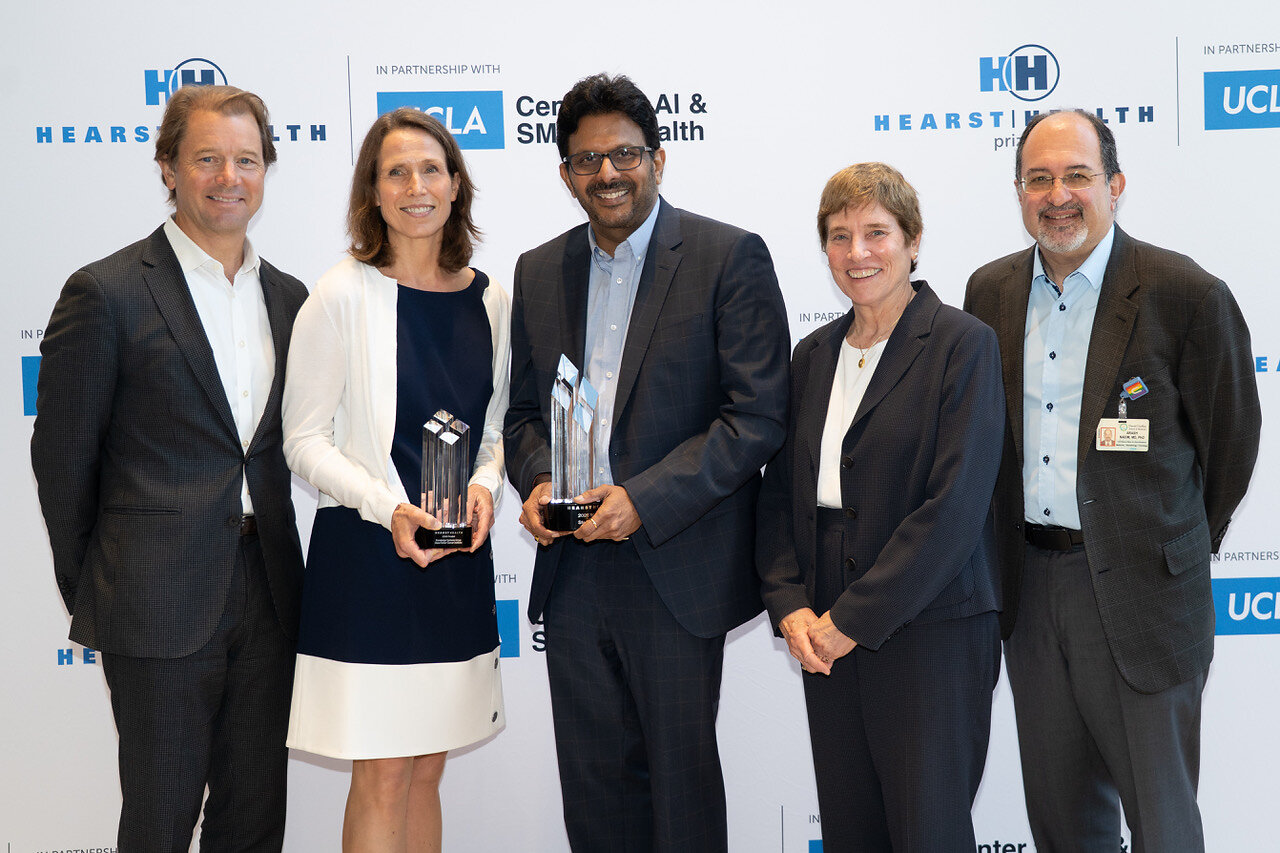
, /PRNewswire/ — Hearst Health, in partnership with the UCLA Center for AI & SMART Health, awarded the 2026 Hearst Health Prize to Steer Health, an AI-driven clinical orchestration company whose platform has measurably reduced care gaps for more than 1.6 million patients across 34 states. Greg Dorn, senior vice president of Hearst and president of Hearst Health, presented the award on June 16, 2026 at the UCLA Health Data Day event. Dana-Farber Cancer Institute was recognized as the 2026 finalist for MatchMiner, an open-source platform that automatically matches cancer patients to precision medicine clinical trials. Hearst Health awarded $100,000 to Steer Health and $25,000 to Dana-Farber Cancer Institute.
Steer Health was recognized for its AI-powered patient engagement and care coordination engine, which addresses one of U.S. healthcare’s most costly and persistent problems: clinical inertia. Up to 40% of patients in the U.S. never complete a specialist referral and nearly one in five scheduled appointments are no-shows, representing an estimated $150 billion in annual waste and millions of patients who fall out of the care continuum each year. Steer’s platform predicts which patients are at risk of disengaging and autonomously guides them through scheduling, intake, and post-visit follow-up, integrated with more than 50 EHR systems.
“We founded Steer Health because too many patients fall through the cracks of a system that wasn’t built for continuous engagement,” said Sridhar Yerramreddy, founder and CEO of Steer Health. “This recognition from Hearst Health validates what our team and hospital partners already know: AI can take on the complex, invisible work of keeping patients connected to care – doing so at a personalized scale no human workforce could achieve alone. We’re honored, and we’re just getting started.”
Closing the gap between a physician’s order and a completed patient visit has historically been a staffing problem. Steer Health reframes it as a data problem. Using a gradient-boosted predictive model to identify at-risk patients and a multi-agent AI system to act on those signals in real time, the platform supported 1.68 million patients across 950+ care sites in 2025 — achieving a 2.2% no-show rate against an 18–20% national average and executing more than 4 million automated follow-ups without human intervention.
“The Hearst Health Prize exists because we believe data science is one of the most powerful tools we have to close the gaps between patients and the care they need. Steer Health and Dana-Farber Cancer Institute are doing exactly that — not in theory, but at scale, in real clinical environments, with measurable results,” said Dorn. “Recognizing this work is central to Hearst Health’s mission and we’re proud to support organizations that are moving the field forward in meaningful ways.”
The Dana-Farber Cancer Institute’s Knowledge Systems Group was named the 2026 finalist for MatchMiner, an open-source clinical trial matching platform operational at Dana-Farber since 2016. Fewer than 10% of adult cancer patients ever enroll in a clinical trial, despite trials being the primary mechanism through which new cancer treatments are developed. The matching problem is overwhelming: thousands of active trials, increasingly complex genomic eligibility criteria, and oncologists who cannot track it all manually.
MatchMiner automatically matches patients to precision medicine trials using genomic data and AI that reads unstructured clinical notes. To date, the platform has facilitated 402 trial enrollments and reduced the time to patient consent by a median of 55 days — a critical window when patients’ health is actively declining. The platform is fully open-source, enabling any cancer center to adopt it without licensing fees, and its AI models are trained on synthetic patient data so they can be shared across institutions without privacy barriers. MatchMiner is now expanding to Mayo Clinic.
“Our partnership with Hearst Health was built to surface and celebrate the data science work that is genuinely transforming patient outcomes. The 2026 finalists represent two very different problems — care access and clinical trial matching — but the same underlying insight: that intelligently applied data can find the patients who need help and connect them to it faster. We are proud to recognize both organizations and to inspire others working toward the same goal,” said Dr. Alex Bui, director of the Medical & Imaging Informatics (MII) group at UCLA.
About the Hearst Health Prize
The Hearst Health Prize is an annual competition that showcases data science programs making a health impact. Visit the Hearst Health Prize webpage to sign up to receive updates, including notifications about the call for submissions for the next Hearst Health Prize.
About the UCLA Center for AI & SMART Health
The UCLA Center for Artificial Intelligence & Systematic, Measurable, Actionable, Resilient and Technology-driven (SMART) Health is a campus-wide collaborative that looks to the integrated transformation of healthcare through emergent data and technologies. A joint effort between the Clinical and Translational Science Institute (CTSI), the Institute for Precision Health (IPH) and the B. John Garrick Institute for the Risk Sciences that brings together UCLA’s experts to shape how digital and data-driven healthcare technologies will help to manage risk, reliability, resilience, uncertainty and precision in future biomedical research and clinical care.
About Hearst Health
The mission of Hearst Health is to guide healthcare organizations by delivering essential intelligence and software that improve the quality, safety and efficiency of care. Hearst Health has been innovating with care for more than 40 years, with a commitment to making a lasting positive impact on health. The Hearst Health companies — FDB, Homecare Homebase, MCG, MHK, QGenda and Zynx Health — elevate care by informing and empowering participants across the health journey. To learn more, visit Hearst.com/Hearst-Health and follow @Hearst Health on LinkedIn.
Media Contacts:
Lindsay Gay Jean-Paul, Hearst Health, [email protected]
David Sampson, UCLA Health, [email protected]
Avni Parekh, Steer Health, [email protected]
John Noble, Dana-Farber Cancer Institute, [email protected]
SOURCE Hearst Health