Universities promise no frontline duty and perks if students enlist in military.
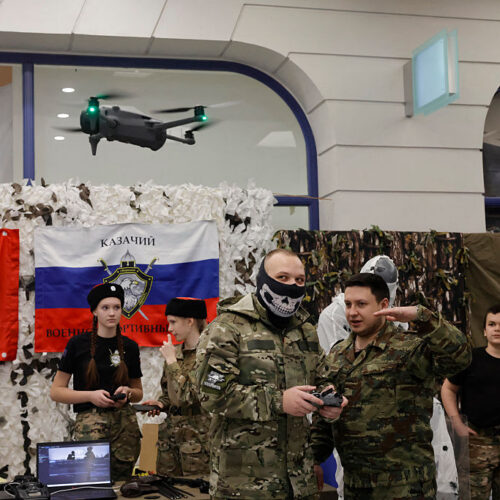
Shaman, a 19-year-old drone operator for the Russian military, flies a quadcopter drone during a demonstration event organized by members of the Berkut Military-Sports Cossack Club in a shopping centre in Voronezh, Russia on January 24, 2026. Credit: TATYANA MAKEYEVA / AFP via Getty Images
Russian universities are promising free tuition and up to $70,000 to students who are willing to serve as drone pilots in the Russian military for a year—all while claiming students can avoid the risk of frontline combat duty in Ukraine. But there has already been one confirmed battlefield death and possibly more among the new cadre of student drone pilots.
That specific recruitment offer appeared on pamphlets distributed at Bauman Moscow State Technical University, according to Bloomberg. Other universities have dangled incentives such as tax holidays, loan forgiveness, and sometimes free land. The independent magazine Groza counted at least 270 Russian academic institutions promoting military contracts to their students in the fifth year of the war that began with Russia’s full-scale invasion of Ukraine in February 2022.
This new wave of recruitment is targeting a population of approximately 2 million men attending Russian universities, including gamers and students with technical skills that could make them suitable trainees as drone pilots, according to Bloomberg. Russia’s Defense Ministry has specifically called for drone pilot recruits with expertise in flying drones, model aircraft, electronics, and radio engineering, with computer skills also being desirable, NBC News reported.
However, the effort carries the risk of further depleting Russia’s future educated workforce on top of the country’s existing brain drain—a research study found that 24 percent of top Russian software developers active on GitHub may have left the country within the first year of the war. Some students have also expressed a similar lack of enthusiasm for the Russian war effort. “No one wants to join,” a student named Andrey told NBC News. “No one is interested.”
Nonetheless, Russia’s effort to recruit student drone pilots goes toward its goal of having 168,000 drone operators by the end of 2026, according to the Kyiv Independent. In that sense, Russia is copying the success of Ukraine’s Unmanned Systems Force that became the world’s first standalone military branch focused on drones in June 2024.
The Russian recruitment efforts have typically promised that university students can serve as drone pilots without risking their lives in bloody infantry assaults on Ukrainian trenches and fortifications. But safety is a relative term as constant surveillance and the threat of drone strikes or artillery fire has created a “kill zone” stretching as far as 25 kilometers on both sides of the frontlines, according to the commander of Ukraine’s Unmanned Systems Force in an interview with Ukrainksa Pravda.
The Russian-language news service of BBC News identified 23-year-old Valery Averin as the first known death among the new wave of Russian university students who trained and deployed as drone operators. Averin’s adoptive mother, Oksana Afanasyeva, was informed of her son’s death in a mortar attack on April 6 near the Russian-occupied city of Luhansk in eastern Ukraine.
“The child had been training on a drone for three months, and now we’re throwing him into an assault, into the meat grinder, someone who had never served in the army,” Afanasyeva told BBC News.
Russia has lost an estimated 1.3 million soldiers as battlefield casualties since the start of its full-scale invasion of Ukraine, according to a NATO official cited by news reporting in February 2026. By comparison, Ukrainian casualties were estimated as being between 500,000 and 600,000 over approximately the same period, including killed, wounded, and missing soldiers.
Into the meat grinder
Elite university students are still luckier than many Russian men—including trained specialists—who are being sent directly into frontline combat. Going back to 2023, the Russian space corporation Roscosmos was already recruiting its own employees to join a militia for the war in Ukraine. By early 2026, Russia had organized three “motorized rifle regiments” for frontline duty by pulling personnel from its Navy, Aerospace Forces, and Strategic Missile Forces, according to the Ukrainian publication Euromaidan Press.
The Russian military’s desperation to fill out its infantry ranks may have even led to the indiscriminate waste of trained drone pilots. In September 2024, a pro-Russian military blogger sparked a Russian government investigation after alleging that Russian drone operators had died in combat when commanders “disbanded their specialized drone unit and committed them to a frontal assault,” according to the nonprofit research organization Institute for the Study of War.
Russia’s emphasis on frontline infantry comes as Russian military forces have mostly abandoned armored vehicle assaults in favor of advancing on foot, motorcycle, or even horseback in the face of Ukraine’s innovative drone warfare. The result has been a series of bloody, attritional attacks resulting in Russian territorial gains measured in the tens of meters per day at best—though attacks are often stopped completely by Ukrainian defenders.
Ukraine is also facing its own infantry shortage and recruitment issues after starting at a manpower disadvantage compared to Russia. But Ukraine seems to have generally avoided Russia’s indiscriminate approach to filling out the infantry ranks. Instead, Ukrainian military commanders are deploying more ground robots to fight on the frontlines.
Recent battlefield assessments indicate that the Russian spring-summer 2026 offensive against Ukraine’s “Fortress Belt” has mostly stalled, and the Russian military’s recruitment rate has dipped below replacement rate for the first time in the war. This comes after SpaceX cut off Russian forces’ access to Starlink satellite Internet terminals, and as the Ukrainian military has used medium-range drone strikes beyond 20 kilometers to devastate Russian supply lines by striking ammunition depots and fuel convoys.

Jeremy Hsu is a reporter exploring a wide range of topics across deep tech and AI. He has previously written for New Scientist, Scientific American, IEEE Spectrum, Wired, Undark Magazine and MIT Tech Review, among many other publications, about topics such as deepfakes, data centers, drones, battery tech, robotics, and GPS jamming. He also has a Master of Arts in Journalism from NYU, and a bachelor’s degree from University of Pennsylvania in History and Sociology of Science, with a minor in English.