
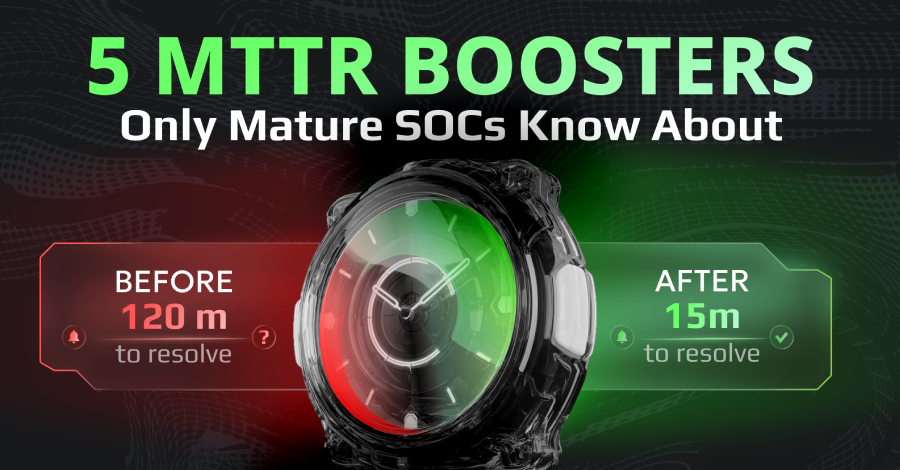

Security teams often present MTTR as an internal KPI. Leadership sees it differently: every hour a threat dwells inside the environment is an hour of potential data exfiltration, service disruption, regulatory exposure, and brand damage.
The root cause of slow MTTR is almost never “not enough analysts.” It is almost always the same structural problem: threat intelligence that exists outside the workflow. Feeds that require manual lookup. Reports that live in a shared drive. Enrichment that happens in a separate tab. Every handoff costs minutes; over the course of a workday, those minutes become hours.
Mature SOCs have collapsed those handoffs. Their intelligence is embedded in the workflow itself at the exact moment a decision needs to be made. Below are the five places where separation matters most.
1. Detection: Catching Threats Before They Become Incidents
In many SOCs, detection begins only when an alert fires. By that point, the attacker may already have a foothold, persistence, or worse.
Mature SOCs shift this dynamic by extending their visibility beyond internal signals. With ANY.RUN Threat Intelligence Feeds, they continuously ingest fresh indicators from real-world attacks and match them against their own telemetry. This means suspicious infrastructure can be flagged even before it triggers traditional alerts.
The effect is subtle but powerful. Detection moves upstream. Instead of reacting to confirmed incidents, teams start catching activity in its early stages, when containment is faster and far less expensive.
 |
| TI Feeds: data sources and benefits |
From a business perspective, this is where risk is quietly reduced. The earlier a threat is identified, the less opportunity it has to evolve into a costly breach.
2. Triage: Turning Uncertainty into Instant Clarity
If detection is about seeing, triage is about deciding. And this is where many SOCs lose momentum.
In less mature environments, triage often turns into a mini-investigation. Analysts pivot between tools, search for context, and escalate alerts “just in case.” The process becomes cautious, slow, and expensive in terms of human effort.
Mature SOCs compress this step dramatically. Using ANY.RUN Threat Intelligence Lookup, they enrich indicators instantly, pulling in behavioral context from real malware executions. Instead of guessing whether something is malicious, analysts immediately understand what it does and how serious it is. Decisions become faster, escalations more precise, and Tier 1 analysts handle far more on their own. For example, just look up a suspicious domain spotted in your perimeter and find out instantly that it belongs to MacSync stealer infrastructure:
 |
| Domain lookup with a quick “malicious” verdict and IOCs |
What further accelerates this process is the AI-powered search inside TI Lookup. Instead of relying on precise syntax, complex filters, or deep familiarity with query parameters, analysts can describe what they are looking for and get it translated into structured queries, removing a layer of friction that traditionally slows down investigations.
This doesn’t just make experts faster; it makes less experienced analysts far more effective. The barrier to advanced search capabilities drops, and the time spent figuring out how to search is replaced by focusing on what the results mean. Decisions become faster, escalations more precise, and Tier 1 analysts handle far more on their own.
For the business, this translates into efficiency that doesn’t require additional hiring. The SOC simply becomes more capable with the same resources.
Stop threats before they start to cost: integrate live TI.
3. Investigation: From Fragmented Clues to a Coherent Story
Investigation is where time can stretch the most. In many SOCs, it’s a process of stitching together fragments: logs from one system, reputation checks from another, behavioral guesses built on limited data.
This fragmentation is expensive. Not just in minutes, but in cognitive load.
Mature SOCs reduce that complexity by anchoring investigations in context-rich intelligence. With ANY.RUN’s threat intelligence ecosystem: indicators are not just labels. They are connected to real execution data, attack chains, and observable behaviors.
Instead of reconstructing what might have happened, analysts can see what did happen. The investigation becomes less about searching and more about understanding.
This shift shortens analysis time and raises the overall quality of decisions. It also allows less experienced analysts to operate with greater confidence, which is often an overlooked advantage.
From a business standpoint, faster and clearer investigations mean reduced dwell time, which directly limits the scale of potential damage.
Built on real-time data from over 15,000 organizations and 600,000 analysts detonating live malware and phishing samples every day, this behavioral intelligence connects raw IOCs to actual attack execution, TTPs, and artifacts. The result? MTTR drops dramatically because context is instant, automation is accurate, and decisions are confident.
4. Response: Acting at the Speed of Confidence
Even when a threat is identified, response can lag. Manual steps, inconsistent playbooks, and delays between decision and action all stretch MTTR.
Mature SOCs treat response as something that should happen almost automatically once a threat is confirmed. By integrating ANY.RUN Threat Intelligence Feeds into SIEM and SOAR platforms, which ensure that known malicious indicators trigger immediate actions such as blocking or isolation.
 |
| TI Feeds integrations and connectors |
There is a certain elegance to this. The system reacts not with hesitation, but with certainty. The time between “we know this is bad” and “it’s contained” shrinks to seconds.
For the business, this is where operational impact is minimized. Faster containment reduces downtime, protects critical assets, and keeps disruptions from cascading across systems.
5. Threat Hunting & Prevention: Learning Before It Hurts Again
The final difference between mature and less mature SOCs lies in what happens between incidents.
Reactive teams move from alert to alert, often encountering variations of the same attack without realizing it. There is little time or structure for proactive work.
Mature SOCs deliberately carve out that space. With ANY.RUN Threat Reports and continuously updated intelligence feeds, they track emerging campaigns, understand attacker techniques, and adapt their defenses in advance.
Over time, this creates a compounding effect. The SOC doesn’t just respond faster. It encounters fewer incidents to begin with.
From a business perspective, this is where cybersecurity starts to feel less like firefighting and more like risk management. Fewer surprises, fewer disruptions, and a stronger overall security posture.
Where the Time Really Goes
What becomes clear across all five areas is that delays rarely come from a single dramatic failure. They come from small, repeated inefficiencies. A missing piece of context here, an extra lookup there, a delayed decision somewhere in between.
Individually, these moments seem minor. Together, they stretch MTTR far beyond what it should be.
Mature SOCs solve this not by speeding up people, but by redesigning how information flows. When ANY.RUN’s threat intelligence, incorporating TI Feeds, TI Lookup, and Threat Reports, is integrated into daily workflows; the need to search, verify, and cross-check is dramatically reduced. The work changes in nature. Analysts spend less time chasing data and more time making decisions.
Boost your SOC to maturity with behavioral threat intelligence. Cut MTTR & protect revenue.
For leadership, the implications are straightforward but significant.
Improving MTTR is not just a technical goal. It is a business lever. Faster detection and response reduce the likelihood of major incidents, limit operational disruption, and improve the return on existing security investments.
ANY.RUN Threat Intelligence supports this across every stage of SOC operations:
- It brings earlier visibility into threats;
- It accelerates decision-making during triage;
- It simplifies investigations with real behavioral context;
- It enables faster, automated response;
- It strengthens proactive defense through continuous insight.
The result is not just a faster SOC, but a more resilient organization.
Found this article interesting? This article is a contributed piece from one of our valued partners. Follow us on Google News, Twitter and LinkedIn to read more exclusive content we post.