It wasn’t the first time the surgeon cut out the wrong organ.
A Florida grand jury has indicted surgeon Thomas Shaknovsky on charges of second-degree manslaughter for the 2024 death of a patient whose surgical procedure was horrifyingly botched.
That patient was 70-year-old William Bryan of Alabama, who was scheduled in August to have his spleen removed in a minimally invasive (laparoscopic) procedure. But instead, Shaknovsky opened Bryan’s abdominal cavity, severed his largest vein with a surgical stapling device—which led to his death—and cut his healthy liver from his body as he bled out, according to an investigation by the state health department. Bryan’s spleen was left untouched.
The second-degree manslaughter charge stems from an investigation by the Walton County Sheriff’s Office, which coordinated with the Office of the State Attorney First Judicial Circuit and additional state and medical authorities.
“The Grand Jury has spoken, and our responsibility is to ensure the charges are carried out through the proper legal process,” Walton County Sheriff Michael Adkinson said in an announcement of Shaknovsky’s indictment. ” Our thoughts remain with the victim’s family and their unspeakable loss.”
Shaknovsky was arrested Monday morning and has since been released on bond. He faces up to 15 years in prison if convicted.
While the indictment is new, the events that led to Bryan’s death were revealed almost immediately. In September 2024, State Surgeon General Joseph Ladapo ordered an emergency suspension of Shaknovsky’s license following an investigation by the state health department that detailed how it happened.
Horror story
Investigators found that the case began just a few days before Byran’s death. At the time, he and his wife were visiting Florida from their home state of Alabama. Bryan developed pain in his upper left abdomen and went to the emergency department of a hospital in Miramar Beach, where Shaknovsky was the on-call general surgeon. Imaging suggested Bryan’s spleen might be enlarged, and there was blood in the membrane that lines the abdominal cavity, though there was no active hemorrhage.
Shaknovsky advised Bryan that he would need to have his spleen removed. But Bryan initially declined to have the surgery, saying he wanted to return home to Alabama and receive treatment at a facility with higher-level care, according to a lawsuit filed by his widow. But Shaknovsky allegedly continued to pressure Bryan over the next few days, and he eventually agreed to the surgery.
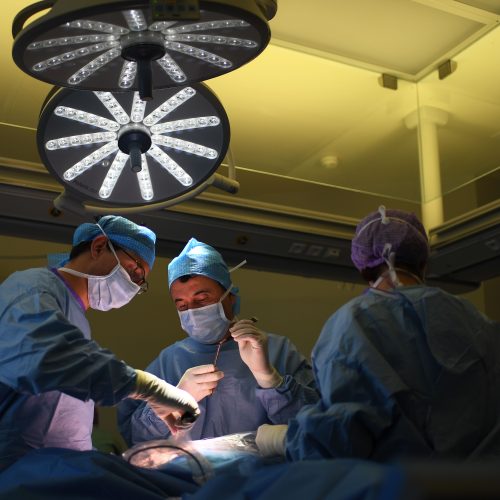
Things went off the rails almost immediately, according to the health department’s report. The surgery was initially scheduled for 4 pm, but Shaknovsky arrived at the hospital an hour late, and Bryan was brought into the operating room (OR) around 5:20 pm when only a skeleton crew was available. Shaknovsky quickly abandoned the plan for a laparoscopic procedure when he realized, after starting, that Bryan had a distended colon that hindered his view.
Shaknovsky switched to an invasive surgery, opening Bryan’s abdominal cavity. OR staff told health department investigators that Bryan’s colon “burst out” when Shaknovsky cut open the cavity, and they had to rush in to move the colon out of the way and suction blood. Shaknovsky then found the blood vessel he wanted to cut and noted to staff that he could feel it pulsing under his fingers. “That’s scary,” he reportedly said to the staff member assisting him.
Shaknovsky then grabbed a surgical stapler, situated it around the vessel, and fired. Bryan immediately began severely hemorrhaging and went into cardiac arrest. Staff reported a significant amount of blood started pouring out, and they began the emergency blood transfusion protocol, then called a code, and began CPR. Shaknovsky, meanwhile, kept working in the abdomen, which was filled with a pool of blood. Despite not being able to see what he was doing, he did not ask staff for a clamp or cauterizer. Instead, Shaknovsky blindly fired another staple into Bryan’s abdomen and kept working.
After a while, the staff was unable to resuscitate Byran, and he was pronounced dead. Shaknovsky extracted an organ he called Byran’s spleen and put it on a table. Staff reportedly looked at the readily identifiable liver in shock. One reported feeling sick to their stomach.
Misidentified organs
The liver Shaknovsky removed was over 2,100 grams, measuring about 23 by 19 by 11 centimeters. An enlarged spleen is at most 500 grams and only up to 20 cm long, the health department noted. Moreover, livers and spleens are anatomically distinct and have different colors and consistencies. The liver is on the right side of the abdomen, while the spleen is on the left, the side Byran had said was painful.
Shaknovsky insisted that the liver be labeled as a spleen and returned to the OR three times that evening to try to convince staff that it was a spleen. A pathology report of the so-called spleen described it as “a grossly identifiable 2,106 g liver.”
An autopsy revealed that Byran’s spleen was intact, his liver was missing, and his inferior vena cava was severed. The inferior vena cava is the largest vein in the body and brings deoxygenated blood from the lower body back to the heart through the liver.
Amid investigating the ghastly circumstances of Byran’s death, investigators also noted that it wasn’t the first time that Shaknovsky had removed the wrong organ. In 2023, he wrongly removed a portion of a patient’s pancreas when he intended to remove the adrenal gland. He reported afterward that the adrenal gland had “migrated.”
The lawsuit Bryan’s widow filed is still pending. She told NBC News: “He would want his death to prevent someone else from being hurt, which is what I think the criminal charges being brought will do. If we had to suffer through this and he had to die, then at least no one else will be hurt by this man now.”

Beth is Ars Technica’s Senior Health Reporter. Beth has a Ph.D. in microbiology from the University of North Carolina at Chapel Hill and attended the Science Communication program at the University of California, Santa Cruz. She specializes in covering infectious diseases, public health, and microbes.