

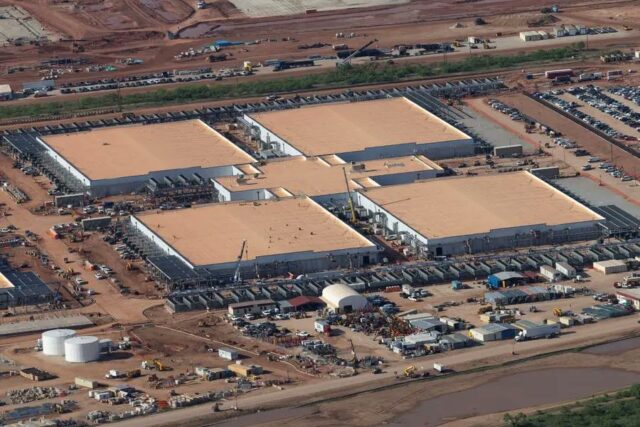
Iran’s Islamic Revolutionary Guard Corps released a video on April 3 warning that U.S. and Israeli infrastructure in the Middle East could face “complete and utter annihilation,” specifically naming the $30 billion Stargate artificial intelligence data center planned for Abu Dhabi as a potential target. The message was delivered by IRGC spokesperson Brigadier General Ebrahim Zolfaghari, who said retaliation would follow if the United States carried out attacks against Iranian power facilities.
“Should the USA proceed with its threats concerning Iran’s power plant facilities the following retaliatory measures shall be promptly enacted,” Zolfaghari said in the video. “All power plants, energy infrastructure, and information and communications technology of the Zionist regime, and all similar companies within the region that have American shareholders shall face complete and utter annihilation.”
Iran leveling up
They released a video of threatening to strike 1GW Stargate AI datacenter in the UAE.The data center is hidden on Google maps they even shown that pic.twitter.com/LuOGIp3BVj
— Furkan Gözükara (@FurkanGozukara) April 3, 2026
After the statement, the video transitions to satellite imagery beginning with a view of Earth from space before zooming toward Abu Dhabi using Google Maps. The camera centers on a desert area near the coast that appears empty at first. Text then appears across the screen stating, “Nothing stays hidden to our sight, though hidden by Google.” The footage then switches to a simulated night-vision view showing the full layout of the Stargate artificial intelligence data center complex.
The Stargate project is a planned AI computing cluster designed to reach 1 gigawatt of computing capacity once construction is completed. Development is scheduled in stages, beginning with a 200-megawatt deployment planned for 2026 and expanding to the full 1-gigawatt scale. The project carries an estimated cost of $30 billion.
Technology companies and investors involved in the project include OpenAI, Nvidia, Cisco, Oracle, Japan’s SoftBank, and the United Arab Emirates artificial intelligence company G42. The facility was introduced as part of an initiative to expand artificial intelligence infrastructure outside the United States.
The agreement for the project was announced in May 2025 during U.S. President Donald Trump’s visit to the United Arab Emirates. According to the U.S. Commerce Department, the initiative represents the largest data center deployment outside the United States. Trump said the project would create thousands of American jobs while extending U.S. artificial intelligence infrastructure into the Middle East.
During the announcement, U.S. Commerce Secretary Howard Lutnick described the project’s strategic goal. “By extending the world’s leading American tech stack to an important strategic partner in the region, this agreement is a major milestone in achieving President Trump’s vision for US AI dominance,” Lutnick said.
The United Arab Emirates government has also stated its objective of becoming a global leader in artificial intelligence by 2031.
The IRGC threat forms part of a series of warnings directed at American technology companies operating across the Middle East. In a message posted Tuesday on the group’s Telegram channel, Iranian officials said attacks against more than a dozen U.S. companies could begin after 8 p.m. on April 1 in Tehran.
Companies named in the warning include Apple, Google, IBM, Intel, Microsoft, Tesla, and Boeing. Iranian officials accused the companies of enabling United States military targeting operations. The IRGC urged employees of those companies to evacuate regional offices and advised civilians to stay away from their facilities.
Earlier in the month, the IRGC-affiliated Tasnim News Agency published a list identifying 29 regional offices and data centers operated by companies including Amazon, Google, IBM, Nvidia, and Palantir. Iranian messaging described those firms as supporting U.S. military and intelligence activities.
Palantir builds the data architecture used in Project Maven, a Pentagon artificial intelligence program that analyzes drone and satellite imagery to identify air-strike targets. The defense contractor also maintains a corporate office in Abu Dhabi.
Iranian attacks have already reached commercial cloud infrastructure in the region. On March 1, Iranian drones struck two Amazon Web Services data centers and damaged another facility located in the United Arab Emirates and Bahrain. The strikes represent the first publicly confirmed attack on hyperscale cloud infrastructure owned by American companies.
The damage disrupted multiple digital services across the region. Banking websites, payment processors, and consumer platforms crashed after redundancy systems to prevent outages were taken offline.
Another report circulated on April 2 claiming that an Oracle data center in Dubai had been bombed. Official media outlets in the United Arab Emirates rejected the report and described it as “fake and fabricated.”
The confrontation is unfolding within a regional war that began on February 28 when the United States and Israel launched attacks on Tehran. Iranian officials say the strikes killed Supreme Leader Ali Khamenei at the start of the conflict.
Since then, approximately 2,000 Iranians have been killed, and at least 13 U.S. service members have died. Iranian retaliatory strikes have targeted locations in Israel, the Gulf states, and Iraq.
The United States responded throughout March with air strikes targeting IRGC drone networks believed to be responsible for the attacks. U.S. Central Command released video footage showing aircraft destroying mobile launchers used to fire drones.
Military operations slowed in recent days after the United States paused strikes on Iranian energy infrastructure while exploring possible peace talks with Tehran. During the pause, the Pentagon has considered deploying up to 10,000 additional troops to the Middle East to expand its military options ahead of a potential ground invasion.
The conflict has also disrupted international shipping routes. The Strait of Hormuz, located between Iran and the United Arab Emirates and Oman, has remained effectively closed for weeks due to Iranian threats, interrupting shipments of oil and other goods worldwide.
American technology companies have invested billions of dollars in computing infrastructure across the Gulf as the region develops capacity for artificial intelligence systems. Data centers such as the planned Stargate facility contain large concentrations of computing hardware that support global AI workloads.
Iranian officials have issued similar warnings against companies including Nvidia, Microsoft, Apple, and Google in recent weeks. The video released by the IRGC places the Stargate artificial intelligence data center in Abu Dhabi among the targets identified in those threats.


