

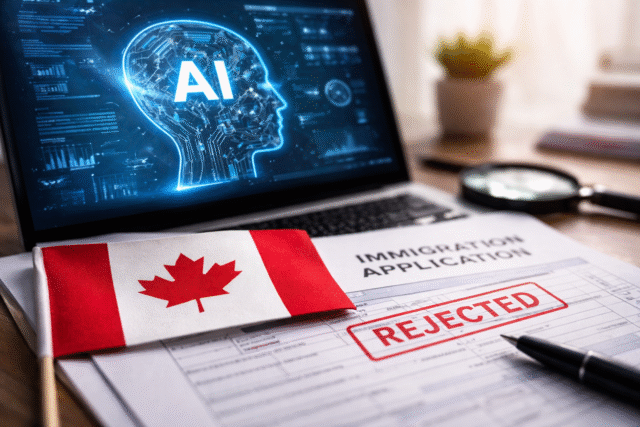
Canada’s immigration system is increasingly relying on artificial intelligence to process applications as officials try to manage large volumes of cases. Government officials say the technology helps sort and review files faster, yet cases involving AI-generated errors, rising delays, and applicants using similar tools have drawn attention to how the system operates.
One case brought the issue into public view when a permanent residence applicant received a refusal letter containing job duties she had never performed.
Kémy Adé said she was shocked when she read the immigration refusal. The letter explained that the Immigration Department rejected her permanent residence application because the duties listed for her job did not match the Canadian work experience she claimed.
According to the refusal letter, her role involved wiring and assembling control circuits, building control and robot panels, and performing programming and troubleshooting tasks. Adé said those duties had no connection to the work she actually carried out.
The department’s decision also stated that generative AI had been used during the review process. The duties described in the refusal letter bore no relation to her real job responsibilities.
The case surfaced as Canada’s immigration system faces heavy demand and growing delays. From 2017 to 2023, immigration expanded quickly as the country increased newcomer targets and approval rates remained high. After the COVID-19 pandemic created a sudden demand for skilled workers such as nurses, the government introduced several new immigration programs to fill labour shortages.
Policy later moved in the opposite direction. The government introduced caps on temporary residents for the first time, making it more difficult for people to move to Canada.
The system is now dealing with the results of those policy changes.
By December 2025, Immigration, Refugees and Citizenship Canada had a backlog of more than one million applications. More than half of permanent-residency and visitor-visa decisions were taking longer than the department’s expected processing timelines.
Immigration lawyers say the delays carry direct consequences for applicants. Temporary workers who have lived and worked in Canada for years have lost jobs and health-care access when their work permits expired before their permanent residence applications were reviewed. Some of those workers have children who cannot attend school.
Other applicants have returned home after losing hope. International students who came to Canada for education may have spent hundreds of thousands of dollars before deciding to leave.
To speed up processing, IRCC is using artificial intelligence to triage, sort, and summarize applications. The department says officers need technological assistance to handle the volume of files.
IRCC recently released its first artificial intelligence strategy describing how the technology will be used in immigration processing. The plan introduces principles based on human-centered oversight, transparency, fairness, security, and reliability.
The strategy divides AI applications into three categories: “everyday,” “program,” and “experimental.” According to the document, the technology may help streamline administrative work, support data analysis, improve fraud detection, and triage low-risk applications so they can be reviewed more quickly.
IRCC says final decisions, including refusals, will still be made by human officers. The department also states that AI systems will not operate autonomously.
Experimental uses described in the strategy include modelling immigration flows and forecasting economic impacts. Fully autonomous AI decision-making is not being adopted.
Artificial intelligence is also changing how applicants and lawyers prepare immigration files.
Many applicants now use AI tools when writing applications or researching immigration options. People who cannot afford legal representation sometimes rely on these tools to prepare documents.
Law firms are also using AI to speed up their work.
One immigration lawyer in Toronto described starting practice in 2017 and realizing that much of the job involved completing forms and gathering documents. Lawyers often copied and pasted information into PDF forms while organizing large numbers of files sent by clients.
In 2019, that lawyer co-founded Visto.ai to address those tasks.
Since the platform launched three years ago, lawyers have used it to generate application checklists, draft submission letters and retainers more quickly, auto-fill IRCC forms, and locate cases for reference. The platform includes a custom research system trained on government and legal sources. If the tool cannot locate information within those sources, it does not provide an answer. It also links directly to source material so law firms can confirm the information.
Tools designed specifically for immigration law have gained importance as Canada’s immigration framework has become more complicated.
During the 2010s, only a few pathways existed for entering Canada. Over the past six years, the government introduced additional immigration streams and later reversed several of them. The result is a patchwork of rules and requirements.
Lawyers increasingly use AI tools to keep track of those rules.
Developers are expected to create additional immigration-specific AI systems. One example involves study permit applications. Preparing those files requires checking several IRCC documents and embassy-specific instructions that applicants may not realize exist.
An AI system built by legal professionals and trained on those government documents could speed up that process.
Problems arise when applicants or lawyers use general chatbots for immigration work.
Large language models such as ChatGPT are trained on broad datasets and may generate inaccurate information. In legal work, choosing the wrong precedent during an appeal could damage a client’s case. Lawyers who rely on invented cases may face penalties, including fines.
Immigration lawyers report receiving emails that appear to be written by AI from people requesting assistance or asking follow-up questions. Clients say they use ChatGPT to draft documents such as submission letters or to research which immigration pathway to choose.
Large language models often provide answers in a confident tone even when the information is incorrect. This can lead to fabricated legal material.
The Toronto Star recently reported that 31 Cameroonians submitted immigration applications citing the same non-existent legal case. Observers expect similar cases to appear again.
Developments in AI raise the possibility that application preparation and review could involve automated systems communicating with each other. Applicants or law firms might use AI to complete forms, which would then be evaluated by government AI systems.
Such use carries risks of misrepresentation. Applicants could upload documents to a chatbot and ask it to fill out forms in a way designed to avoid refusal. If discovered, misrepresentation can lead to bans of five years or longer.
The government has not fully described how extensively it uses AI when processing immigration applications. Machines operate through programmed rules and do not have the nuance of human judgment.
Law firms or the technology they use may eventually detect patterns in how files move through the system. For example, forms with a particular box checked might consistently enter slower processing streams.
Law firms try to maintain strong approval rates. Lawyers or the software they use could attempt to optimize application forms for success. In situations involving facts that are difficult to verify, such as criminal records in countries that do not share data with Canada, this could encourage adjustments within regulatory limits.
Canada’s immigration system includes measures designed to protect public safety. Heavy dependence on automated systems could weaken those protections.
Officials say the department’s use of AI must be responsible and avoid arbitrary refusals. Using automated tools to clear files quickly could lead to appeals that add pressure to the court system.
Immigration policies also affect Canada’s ability to attract newcomers. Interest from international students has declined, and the number of people leaving Canada has reached a record high.


