

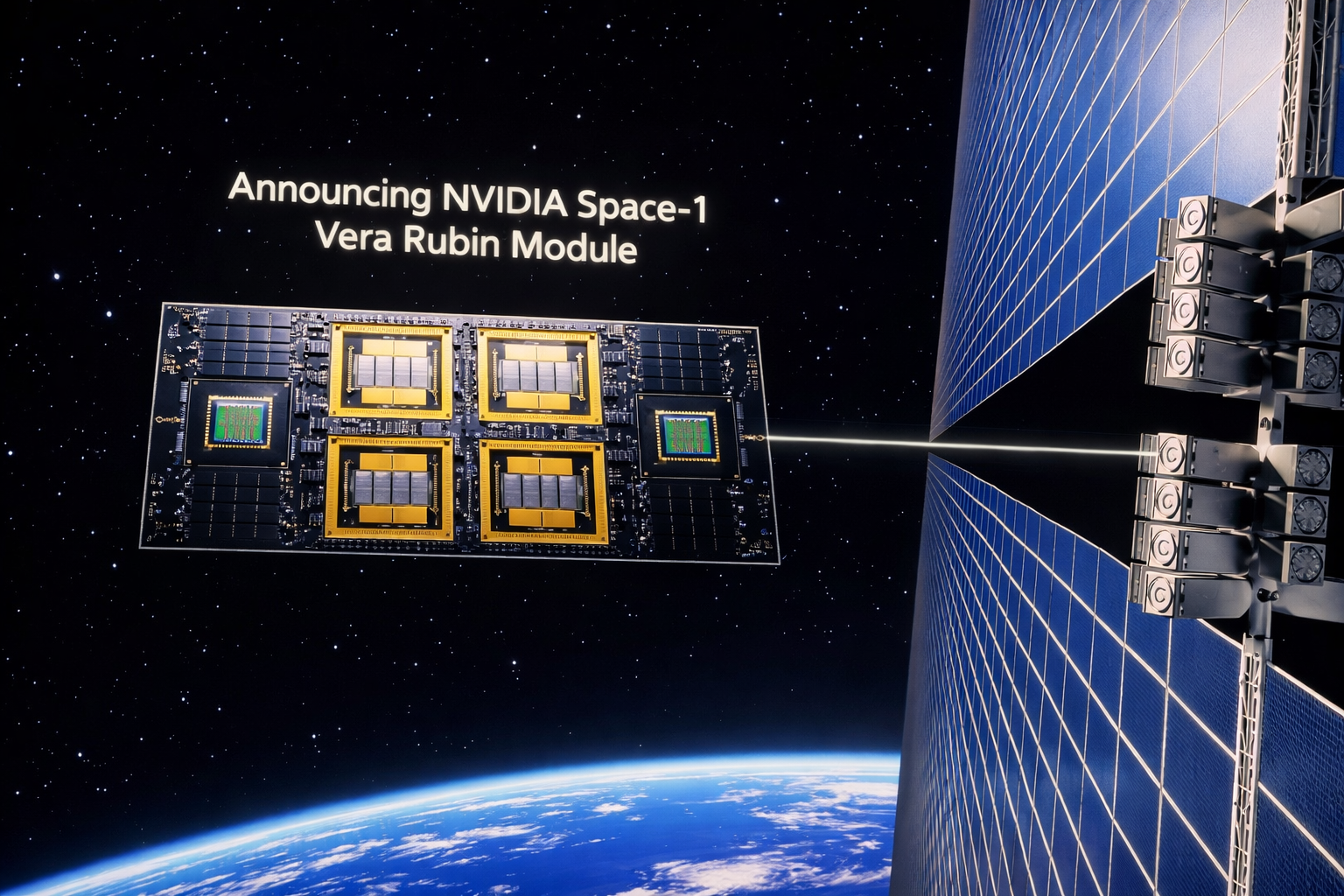
Nvidia announced new computing platforms intended for satellites and orbital data centers during its GTC 2026 AI conference in San Jose on March 16. The California-based company introduced the Space-1 Vera Rubin Module, a system built to bring advanced artificial intelligence processing into orbit and support applications such as geospatial intelligence, satellite constellations, and autonomous space operations.
The computing system operates in environments with strict size, weight, and power (SWaP) constraints, a requirement for spacecraft hardware. Nvidia said the platform provides data-center-class performance for satellites and other space missions while supporting computing workloads across space and ground infrastructure.
The Space-1 Vera Rubin Module forms part of Nvidia’s accelerated computing platform for space. According to the company, the Rubin GPU integrated into the module delivers up to 25 times more AI compute for space-based inferencing compared with the Nvidia H100 GPU. That performance supports workloads such as orbital data centers, advanced geospatial intelligence processing, and autonomous space operations.
Nvidia’s new system integrates GPU and CPU components with high-bandwidth interconnects to process data streams from space-based instruments. The company said the computing capability supports large language models and advanced foundation models operating directly in orbit, enabling on-orbit analytics, autonomous scientific discovery, and rapid data insights.
The company introduced additional platforms for satellite environments, including Nvidia IGX Thor and Nvidia Jetson Orin. IGX Thor is based on Nvidia’s Blackwell architecture and built for mission-critical edge environments. The platform supports real-time AI processing, functional safety features, secure boot capability, and autonomous operation, enabling spacecraft to process sensor data locally while reducing bandwidth usage.
Jetson Orin delivers AI inference and accelerated data processing in a compact module. Nvidia said the platform supports real-time processing of vision, navigation, and sensor data directly onboard spacecraft, reducing latency and limiting the need to transmit raw data to Earth.
Both IGX Thor and Jetson Orin are available now, while Nvidia said the Space-1 Vera Rubin Module will become available at a later date.
Several space companies plan to use Nvidia’s computing platforms for future missions. Nvidia said Aetherflux, Axiom Space, Kepler Communications, Planet Labs PBC, Sophia Space, and Starcloud are working with the company to deploy accelerated computing across orbital and ground environments.
“Space computing, the final frontier, has arrived,” said Jensen Huang, Nvidia’s founder and chief executive officer. “As we deploy satellite constellations and explore deeper into space, intelligence must live wherever data is generated.”
Huang said the company is working with partners on computing systems for orbital data centers, but technical challenges remain. Cooling high-performance hardware in orbit presents engineering challenges because spacecraft cannot rely on conventional cooling techniques used in terrestrial data centers.
“In space, there’s no convection, there’s just radiation, and so we have to figure out how to cool these systems out in space, but we’ve got lots of great engineers working on it.”
Interest in performing AI processing directly in orbit has increased as satellite networks generate larger volumes of data. Satellite operators want the ability to analyze information in space instead of transmitting raw data back to Earth, where communication bandwidth can limit data transfer.
Nvidia’s computing platforms are already part of the space technology ecosystem through ground-based systems. Many satellite operators use Nvidia GPUs for image processing and analytics in terrestrial data centers. Nvidia said the RTX PRO 6000 Blackwell Server Edition GPU provides up to 100 times faster performance than legacy CPU-based batch systems for geospatial intelligence workloads that analyze large satellite imagery archives.
Planet Labs operates Earth-imaging satellites that capture images of the planet daily. The company announced a collaboration with Nvidia to accelerate the processing of imagery data. Planet said it plans to integrate Nvidia computing platforms across space and ground infrastructure to reduce the time required to process imagery from hours to seconds.
“Planet images the Earth every day, a data challenge that requires the world’s most advanced computing.”
As the number of satellites increases, the volume of data produced by sensors such as imaging systems, radars, and radio-frequency detectors continues to expand. These datasets contribute to hundreds of petabytes of historical archives on Earth used for geospatial trend analysis.
AI-accelerated processing can support disaster response and environmental monitoring by identifying wildfires, floods, and oil spills in high-resolution imagery. It can also support climate and weather forecasting through analysis of atmospheric patterns and long-term climate changes. Infrastructure monitoring applications include automated detection of objects and patterns used to monitor energy grids, transportation networks, and agricultural conditions.
Starcloud is developing orbital data centers that host computing systems directly in orbit. The company launched a test satellite in November carrying an Nvidia H100 GPU, the first time an Nvidia GPU had reached orbit.
Interest in space-based computing has increased as artificial intelligence workloads drive demand for large data centers on Earth. High electricity consumption from AI infrastructure has led technology companies to explore alternatives, including space systems powered by solar energy.
Google is exploring space-based computing through its Project Suncatcher initiative. The company has tested its Tensor Processing Units (TPUs) with particle accelerators that simulate radiation levels found in low-Earth orbit. Google also partnered with Planet for a small deployment and has discussed sending gigawatts of computing capacity into space in the future.
Elon Musk has proposed another orbital computing project. The SpaceX chief executive seeks approval from the Federal Communications Commission to launch one million satellites intended for orbital AI data centers. Musk has said the satellites could use chips developed by Tesla, another company he leads, though timelines for the project remain unclear.
The push for orbital computing gained additional attention last month when xAI was acquired by SpaceX in a $1.25 trillion deal, with plans linked to future space-based data centers. SpaceX is also one of Nvidia’s largest customers.
Orbital data centers face criticism from several industry figures and analysts. Critics include OpenAI chief executive Sam Altman, short seller Jim Chanos, Amazon Web Services chief executive Matt Garman, and analysts at Gartner. Scientists have also raised concerns about environmental impacts, including light pollution and orbital debris associated with large satellite constellations.
Nvidia’s interest in orbital infrastructure appeared earlier this month through a job listing for an orbital data center system architect. The posting described the role as an opportunity to work in a new field of computing.
“This is an opportunity to join the leader in AI systems at the inception of a completely new industry.”
Earlier in the month, Nvidia posted a job listing for an orbital data center system architect, describing the role as part of a new computing industry.
“This is an opportunity to join the leader in AI systems at the inception of a completely new industry.”


