

Omdia reports that Europe’s smartphone market fell 1 percent in 2025 to 134.2 million units, ending a year shaped by weak demand and new eco design and USB C regulations. The technology research and advisory group’s data shows the region is still highly competitive, with the largest vendors increasing their combined share.
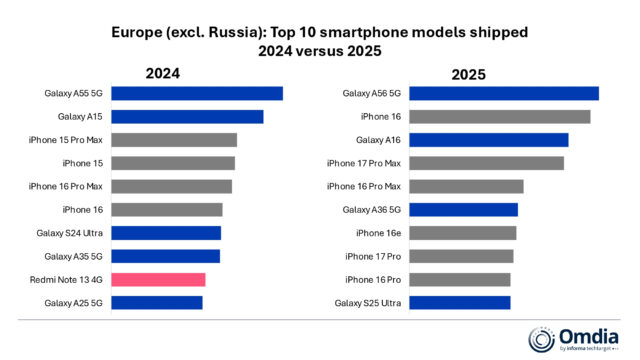
Samsung retained its position as Europe’s largest smartphone vendor, with shipments edging up to 46.6 million units. It faced a slow first half of 2025 due to the absence of the Galaxy A0x series but recovered in the second half, supported by a discounted Galaxy A16 and continued demand for the Galaxy A56, Europe’s top selling model in 2025.
SEE ALSO: The global smartphone market grew in 2025, but the memory crisis hangs over 2026
Apple recorded 6 percent growth to 36.9 million units, reaching a record 27 percent market share in Europe. This was driven by strong iPhone demand among consumers and businesses.
Performance centered on iPhone 16, the Pro Max versions of iPhone 16 and iPhone 17, and iPhone 16e. The 16e ranked among Apple’s top shipping models, mainly because it replaced iPhone 14 and earlier models that were discontinued in late 2024 because of USB C requirements.
Xiaomi held third place in Europe with a 16 percent market share, even as shipments declined 1 percent to 21.8 million units. Its place was mostly down to the Redmi series in the budget segment. Toward the end of the year, its overseas expansion of a new retail strategy reached Europe, marked by additional Xiaomi Store openings and a broader ecosystem portfolio.
Motorola remained in fourth, although its shipments fell 5 percent to 7.7 million units. Demand stayed soft in the first half of the year before improving in the second half, including double digit growth in the fourth quarter. Expansion in Poland, Italy, Spain, and the UK helped its position.
Honor entered Europe’s top five for the first time, growing 4 percent to 3.8 million units. The Chinese firm’s performance was largely tied to its affordable X series, and its focus on building share and strengthening relationships with key channel partners.
Omdia’s thoughts
“Europe’s five largest smartphone vendors continued to gain combined share, reflecting the importance of scale for long-term success in the region,” said Runar Bjorhovde, Senior Analyst at Omdia.
“Even though shares continue to shift towards the largest players, fierce competition within the channel continues to reign across all markets, increasing the need to differentiate and understand how to most effectively capture customers. The fierce channel competition has also created a growing willingness amongst sales partners to introduce new vendors with attractive products and differentiated brands into their portfolios. Even though many vendors beyond the top 5 faced big hurdles last year, vivo, London-headquartered Nothing and Amsterdam-headquartered Fairphone grew by high double digits. These vendors are excellent examples that there are opportunities through strong differentiation even in such an established, mature and highly competitive region.”
Addressing the ongoing memory issues, Bjorhovde noted: “In 2026, concerns around memory pricing have created a challenging outlook. In Europe, which made up just 10.8 percent of all smartphones shipped worldwide in 2025, the biggest question is which vendors are most likely to prioritize the region if hit by price increases or supply shortages.”
He added: “We expect the largest vendors to be more resilient due to their scale and price-band coverage. However, for many vendors, it will be critical to find the right balance between different regions and markets. Scaling a smartphone business within Europe can be very gradual and challenging, requiring consistent investment over time, making it very costly to scale back. Europe’s large premium segment makes it attractive to many vendors in the long-run alongside a less price-sensitive mass-market segment.”
Concluding his analysis, Bjorhovde said: “However, even in the face of short-term difficulties, capturing interest and demand from customers must be the top priority for all industry players. Both vendors and channel partners need to find key differentiation points, target core influence stages in the buying journey, and retain customers more effectively than ever before.”
What do you think about Europe’s smartphone market outlook for 2026? Let us know in the comments.


