, /PRNewswire/ — As darkness, low-visibility conditions, and adverse weather pose higher risks to safe driving, automotive perception architectures are evolving from “single sensor” to “sensor fusion”. Raytron, a leader in infrared thermal imaging, announced that it has established partnerships with over 15 leading OEMs, and its automotive thermal cameras have been deployed across more than 20 vehicle models, marking a major milestone in night vision and all-weather perception for intelligent vehicles.
Thermal Imaging Improves Nighttime Safety for Passenger Vehicles
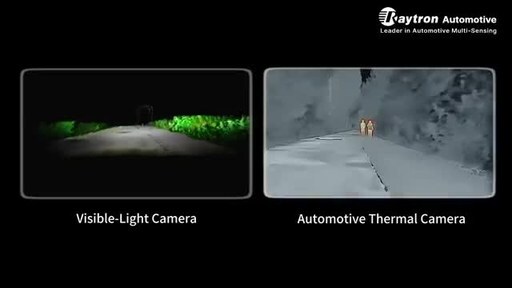
Animal and pedestrian collisions remain a critical pain point in nighttime road safety. While conventional headlights typically provide a visibility range of 100 to 150 meters, Raytron’s automotive thermal cameras are more than double that reach, extending detection to over 300 meters. By capturing high-contrast thermal signatures, the system identifies pedestrians, animals, and obstacles in total darkness far earlier than visible-light cameras. When integrated into a thermal-based AEB system, as deployed on the Zeekr 9X, the vehicle can initiate autonomous emergency braking when drivers fail to perceive hazards at night, significantly reducing the risk of nighttime collisions.
Reliable Perception for Commercial Vehicles in Extreme Environments
Commercial vehicles, such as mining trucks and heavy-duty freight haulers, frequently operate in dust, fog, sandstorms, and low-visibility environments. These environmental “obscurants” significantly degrade the performance of visible-light cameras and LiDAR sensors. In contrast, Long-Wave Infrared (LWIR) technology, operating in the 8-14μm wavelength range, offers superior atmospheric penetration. For heavy-duty vehicles with extended braking distances, early obstacle detection is a safety necessity rather than merely a feature. Raytron’s automotive thermal cameras are already deployed across multiple commercial vehicles, such as Breton, Kargobot, and Zhizi Automobile, supporting safer operations in mining, logistics, and industrial transportation.
Sensor Fusion Drives the Future of Autonomous Vehicles
In L4 autonomous driving, a single sensor may struggle to address complex corner cases. Sensor Fusion—combining visible-light camera, LiDAR, 4D mmWave imaging radar, and infrared thermal imaging—has become the industry standard for robust perception. Thermal imaging provides a unique edge by excelling in nighttime and low-visibility scenarios and enhancing the detection of vulnerable road users (VRUs) through their thermal signatures. Raytron’s automotive thermal cameras have already been successfully integrated into the Robotaxi of DiDi Autonomous Driving, providing a critical perception layer for safe and reliable driving.
For Further Information
Email: [email protected]
Website: https://en.raytrontek.com
LinkedIn: Raytron Technology Co., Ltd.
Video – https://mma.prnewswire.com/media/2873273/Pr.mp4