
For the first time, Google’s grip on product discovery is under serious pressure. A new U.S. consumer study suggests that conversational AI tools, especially ChatGPT, are becoming the preferred starting point for online shopping.
The research comes from Joe Youngblood, a Dallas-based SEO strategist and marketing theorist, and is based on a survey of 1,151 U.S. adults. It focuses on how Americans discover new products online and how often they turn to AI instead of search engines.
ChatGPT goes shopping
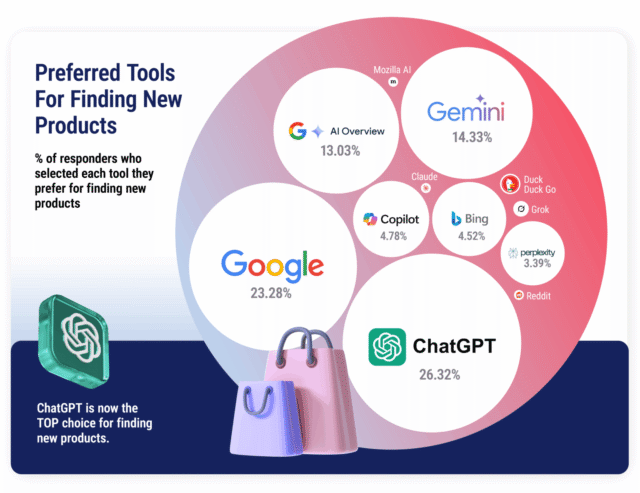
Across all survey respondents, 26.32 percent said they prefer ChatGPT over other tools when shopping online. Google Search followed closely at 23.11 percent, placing it behind an AI chatbot rather than a competing search engine.
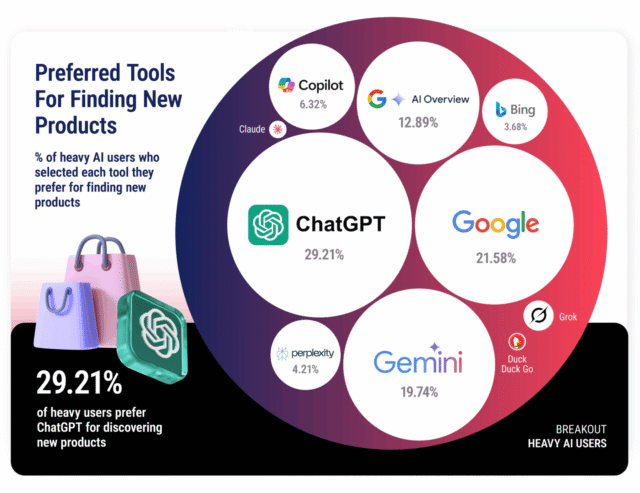
The gap becomes wider among so-called heavy AI users, defined as people who engage with AI daily. In that group, 29.21 percent prefer ChatGPT, while only 21.58 percent still choose Google Search.
“AI is quickly stepping into the role of digital personal shopper,” said Joe Youngblood. “Consumers are asking AI for recommendations, comparisons, and even personalized shopping advice and many find it easier than sifting through Google’s ads and search results. This signals a dramatic shift in how people find products online.”
The study found that 75 percent of Americans have used AI in the past six months. ChatGPT leads overall AI usage at 46.13 percent, ahead of Google Gemini at 22.76 percent and Meta AI on Facebook at 19.29 percent.
Respondents said they use AI for a wide range of tasks, including shopping research, learning, idea generation, grammar fixes, and entertainment.
When participants were asked to choose their preferred method for finding new products, ChatGPT ranked first overall. Google’s traditional search engine, including Google Shopping, landed in second.
SEE ALSO: Ads are coming to ChatGPT, and the $8 plan is the compromise
Google’s AI tools, including AI Mode and AI Overviews, followed behind both ChatGPT and standard search. Bing’s Copilot Chat, Bing Search, and Perplexity trailed further back, each capturing only a small share of preference.
Among heavy AI users, ChatGPT’s lead grows even larger. While Google still dominates search overall, the single most popular way this group discovers new products right now is through ChatGPT’s chat interface rather than a search results page.
Google’s AI Mode performs better with these users than it does with the general population, but it still doesn’t beat ChatGPT.
The study includes an interpretation that’s likely to resonate with frustrated shoppers. It argues that Google has intentionally made ecommerce search harder to navigate in order to drive ad clicks, pushing users toward alternatives that feel faster and less cluttered.
In many cases, having a back-and-forth conversation with ChatGPT and tweaking questions step by step feels easier than running multiple searches and filtering ads.
For direct-to-consumer brands and online retailers, the takeaway from this survey could be a worry. If shoppers increasingly rely on AI systems that offer limited analytics and visibility, brands risk becoming invisible unless they adapt their content for AI-driven discovery alongside traditional search.
What do you think about AI replacing search for shopping? Let us know in the comments.